1,555 NEUTRINOS THAT NUDGED A WHOLE NUCLEUS
Sometimes a neutrino does not hit one particle inside an atom, but the whole nucleus at once, which recoils as a single block. This “coherent elastic neutrino-nucleus scattering” was predicted in 1974. Because the entire nucleus takes part, the chance of a collision is boosted, so detectors weighing only a few kilograms can see it.
It was first detected by the COHERENT collaboration, at a spallation neutron source, an accelerator facility that also produces neutrinos. Large dark-matter detectors have also reported evidence of it with neutrinos from the Sun. Nuclear reactors are another source: they produce antineutrinos of lower energy, up to about 10 million electronvolts. The first detection at a reactor came from CONUS+ itself, with a signal 3.7 times larger than its uncertainty (3.7 σ, in physicists’ shorthand).
A whisper of energy
The catch is how small the kick is. An antineutrino from a reactor makes a germanium nucleus recoil with a few thousand electronvolts at most. Only 15 to 20% of that energy turns into an electric signal the detector can read. The events all pile up just above the lowest energy the detector can register — exactly where calibration is hardest.
A detector next to the core
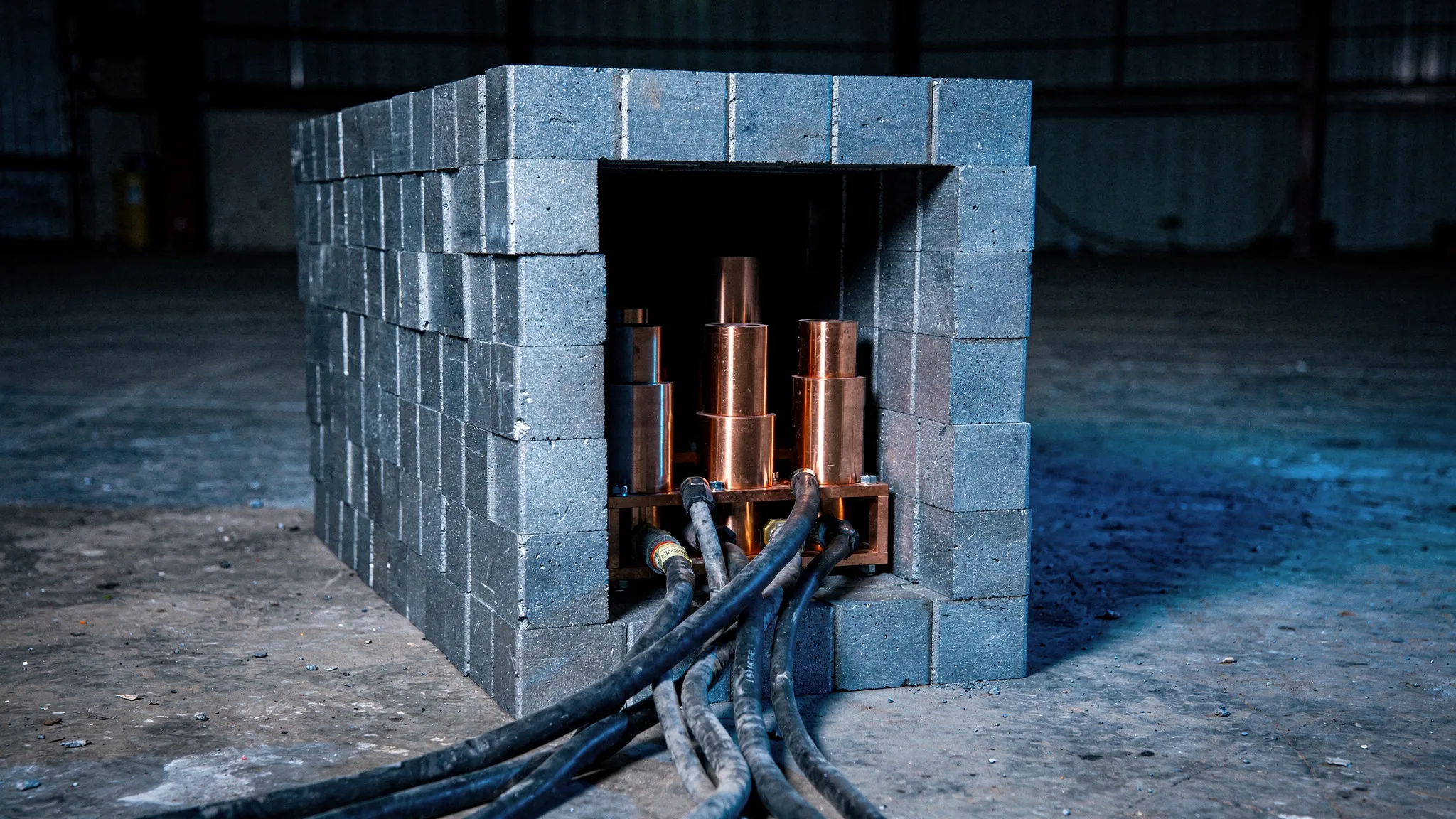
CONUS+ sits at the Leibstadt nuclear power plant in Switzerland, 20.7 metres from the core of a reactor producing 3.6 gigawatts of heat. It has run since November 2023. For its second campaign, two larger crystals of ultra-pure germanium joined one of the original detectors: 5.6 kilograms of active mass in total. A compact shield of lead and boron-loaded plastic, a detector that flags muons (heavy cousins of the electron produced by cosmic rays) and a constant flush of radon-free air cut the background by a factor of about 10,000.
Data were taken from February 2025 to July 2026: 1,296 kilogram-days with the reactor running (detector mass multiplied by days of data taking) and 86 with it stopped.
Counting blind
To avoid fooling themselves, the physicists kept the low-energy data hidden while they set up their analysis, then unveiled the detectors one by one. The result: 1,555 ± 152 events. The signal is 10.2 times larger than its uncertainty. The Standard Model of particle physics predicted 1,701 ± 198 — agreement within 0.6 standard deviations, a measured-to-predicted ratio of 0.91 ± 0.14.
A useful check: with the reactor stopped, the fit finds 22 ± 29 events, consistent with zero. Had the 1,555 events come from a background unrelated to the reactor, the reactor-off data, 15 times smaller in exposure, would still have shown about 103 of them.
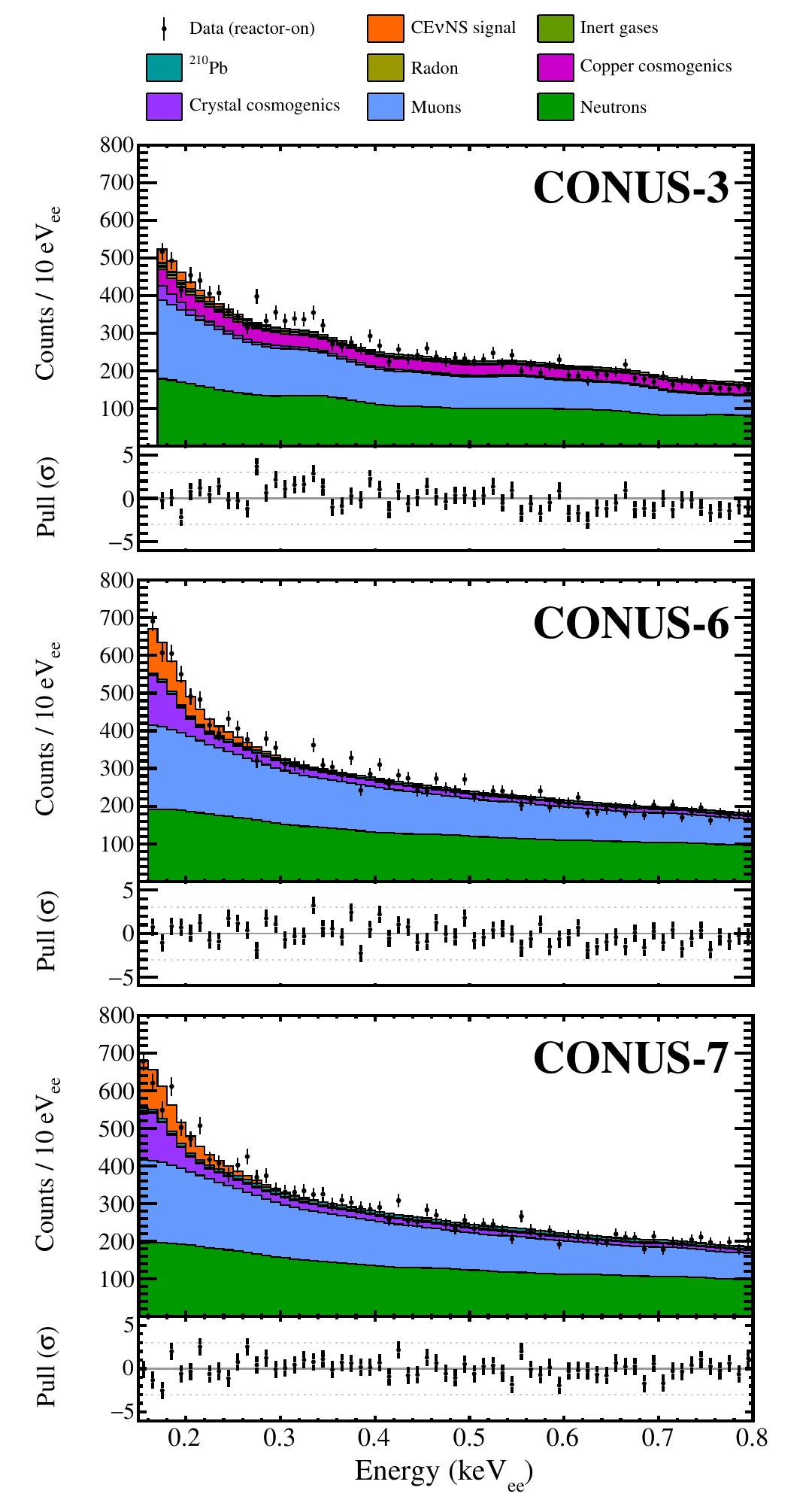
Counts in the three detectors with the reactor running: the neutrino signal (orange) sits on top of the backgrounds, just above the threshold. — Figure 1, CONUS Collaboration (2026), arXiv:2610.37318.
The largest haul yet
According to the authors, this is the largest sample of such collisions ever detected, and the most precise measurement at reactor energies, with a precision comparable to COHERENT’s recent result on germanium. The uncertainty on the count is now 9.8%, almost three times smaller than in the first campaign.
It agrees with the upper limits set by other germanium experiments at reactors. By contrast, the signal reported by the Dresden-II experiment corresponds to a clearly higher rate than those seen by the other germanium experiments at reactors, including this one.
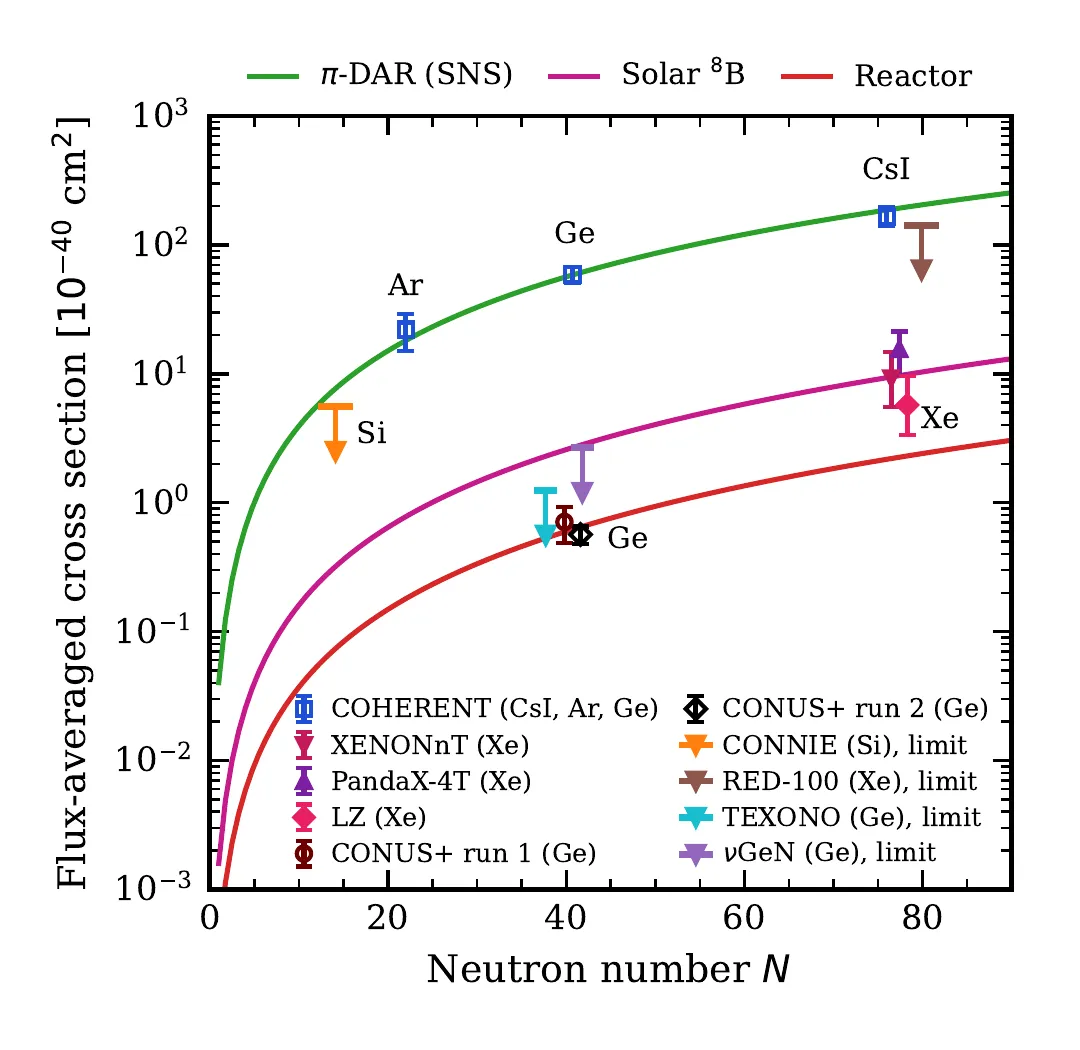
Strength of the collision against the number of neutrons in the target nucleus: CONUS+ (black diamond, germanium) sits on the reactor curve (red). — Figure 3, CONUS Collaboration (2026), arXiv:2610.37318.
Weighing the weak force
In the Standard Model, the collision rate grows with the square of the nucleus’s “weak charge”:
Q_W = N − (1 − 4 sin²θ_W) Z
where N and Z are its numbers of neutrons and protons, and θ_W is the weak mixing angle, a parameter of the weak nuclear force, the force behind some kinds of radioactivity and the only one besides gravity that neutrinos feel. From the count, the team finds sin²θ_W = 0.225 ± 0.022, in line with the expected 0.2387. Among measurements of this kind, it probes the force in the gentlest collisions, where the neutrino gives the nucleus the smallest push (the lowest “momentum transfer”).
Still counting
The measurement is still limited mostly by the number of events. One more year of data would bring the statistical uncertainty down to about 5%. Better calibration at the threshold and new measurements of how germanium converts recoil energy should shrink the uncertainty on the prediction. The authors see reactor neutrinos moving from first detection to precision measurement.