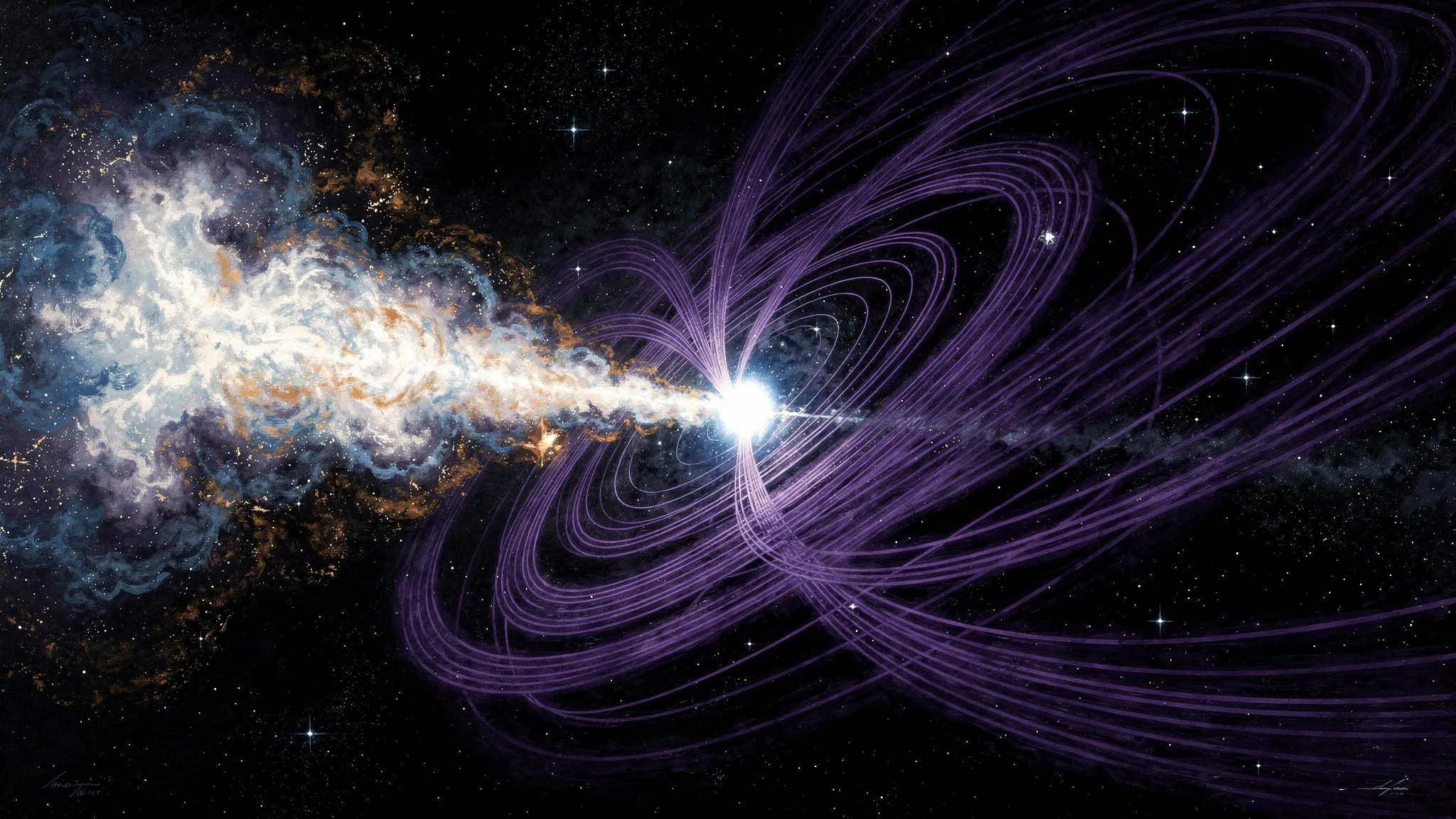
A 1991 GAMMA-RAY FLASH RINGS LIKE A MAGNETAR
On 11 July 1991, the BATSE instrument aboard the Compton Gamma Ray Observatory recorded a flash of gamma rays. GRB 910711 (GRB for gamma-ray burst; the digits give the date) was reported as the shortest burst the mission had seen: a bright spike of about 10 milliseconds, then a faint tail of 100 to 200 milliseconds. In 2023, an analysis of 724 short bursts made it the strongest candidate for kilohertz oscillations — brightness rising and falling thousands of times per second — read as the motions of a “hypermassive” neutron star, too heavy to stay stable for long, left by a merger.
Two suspects for one short flash
Short gamma-ray bursts have two possible sources: a merger of compact stars, or a giant flare from a magnetar, a neutron star with an ultra-strong magnetic field. Some giant flares from other galaxies resemble merger bursts in duration and the energy of their light; without a precise position on the sky, the two are hard to tell apart. GRB 910711’s position is uncertain by about 6 degrees.
Run-Chao Chen and Bin-Bin Zhang (Nanjing University), Ore Gottlieb (Massachusetts Institute of Technology) and five colleagues started from a tension in the merger reading.
Light too hard to carry a beat
The spectrum of GRB 910711 is fitted about as well by a blackbody — the glow of a hot, opaque body — as by the shape usually fitted to merger bursts. With that second shape it comes out unusually “hard” — weighted towards high-energy photons — at the extreme end of the bursts BATSE measured, and harder than a transparent gas can emit.
The natural fix: light emerging from a photosphere, the layer where an opaque cloud lets its light go. But there, the light comes out far from the central engine, after many scatterings. A kilohertz beat set by a neutron star at the centre would need an extra mechanism to survive the trip, or to be rebuilt on the way out.
A fainter twin of a known flare
Their benchmark is GRB 200415A, recorded on 15 April 2020: a magnetar giant flare from the nearby galaxy NGC 253, 3.5 megaparsecs away — the megaparsec being astronomers’ unit for distances between galaxies.
Aligned on their peaks, the two light curves look alike: the same 10-millisecond spike, the same weaker tail, features as short as about 90 microseconds — millionths of a second — in 1991, and 65 in 2020. A model of the 2020 flare, simply made fainter as if it had gone off farther away, reproduces the shape of the 1991 burst. An illustration, the authors stress, not a distance measurement.
Overtones of about 360 hertz
Breaking the spike’s flicker down into rhythms, the team sees a bump stand out at 360 hertz — 360 times per second — in the 1991 burst, and at 350 hertz in 2020. Over 10 milliseconds, frequencies closer than about 100 hertz cannot be told apart: the two bumps are indistinguishable.
Maps of rhythm against time show peaks lighting up at whole multiples of 360 hertz, like the overtones of one note: 1, 3, 5, 6 and 11 times 360 in GRB 910711; 2, 4, 6 and 12 times in GRB 200415A. Both share the sixth, about 2,160 hertz, close to an oscillation already reported in the 2020 flare.
The bispectrum checks whether oscillations are coupled: coupled oscillations create power at the sum of their frequencies. In the 2020 flare, the 4,320-hertz component matches two coupled components at 2,160 hertz, which themselves match 720 and 1,440 hertz coupled.
100,000 fake bursts
To test chance, for each burst the team made 100,000 fake light curves with the same spike shape and photon-counting noise, but no oscillation. The 360-hertz bump came out at least as strong in about 5% of them for GRB 910711, and 0.1% for GRB 200415A. When the fakes also carried the kilohertz oscillations already reported and a more realistic background noise, those figures rose to 15.5% and 33.4%: on its own, the low bump becomes less unexpected.
The overtones were tested only against fakes without oscillations, and hold up there. A small difference in the base frequency is multiplied at each overtone, so the pattern tests it more finely than the bump alone. Scanning from 260 to 460 hertz, both bursts prefer about 360 hertz; the fakes do not. Against fakes without oscillations, the combined strength of the couplings was reached only 1.3 times in 10,000 for GRB 910711, and 4.5 times for GRB 200415A.
Seventeen candidate galaxies
At any distance, GRB 910711 would be too faint for its light’s energy, compared with known merger bursts. As a giant flare it fits, if it lies within about 55 megaparsecs, some 16 times farther than NGC 253. In that range and its patch of sky, the team lists 17 galaxies, the nearest at about 9.1 megaparsecs, all classed as mostly star-forming, where young magnetars are expected. If the reading holds, BATSE caught its first giant flare from another galaxy in 1991.
What could ring at 360 hertz
In giant flares from our Galaxy, fast oscillations appeared in the fading tails, not the spike; one, at about 625 hertz, was attributed to a vibration of the star’s crust. Under some assumptions it could fall near 360 hertz, but it depends on each star’s interior and magnetic field: two magnetars sharing it would be a coincidence. More speculative is a vibration at the boundary where nuclear matter turns into quark matter, where neutrons dissolve into their constituents, deep in the core: its frequency, between 100 and 1,000 hertz, depends mainly on nuclear physics, little on the star’s mass. How any such vibration would shape the spike’s light remains uncertain.
A beat heard in the gamma rays alone
The results “do not uniquely establish” a magnetar origin, the authors write, but make it “the more economical interpretation”: a merger must explain the hard spectrum, a beat crossing the photosphere, the likeness to the 2020 flare and the shared overtones all at once. If such overtones turn up in future short bursts, the gamma rays alone could help tell flares from mergers, in time to plan follow-up observations. GRB 910711 keeps a 6-degree patch of sky, 17 candidate galaxies, and a beat near 360 hertz.