HOW A MAGMA OCEAN COULD TURN HYDROGEN INTO WATER
Picture the young Earth after a giant impact: a global ocean of molten rock — a magma ocean — under a dense atmosphere made mostly of hydrogen. Bring hydrogen into contact with an iron oxide that carries extra oxygen, and the hydrogen takes the oxygen and becomes water. Could that have happened on a planetary scale, and how fast? Tatsuya Yoshida, of the Earth-Life Science Institute at the Institute of Science Tokyo, and colleagues at Hokkaido University, Tohoku University and Japan’s National Institute of Information and Communications Technology built a model to find out.
Iron split in two at depth
In a deep magma ocean, at the pressures of the lower mantle, the deep part of the mantle, ferrous iron (FeO, one oxygen atom per iron atom) can disproportionate: it splits into metallic iron and ferric iron (FeO₁.₅, one and a half oxygen atoms per iron atom), following 3 FeO → 2 FeO₁.₅ + Fe. The metal sinks into the core and convection spreads the ferric iron, leaving the melt, according to earlier studies, about as oxidised as today’s mantle. How fast would it react with the hydrogen above, and what would the atmosphere do to the magma in return? Many earlier models treated the mantle and magma as a bottomless supply of oxygen.
A skin that keeps sinking
The model couples hydrogen seeping into the melt, its reaction with ferric iron (H₂ + 2 FeO₁.₅ → H₂O + 2 FeO), the sharing of water and oxides between air, magma and the solid mantle crystallising beneath, and the planet’s cooling. The air starts with about ten hydrogen molecules per water molecule. Amounts are counted in N_TO: one N_TO is as many hydrogen molecules as there are water molecules in today’s oceans. How well magma and solid mantle mix is unknown, so the team ran two extremes: free exchange (Case 1), or melt trapped in the mantle as it solidifies (Case 2).
The bottleneck is the top of the magma. Hydrogen diffuses only very slowly through molten rock, so it must cross a thin boundary layer at the surface. That layer does not stay put: cooled from above, it grows denser until it sinks and fresh melt takes its place. For a hot, deep magma ocean — surface temperature of 2,400 kelvin, a pressure of 50 gigapascals at its base, 400 watts of heat escaping through every square metre — this happens every 70 seconds or so.
In that time, hydrogen reaches less than a millimetre into a layer 19 millimetres thick. But the constant renewal keeps the hydrogen gradient steep, so the inflow stays high: above 0.1 N_TO per thousand years, 0.35 on average.
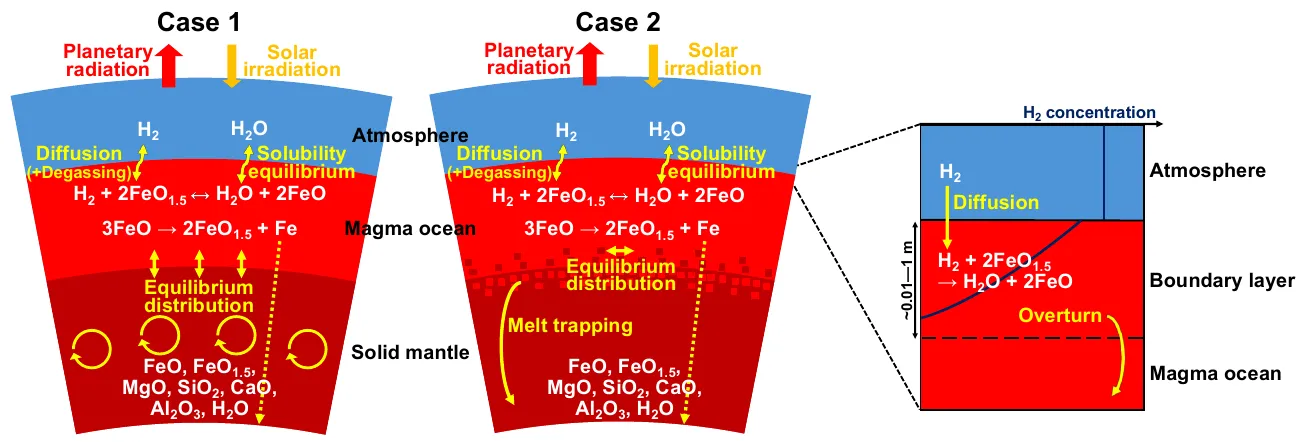
The model: hydrogen diffuses from the atmosphere into a thin boundary layer, reacts with ferric iron to make water, and the layer overturns into the magma ocean. Deeper down, iron splits into ferric iron and metal. Cases 1 and 2 differ in how the magma exchanges material with the solid mantle. — Figure 1, Yoshida et al. (2026), arXiv:2610.38503.
About ten thousand years
In the main example — 10 N_TO of hydrogen and water in all, magma reaching down to 50 gigapascals (the authors mark depth by the pressure at the bottom: the deeper, the higher) — ferric iron is consumed, but iron keeps splitting at the base of the magma ocean and replaces it, so the melt stays about as oxidised. The surface reaches chemical equilibrium with the air once the air holds about as much water vapour as hydrogen: after about 0.01 million years, or 10,000 years. By then, hydrogen, counting air and magma together, has dropped from about 5 N_TO to under 1, and water, mostly dissolved in the melt, has nearly doubled. The authors get this speed when the magma ocean is deep and hot enough to reach into the lower mantle.
The magma ocean then freezes over about 2 million years in Case 1, under an atmosphere that acts as a blanket. Water escapes from the melt as it crystallises: in Case 1, more than 80% of it ends up in the air.
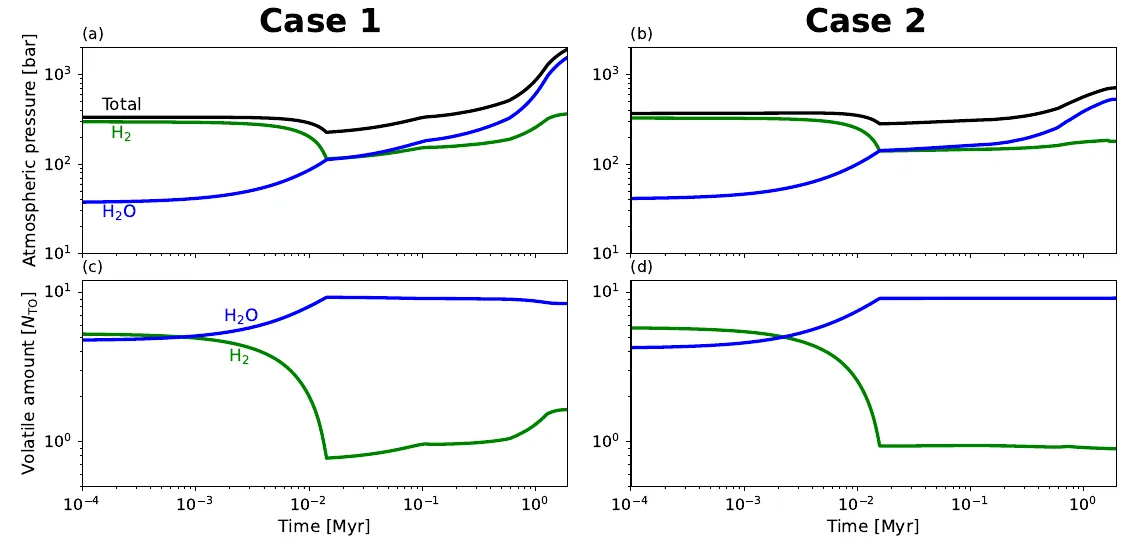
Top: pressure of hydrogen (green) and water vapour (blue) in the atmosphere. Bottom: total amounts, in N_TO. Left, Case 1; right, Case 2. Near 10⁻² million years, hydrogen collapses and water rises. — Figure 6 (panels a–d), Yoshida et al. (2026), arXiv:2610.38503.
The air pushes back
As crystals form, they take up ferric iron unevenly. In Case 1, it favours the solid mantle and the melt would drift towards reducing, that is, hungry for oxygen rather than ready to give it up; water leaving the magma then reacts with ferrous iron, and the air oxidises the magma. In Case 2, ferric iron piles up in the melt once the upper mantle, its shallowest part, solidifies; hydrogen then reduces it. The atmosphere acts as a buffer, and both cases end with broadly similar air. Switch off this oxygen bookkeeping, as earlier models did, and they diverge substantially.
Deeper oceans, more water
Across all runs, the deeper the magma ocean, the more water it makes: higher pressure favours the splitting of iron. For depths in the range inferred from how iron-loving elements were shared between metal and rock — 28 to 53 gigapascals at the base — more than 70% of the hydrogen ends up as water. If the young Earth gathered as much hydrogen as the water held today by all of Earth outside its core, 1 to 10 N_TO, this chemistry could explain Earth’s water budget, the authors write.
Mars fits the trend. A Martian magma ocean, if there was one, could reach no deeper than the planet’s core, at 18 to 19 gigapascals, and the model then gives a mantle far less oxidised than Earth’s — consistent with Martian meteorites, whose chemistry sits near the point where iron metal and iron oxide coexist.
What could change the picture
The model assumes that iron droplets fall into the core at once; kept suspended by convection, they could leave the surface reducing and limit water production. High-pressure experiments disagree on how much ferric iron forms. Diffusion data stop near 1,700 kelvin and the reaction rate comes from solid iron oxides, so hydrogen uptake is probably underestimated. And the model leaves the mantle with a ferric-to-ferrous iron ratio of 0.06 to 0.15, above today’s 0.02 to 0.06: later processes, such as the late arrival of metal-rich material, would have to lower it.
A sky that stayed hydrogen-rich
Once the magma ocean froze, the water vapour should have condensed into a surface ocean. The leftover hydrogen would have stayed in the air with carbon and nitrogen gases; the authors suggest it could have helped make methane, ammonia, then organic compounds that may have gathered in that first ocean. A large share of that ocean’s water, in this picture, began as hydrogen in the sky, drawn into the magma through a skin that sank and renewed itself every minute or so.