IN SPACE, THE LESS STABLE MOLECULE WINS
Many molecules found in space are built from just four elements: hydrogen, carbon, nitrogen and oxygen — the building blocks of organic and prebiotic chemistry. Arranged the right way, they can form the peptide bond, –C(=O)–N(–H)–, which links amino acids into proteins. The authors see the isocyanate group, –N=C=O, as its essential substructure: the same N–C–O chain. Of the more than 350 molecules identified between the stars, only five carried it, including isocyanic acid, HNCO.
Two ways to add a proton
Isocyanic acid can pick up an extra proton in two places. On the nitrogen, it becomes H₂NCO⁺, the most stable arrangement, already detected in space. On the oxygen, it becomes HNCOH⁺, an isomer — same atoms, different arrangement — that sits higher in energy, by 18 kilocalories per mole — the energy carried by a gas at about 9,000 kelvin, far beyond the cloud’s 100 or so.
Theory and laboratory hinted that the second form should not be rare. Recent calculations of the reaction between the ion H₃⁺ and HNCO, thought to be one of the main ways these ions form, found it produces HNCOH⁺ about 80% of the time. In a laboratory experiment, HNCOH⁺ was twice as abundant as H₂NCO⁺. And once formed, HNCOH⁺ can hardly turn into its stable twin: a high energy barrier stands in the way. Yet nobody had ever seen it in space.
A cloud shaken by collisions
Marta Rey-Montejo, of Spain’s Centro de Astrobiología, and her colleagues in Spain, Germany, Japan, the United States and Chile looked towards G+0.693-0.027, a molecular cloud near the centre of the Milky Way. Large-scale shocks, probably from a collision between clouds, tear material off the icy mantles and cores of dust grains and release it into the gas. That makes the cloud one of the most prolific places to discover new molecules.
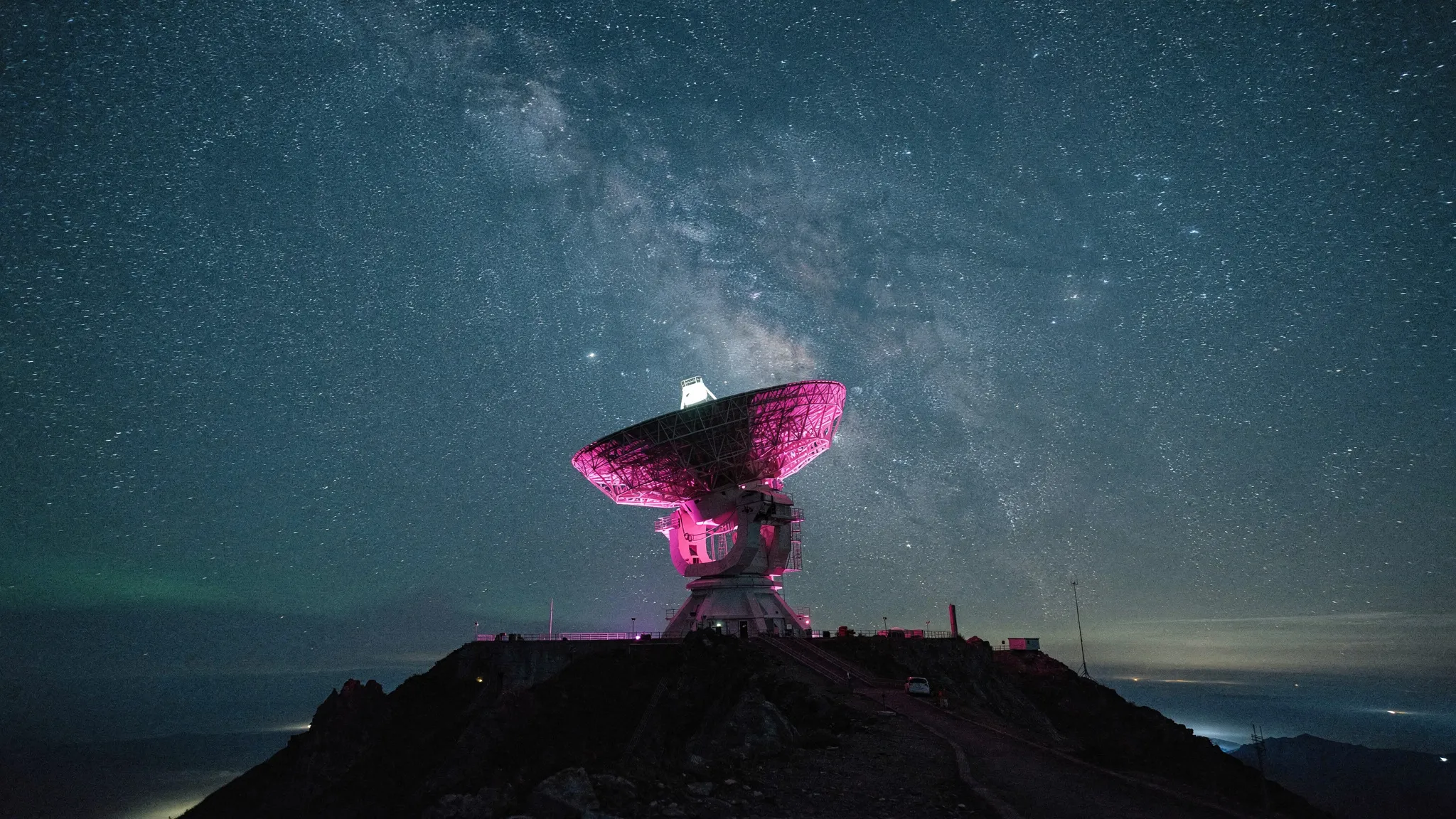
They used an ultra-deep survey of the cloud by three radio telescopes — the Yebes 40-metre, IRAM 30-metre and APEX dishes — covering nearly 150 GHz of frequencies between 31 and 275 GHz.
Seven lines, one molecule
A molecule spinning in space emits at a ladder of precise radio frequencies, each showing up as a narrow spike — a spectral line. Only the two lowest rungs of HNCOH⁺ had been measured in the laboratory, so the team extrapolated the rest. Eight rungs fell inside the survey; seven could be analysed, the eighth lying under a line from Earth’s atmosphere.
They all lined up. The fit gives a column density of 9.9 × 10¹² molecules per square centimetre along the line of sight, an abundance of about 7.3 × 10⁻¹¹ relative to molecular hydrogen, and a temperature of about 24 kelvin for the molecule’s rotation. Most of these lines had never been measured in any laboratory; from them, the team derived a first value for how the spinning molecule stretches, in close agreement with quantum-chemical calculations.
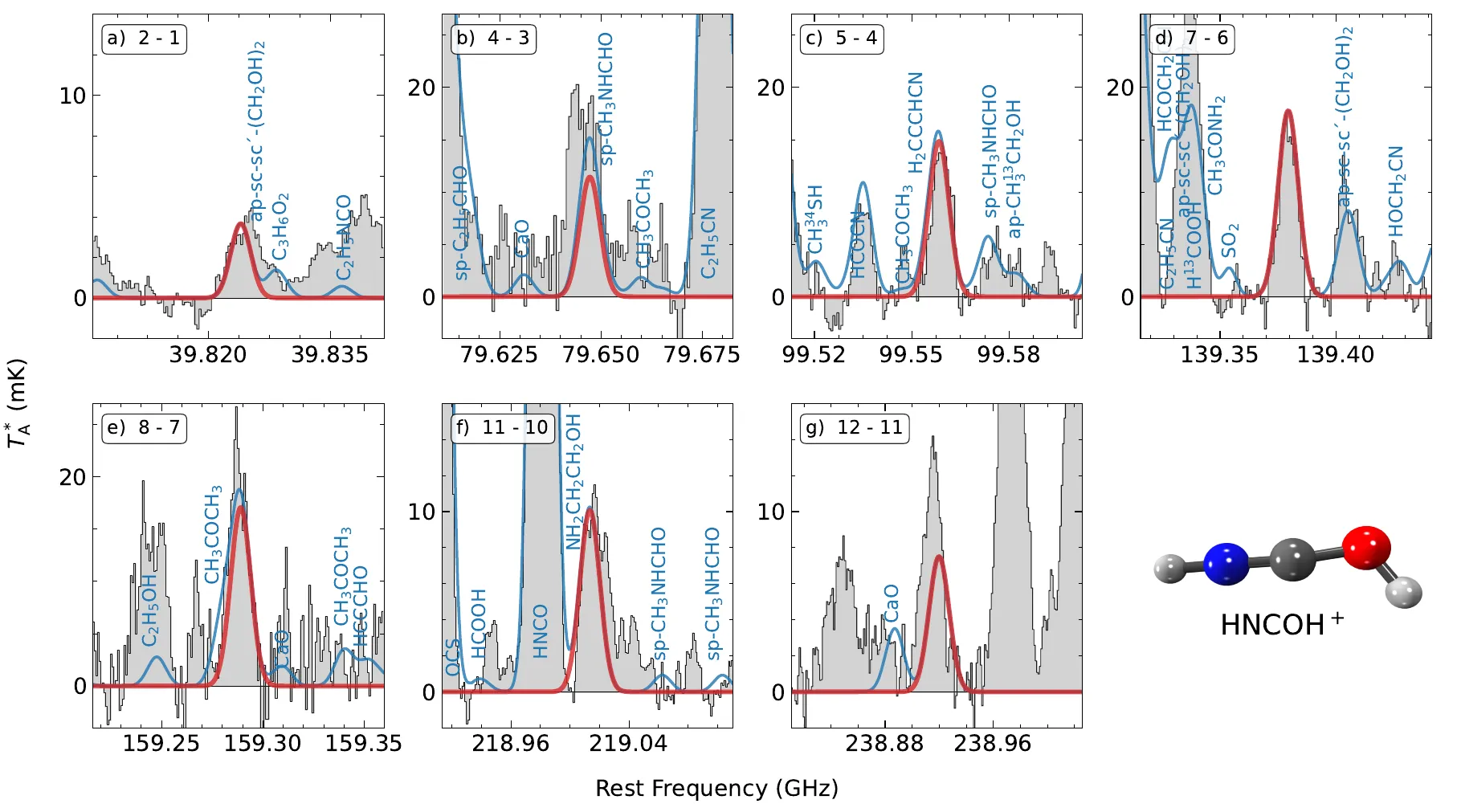
The seven rotational lines of HNCOH⁺ towards G+0.693: observed spectrum (grey), fit for HNCOH⁺ (red), all known molecules (blue). The molecule’s structure is shown at bottom right. — Figure 1, Rey-Montejo et al. (2026), arXiv:2610.39654.
The less stable twin wins
With newer data, the team also re-measured the stable twin, H₂NCO⁺: 2.6 × 10¹² per square centimetre. That makes HNCOH⁺ 3.8 times more abundant.
If the two forms simply settled according to their energies, at the cloud’s temperature of about 70 to 140 kelvin, HNCOH⁺ would be more than 20 orders of magnitude rarer than H₂NCO⁺. Instead, its abundance reflects how it is made: the reaction that forms these ions favours the less stable form. The authors note that other families of isomers in space show the same pattern, with high-energy forms as common as their stable counterparts. The two ions also differ in how fast they spin: HNCOH⁺ appears warmer than H₂NCO⁺ (about 24 against 9 kelvin, while the gas itself is at about 70 to 140 kelvin). A possible reason, the authors suggest: HNCOH⁺ is less polar, so it gives off its spin energy as radio waves less readily, and collisions with the gas keep it spinning faster.
Six molecules and counting
HNCOH⁺ is the sixth molecule found in space that carries the isocyanate group. The authors call for a dedicated laboratory study to map its full rotational spectrum. Their broader lesson is about how chemistry works between the stars: there, the most stable arrangement of atoms is not necessarily the most common one — what counts is the road by which a molecule is born.