A PLANET DETECTOR SCORED 0.97 — ON REAL FALSE ALARMS, A COIN TOSS
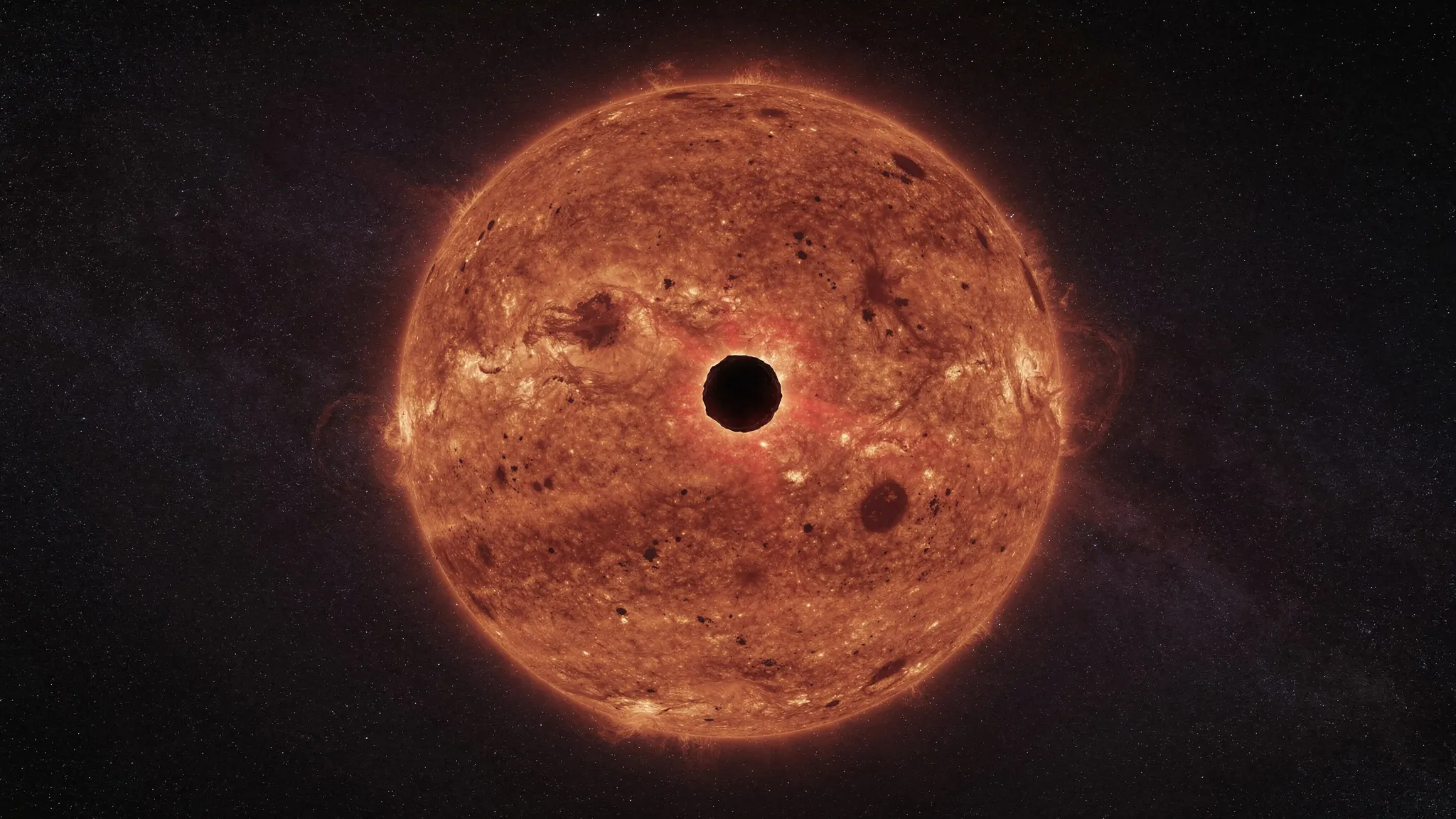
The TESS satellite watches stars for transits: the small dip in light when a planet passes in front of its star. Some planets circle their star in less than a day. These ultra-short-period planets orbit a few stellar radii away, hot enough on their dayside to melt rock, and they are most common around low-mass stars such as M dwarfs. To find them in huge volumes of data, neural networks have become the standard tool, and published scores look nearly perfect: 0.988, 0.999, even 1.0.
Grading on an easy test
Juan Francisco Pagés Navarrete, an independent researcher in Málaga, Spain, built such a detector and measured it honestly. The score used is the AUC: the probability that a real planet picked at random gets a higher score than a false alarm picked at random. An AUC of 1 is perfect; 0.5 is chance.
Tested the usual way — confirmed planets against 263 eclipsing binaries, pairs of stars that dim each other, drawn from a catalogue of 4,584 — the network scored 0.97.
Along the way, the author caught it cheating once. An earlier version had learned that “a narrow, sharp V-shaped dip means a binary star”, because the simulated binaries used for training all looked like that. It scored 0.99 on simulations and rejected real planets, whose dips are often just as narrow.
The coin toss
The real test used a different set of false alarms: signals from the TESS follow-up programme that had passed automatic filters and human checks, and were rejected only after further observations. Against 253 of them, the very same network scored 0.5001 — the value of a random guess.
To find the culprit, the author swapped one ingredient at a time. Changing the planets moved the score by 0.11 at most. Changing the false alarms dropped it from 0.97 to chance.
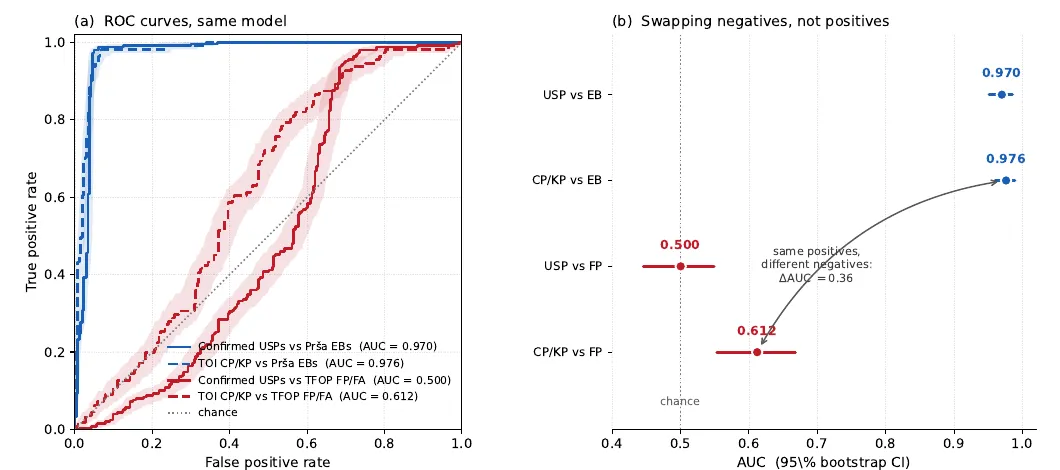
The same network on four test sets: blue against catalogued binaries, red against real false alarms. Swapping the false alarms, not the planets, drives the score to chance. — Figure 2, Pagés Navarrete (2026), arXiv:2610.42009.
Stars hiding behind stars
The reason is physical. A TESS pixel covers 21 arcseconds of sky — more than five times wider than a pixel of the earlier Kepler telescope — so the light of several stars often falls into the patch measured for one target. If a neighbouring star eclipses, its dip is diluted into the target’s light and looks just like a small planet. This is a blend.
By comparing images taken during and outside each dip, the author located where the vanishing light came from. In 61 of the 145 real false alarms it could analyse this way — 42% — the source sat more than one pixel away from the target. That is a minimum: neighbours closer than one pixel escape the test.
A ceiling you can calculate
If blends are indistinguishable from planets, a detector can only toss a coin on them, even if it is perfect on everything else. That gives a simple ceiling: AUC = 1 − f/2, where f is the share of blends. With f = 0.421, the ceiling is 0.789.
Retrained on real false alarms, and tested against planets found by TESS itself, where it had started at 0.61, the network climbed to 0.80 ± 0.06 — well within the prediction’s margin of error (0.19 standard deviations). Two independent routes, one through images and one through the network, land on the same number. Choosing when to stop training by peeking at the test data — a common shortcut — would have added 0.04 to the score, a gap often used to crown a new architecture.
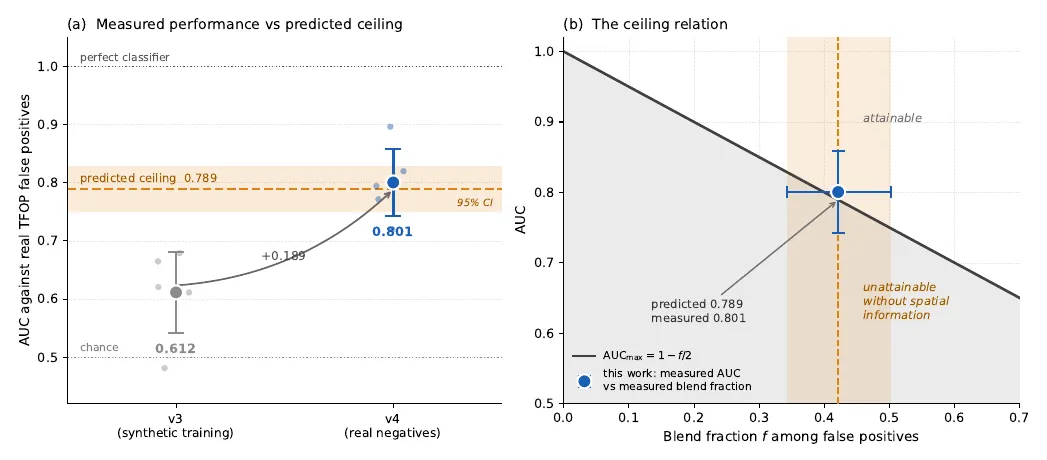
Left: retraining brings the network up to the predicted ceiling. Right: the ceiling 1 − f/2 against the blend fraction, with the measurement on the line. — Figure 4, Pagés Navarrete (2026), arXiv:2610.42009.
The limit, the paper argues, lies neither in the architecture, nor in the amount of training data, nor in computing power. It lies in what a light curve — a star’s brightness recorded over time, in a single colour — contains.
Looking where the curve cannot
So the author chained the network with other clues: where the light comes from, how the dip depth changes with colour, models of the surrounding stars with sharp images from large telescopes, and the Gaia satellite’s check of whether a star’s motion on the sky fits a single star.
Of 435 unresolved candidates, 49 scored above 0.9. Twenty-nine were blends. Of the 20 left, 19 were false alarms — among them four blends betrayed by colour, seven by position, and one flagged by Gaia alone despite a clean record from the ground. Among the survivors, the two highest scores went to a binary star and a blend.
A seven-hour year
The twentieth is TOI-6662 b, ranked only 26th by the network. It is 0.94 times the size of Earth and circles an M dwarf a third the Sun’s radius every 7.05 hours. It sits at 1.19 times the distance where tides would tear it apart, which means its density must be at least close to Earth’s, or tides would already have torn it apart. It receives about 366 times the light Earth gets from the Sun, for a temperature around 1,220 K: on the edge of keeping an ocean of magma.
Another team, Collier and colleagues, validated the same planet independently with the same conclusions. The validation is statistical: the planet’s mass is still unmeasured. For the author, a detector like this one is worth having, “provided its output is read as what it is: a prioritisation, not a decision.”