A NEUTRON-STAR COLLISION 12 BILLION YEARS IN THE MAKING
In 2017, the LIGO and Virgo detectors caught the gravitational waves of two neutron stars spiralling into each other: GW170817. Telescopes then saw the explosion itself, a burst of gamma rays and a kilonova — the glow of the hot, freshly forged heavy elements thrown out by the collision — in the galaxy NGC 4993. A second neutron-star merger, GW190425, has been detected since, but it was poorly located and no light was found. GW170817 therefore remains the only gravitational-wave event ever tied to a galaxy.
That galaxy is a clue. Ryan Foley, of the University of California, Santa Cruz, used it to ask how long such pairs wait before they merge — and found an answer that does not fit the usual picture.
The waiting time
Astronomers call it the delay time: the time between the birth of the stars and the merger. Once two neutron stars have formed, they slowly lose orbital energy to gravitational waves. The time this takes grows with the fourth power of their separation, so pairs born close merge fast and pairs born wide merge late.
For a broad range of plausible starting separations, this gives a simple rule: the number of mergers per unit of delay time falls as 1 divided by the delay. Add a minimum delay of about 10 million years, and you get the canonical distribution. Its message: most pairs merge soon after their stars are born, and few wait billions of years.
Dating NGC 4993
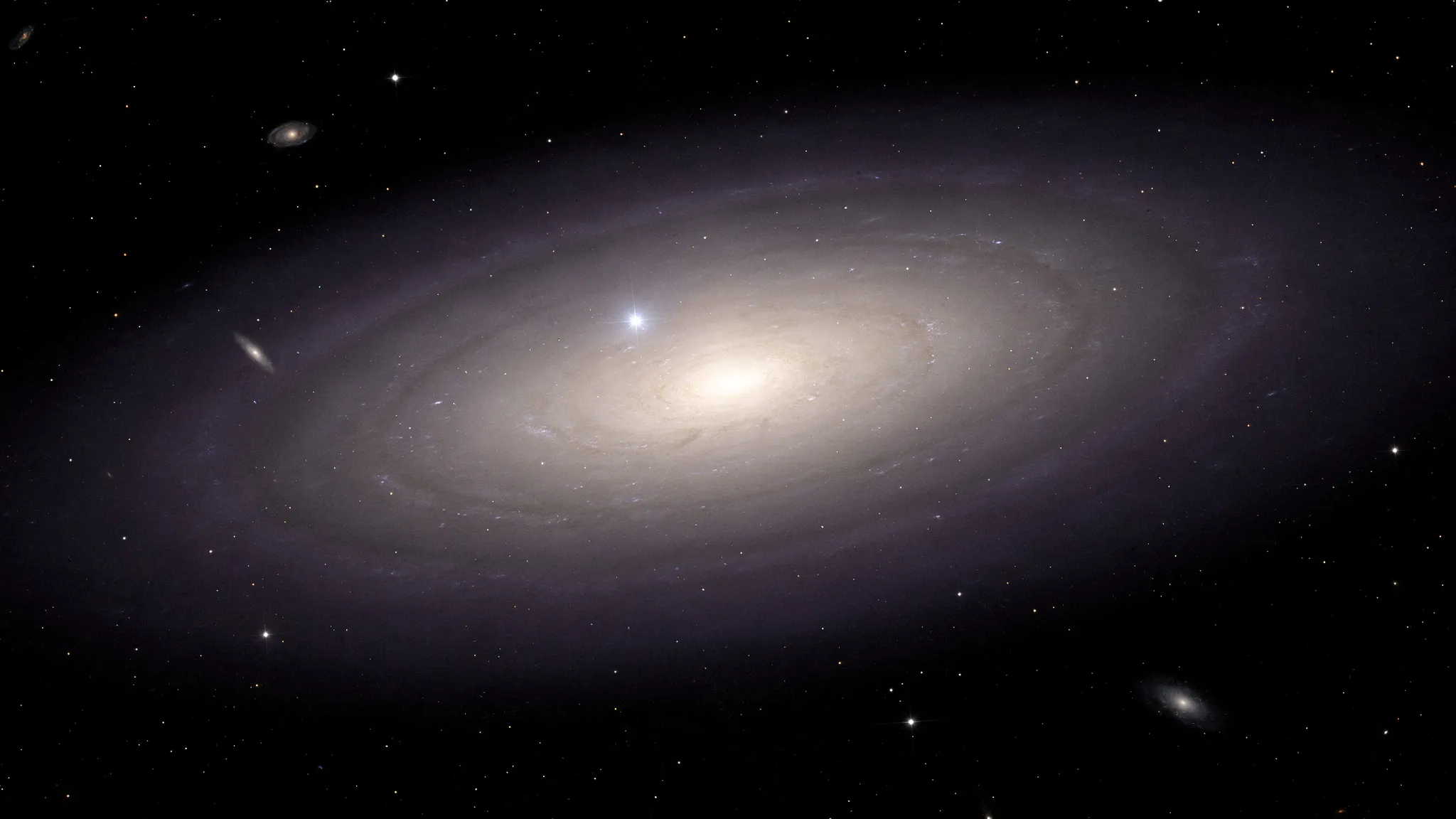
NGC 4993 is an “early-type” galaxy (class S0): a galaxy that forms few new stars today. No cluster of stars and no star-forming region sits near the spot where the kilonova shone, so the pair most likely formed long before the merger, somewhere else in the galaxy. Foley therefore modelled the stars of the whole galaxy, combining measurements in 14 colours from ultraviolet to infrared with a spectrum from the MUSE instrument on the Very Large Telescope.
The fit splits the galaxy’s history into 20 time bins and lets each one form stars freely. The result is stark. The average age of its stars is 12.4 billion years (between 11.7 and 12.9, at 90% confidence). Star formation peaked between 12.5 and 13 billion years ago, at 54 solar masses of new stars per year, and has stayed below one solar mass per year for the last 9 billion years. About 96% of the galaxy’s mass was in place 10.2 billion years ago. Shells around the galaxy point to a small merger about a billion years ago, but the spectrum shows no sign of the young stars it might have produced.
So GW170817 most likely had a delay of roughly 12 billion years.
A 1.8% chance
Foley then combined this age with the cosmic history of star formation, the merger rate measured by the LIGO-Virgo-KAGRA collaboration and the two detected mergers.
Under the canonical distribution, for every merger seen today with a delay of 10 billion years, there should be about 2 with a delay of 1 billion years and 16 with a delay of 100 million years (for the same span of delay times). The chance that a detected merger is as old as GW170817 is only 1.8%. The reason is plain: NGC 4993 formed half of its stars more than 12.6 billion years ago, whereas the Universe as a whole had formed only 1.1% of its stars by then.
On average, astronomers would need 55 more detections before expecting one like it. Yet the very first merger ever located turned out to be that rare case.
What the data prefer
When the minimum delay is left free, the data favour a very long one. A distribution in which no pair merges before 12.6 billion years is preferred over the canonical one by a factor of 40 to 140, depending on how the merger rate is folded in, and over the distributions inferred from short gamma-ray bursts and from double neutron stars in the Milky Way by 80 to 280. In one treatment, the minimum delay exceeds 7.5 billion years at 90% confidence.
Three ways out
For the canonical picture to survive, short-delay mergers must be “missing”. Foley lists three explanations.
- The pairs could be born much wider apart than assumed. A minimum delay of 10 billion years means no pair of 1.5-solar-mass neutron stars starting closer than 0.021 astronomical units (0.021 times the Earth–Sun distance). Foley finds that unlikely: it would clash with known double neutron stars and with massive binary stars.
- The detectors could have missed many mergers. Foley calls that extremely unlikely.
- Another way of forming pairs, with long delays, could rival or dominate the usual one.
Foley favours the third. The most promising candidate is dense star clusters, where pairs can form through gravitational encounters between stars, with delays close to the age of the Universe. Of the roughly 24 double neutron stars known in the Milky Way, one confirmed and three unconfirmed sit in globular clusters, a type of dense star cluster. But no cluster was seen at the site of GW170817, and recent theory predicts too few cluster mergers: the rate would have to be higher than expected.
Ripples beyond one event
If mergers wait this long, they arrive too late to enrich the young Galaxy with the heavy elements they forge, such as europium (the so-called r-process elements). And searches that hunt for the light of new mergers by favouring star-forming galaxies may not be aiming at the most promising ones. With a minimum delay of 10 billion years, no such merger could happen before the Universe was 10 billion years old, so future detectors would see far fewer of them at great distances.
All of this rests on two events, only one of them located. Foley expects more detections to sharpen the picture, and suspects the true distribution is less simple than a single power law with a minimum delay.