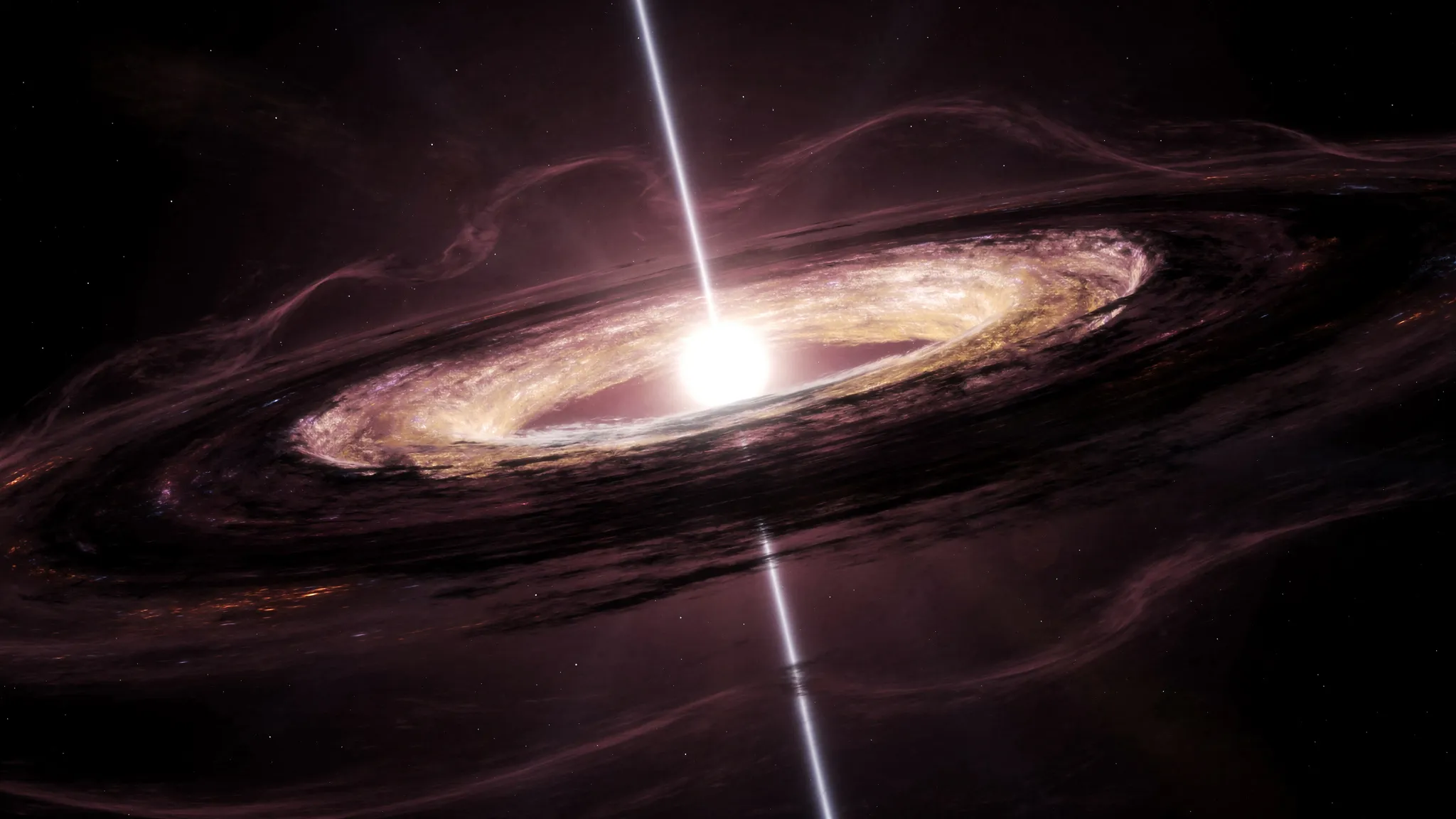
WHERE A YOUNG STAR BURNS OFF ITS CARBON
Carbon is the backbone of life as we know it: more than half the dry mass of a human body. Yet Earth is strangely short of it. The bulk of our planet’s rock holds, for its mass, about four orders of magnitude — ten thousand times — less carbon than the Sun, or than the interstellar dust from which Earth was born. Several explanations have been proposed, from ultraviolet light to oxidation, but none fully accounts for it.
One suspect is heat. The carbon in dust grains comes in several forms — soot-like amorphous carbon, hydrocarbons, graphite — that break down at different temperatures. From roughly 500 kelvins, the soot line, the most volatile forms escape; by about 1,200 kelvins, even amorphous carbon is gone. Earlier work estimated that this heating must have happened within the first million years of Earth’s formation.
A star caught at “time zero”
HOPS-68 is a very young star in the Orion molecular cloud, about 414 parsecs away. A companion study by the same team showed that the middle of its inner disk reaches 1,400 kelvins — hot enough for all dust to vaporize. Our Solar System went through such a phase too: it is the “time zero” of the meteorite record, the moment the clock of meteorite history starts, when grains rich in calcium and aluminium condensed from hot gas near the young Sun. Only two young, low-mass stars are known candidates for that moment, both in Orion.
F. J. Ballieux, M. K. McClure and colleagues, at Leiden University with partners in the United States and Germany, have now examined the carbon in its spectrum, taken by JWST’s Mid-Infrared Instrument, together with archival data from the ALMA (sub)millimetre array.
A spectrum full of hydrocarbons
The light of HOPS-68 is crossed by the fingerprints of many carbon molecules:
- warm hydrogen cyanide and acetylene, at about 320 and 430 kelvins, in large amounts — about 20 times more than around the other “time zero” star. The shift of their lines in the spectrum shows them moving towards us at 39 to 53 kilometres per second relative to the star, like the oxygen-bearing gas that traces a wind blowing off the disk;
- colder molecules, around 40 to 55 kelvins, including diacetylene (C₄H₂), the methyl radical (CH₃, a molecular fragment with a free bond, highly reactive) and carbon monosulfide, probably in the outer disk or along the walls of the cavity carved by the star’s outflow, the gas the young star blows out;
- triacetylene (C₆H₂), a chain of six carbon atoms, detected for the first time around a young star.
ALMA adds another clue: the C₂H radical lines the walls of the outflow cavity, moving outwards with the jet rather than falling in.
A carbon destruction zone
The authors propose a scenario. Between the soot line and the point where even amorphous carbon vaporizes — roughly 500 to 1,200 kelvins — lies what they call a “refractory carbon destruction zone”: there, all the solid carbon leaves the grains and becomes gas. At HOPS-68, the very hot inner region pushes this zone outwards and enlarges it. The released carbon is then either swallowed by the star or carried away by the disk wind.
Either way, the dust in the region where rocky planets form loses its carbon. The same process, the team suggests, may have contributed to Earth’s carbon deficit. How much carbon the wind actually removes remains to be measured.
Farther out, ultraviolet light breaks acetylene into C₂H, which reacts with more acetylene to build longer chains such as C₄H₂ and C₆H₂. Between 900 and 1,100 kelvins, the destruction zone might even forge polycyclic aromatic hydrocarbons — flat molecules made of rings of carbon atoms fused together — as in a flame — something still to be confirmed.
From a protostar to asteroids
The study has two wider consequences. First, carbon chains seen around other young stars have usually been attributed to gas falling in from the surrounding envelope; at HOPS-68 they clearly flow out, which suggests that this chemistry may trace outflows instead.
Second, samples returned from the asteroids Ryugu and Bennu contain abundant chain-like (“aliphatic”) organic matter. Because the long chains of HOPS-68 form outside the wind, they are not blown away; they could later fall back onto the outer disk. The authors suggest such chains might contribute to the organic matter of asteroids and meteorites. If so, HOPS-68 would show, in one young system, both the formation of those meteorite grains and the carbon-rich material in which they are embedded — a Rosetta stone for the formation of the first small bodies of a planetary system.