CAN LIGHT BOUNCE OFF LIGHT?
Shine two flashlights so that their beams cross: each beam goes on as if the other were not there. This is the superposition principle, at the heart of optics. It holds because the equations of electromagnetism are linear, and it matches everyday experience.
Since the work of Euler, Heisenberg and Kockel in the 1930s, physicists have known that the principle is not quite exact. Quantum physics fills the vacuum with fleeting fluctuations — in quantum electrodynamics, virtual pairs of electrons and positrons. Through them, light can feel light. Two consequences follow: light-by-light scattering, where one beam deflects photons of another, and vacuum birefringence, where the vacuum changes the polarization of light — the direction in which its electric field oscillates — passing through a strong field. Neither has yet been verified experimentally at low energy, where photons carry much less energy than the energy locked in the mass of an electron.
X-rays against an intense laser
The BIREF@HIBEF collaboration — about 80 researchers, including teams at the Helmholtz Institute Jena and the Helmholtz-Zentrum Dresden-Rossendorf — set up the collision at the European X-Ray Free-Electron Laser in Schenefeld, Germany:
- the pump: the ReLaX laser, near-infrared pulses of 23 femtoseconds (millionths of a billionth of a second) carrying 4 joules, focused to a spot about 1.1 by 1.4 micrometres, reaching 7.7 × 10²¹ watts per square centimetre;
- the probe: X-ray pulses of 8.766 keV (kiloelectronvolts: each X-ray photon carries over 5,000 times the energy of a photon of the infrared pump), each with about 100 billion photons, fired head-on into the pump.
The intense field of the pump should slightly disturb the vacuum, and a few X-ray photons crossing it should come out with their polarization flipped. Even in ideal conditions, that is about one photon in 10¹³ — and those photons travel in the same direction as the 100 billion others.
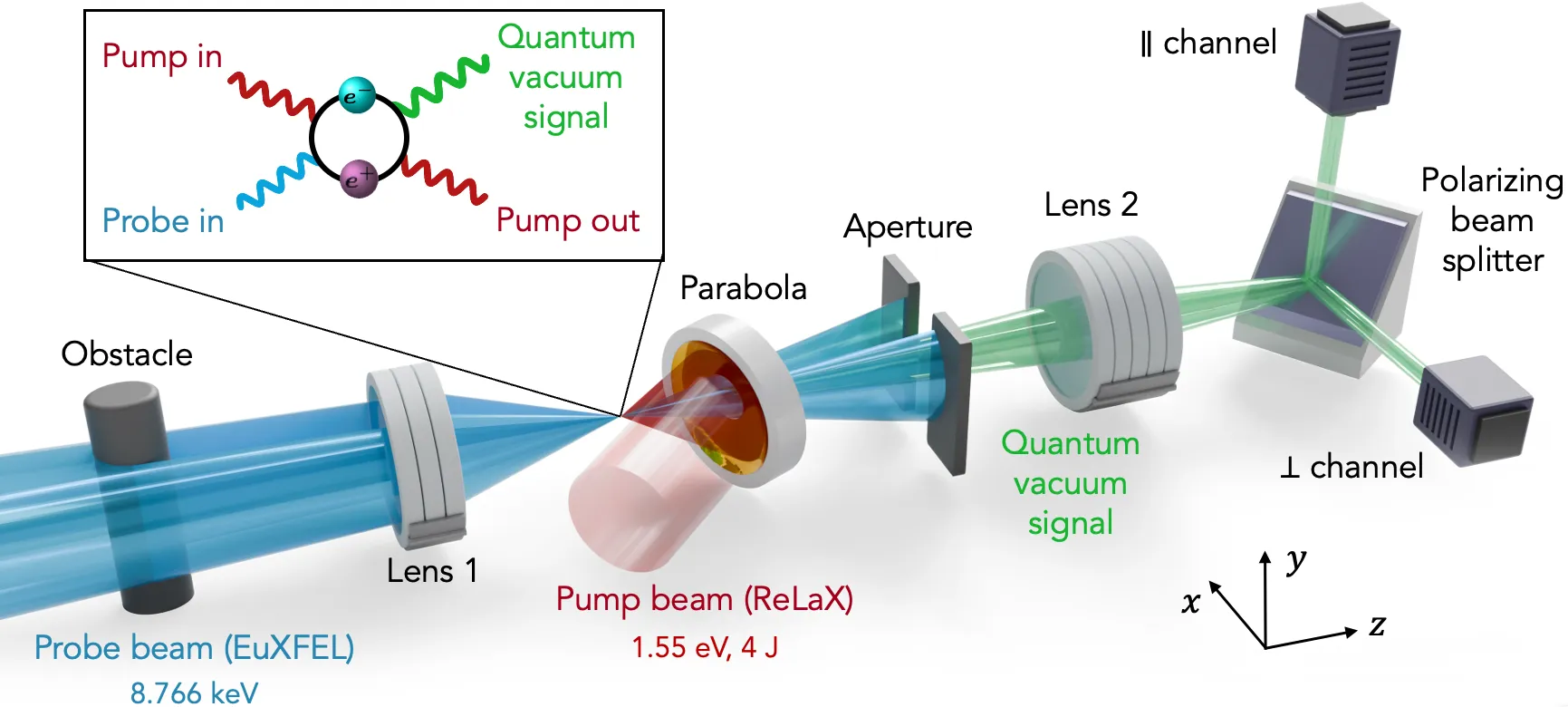
The dark-field setup: a wire casts a shadow in the X-ray beam, the quantum vacuum signal created at the collision passes through the aperture, and a beam splitter separates its two polarizations. — Figure 1, Matheron, Šmíd et al. (2026), arXiv:2611.04531.
Hiding the beam in a shadow
The trick is a dark field. A polished tungsten wire, 250 micrometres thick, is placed in the X-ray beam before it is focused. It casts a shadow. At the focus the shadow vanishes; after it, the shadow reappears — but the signal, born in the tiny focal spot, spreads out in a wider cone that fills it. A 40-micrometre aperture then blocks the main beam and lets the shadowed region through, and a germanium crystal splits the two polarizations onto two photon-counting detectors. Only about 4 X-ray photons in a trillion of the main beam leaked into the flipped-polarization channel; the unchanged-polarization channel, by contrast, still received about 7,000 probe photons per shot.
The pump fires at 0.5 hertz and the probe at 10 hertz, so each collision comes with 19 reference shots without the pump. Over 2,751 collisions and 52,441 reference shots, the flipped channel counted 0.4649 photon per shot with the pump, 0.4636 without: no difference. After subtracting the background, the excess was −0.0024 photon per shot, consistent with zero.
A silence ten billion times more telling
To know what silence means, the team simulated the whole experiment, beam by beam and lens by lens, including the measured misalignment of every shot. Quantum electrodynamics predicts a total of only 0.0008 photon in the flipped channel for the whole campaign: far below what this run could detect.
The result is an upper limit. At 95% confidence, light-by-light scattering is at most 70,000 times the value predicted by quantum electrodynamics, at a collision energy of 116 electronvolts (the square root of the product of the energies of one X-ray photon and one laser photon, 8,766 and 1.55 electronvolts). A signal of more than 56 photons over the 2,751 collisions would have stood out. Earlier experiments at low energy had only reached limits about ten billion times weaker.
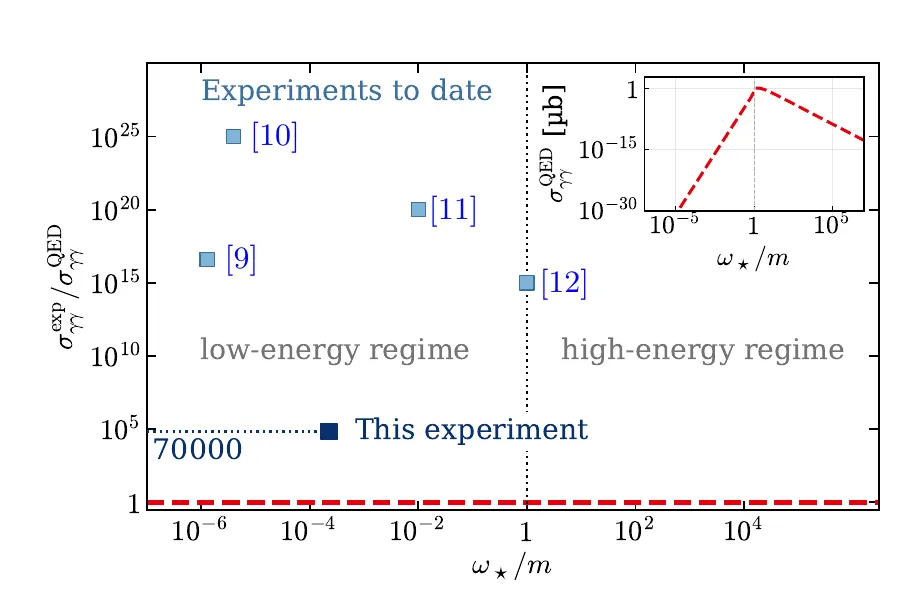
Upper limits on light-by-light scattering, relative to the quantum prediction (dashed red line at 1): this experiment, at 70,000, against earlier low-energy experiments. — Figure 4, Matheron, Šmíd et al. (2026), arXiv:2611.04531.
Closing the gap
The gap of 70,000 is not out of reach, according to the authors. Running ReLaX at its published 8 joules and 1 hertz would give 8 times more signal for the same time; a dark-field geometry freed from the constraints of the current facility would improve the background rejection by more than a thousand; faster detectors would gain another factor of ten or more. Together, these upgrades should allow the first direct laboratory observation of light scattering off light — and then measure the two numbers, a and b, that quantum electrodynamics assigns to the vacuum’s response.