THREE PLANETS THAT SHOULD HAVE BEEN SWALLOWED
Late in its life, a star like the Sun climbs what astronomers call the red-giant branch: its outer layers swell by orders of magnitude. Tides and the loss of stellar mass should then drag in and engulf any planet orbiting too close — within about one astronomical unit (the Earth–Sun distance) for Sun-like stars. Surveys of aged stars do find very few giant planets on short orbits.
At the top of that branch, helium ignites in the core and the star shrinks back. It settles into a smaller stage called the red clump, burning helium in its core. So any planet seen close to a red-clump star must have lived through the moment its star was at its largest. Until now, only one such “forbidden” planet had been reported.
Listening to the stars
The difficulty is telling the two stages apart. A giant on its way up and a giant on the red clump look alike in their light. But they do not vibrate the same way. Stars oscillate, and their oscillations probe the density of their core: this is asteroseismology.
Wen-Xu Lin, Sheng-Bang Qian and colleagues at Yunnan University and the Chinese Academy of Sciences screened every known planet-hosting star this way, using light curves recorded by the TESS mission. Three stars came out as securely on the red clump: 24 Boo, HD 12648 and TYC 4282-605-1. The team then reanalysed years of measurements of each star’s wobble, caused by the pull of its planet, from three observatories.
Orbits inside the old star
The three planets:
- 24 Boo b circles its star in 30.3 days, at 0.183 astronomical units — the closest planet known around a red-clump giant. Its minimum mass — the wobble does not reveal how the orbit is tilted, so only a lower limit is known — is about three quarters of Jupiter’s.
- TYC 4282-605-1 b: 101.6 days, 0.489 au, at least 14 times Jupiter’s mass.
- HD 12648 b: 132.9 days, 0.516 au, at least 2.5 times Jupiter’s mass.
The stars themselves are now about 10 to 12 times wider than the Sun. The question is how wide they were at the top of the red-giant branch. The team computed that maximum radius with stellar-evolution models, varying the uncertain details of convection and composition. The orbit of 24 Boo b is smaller than the maximum radius given by every model tested, and so is that of TYC 4282-605-1 b. HD 12648 b is closer to the boundary: its chance of having been engulfed drops from nearly certain to 43% for the most favourable convection setting.
A model of the orbit itself — mass loss, drag from the stellar wind, tides — gives a simple rule: under ordinary evolution of a single star, a planet seen around a red-clump star should never orbit closer than the star’s past maximum radius. 24 Boo b and TYC 4282-605-1 b do under every model tested; for HD 12648 b, it depends on the convection setting.
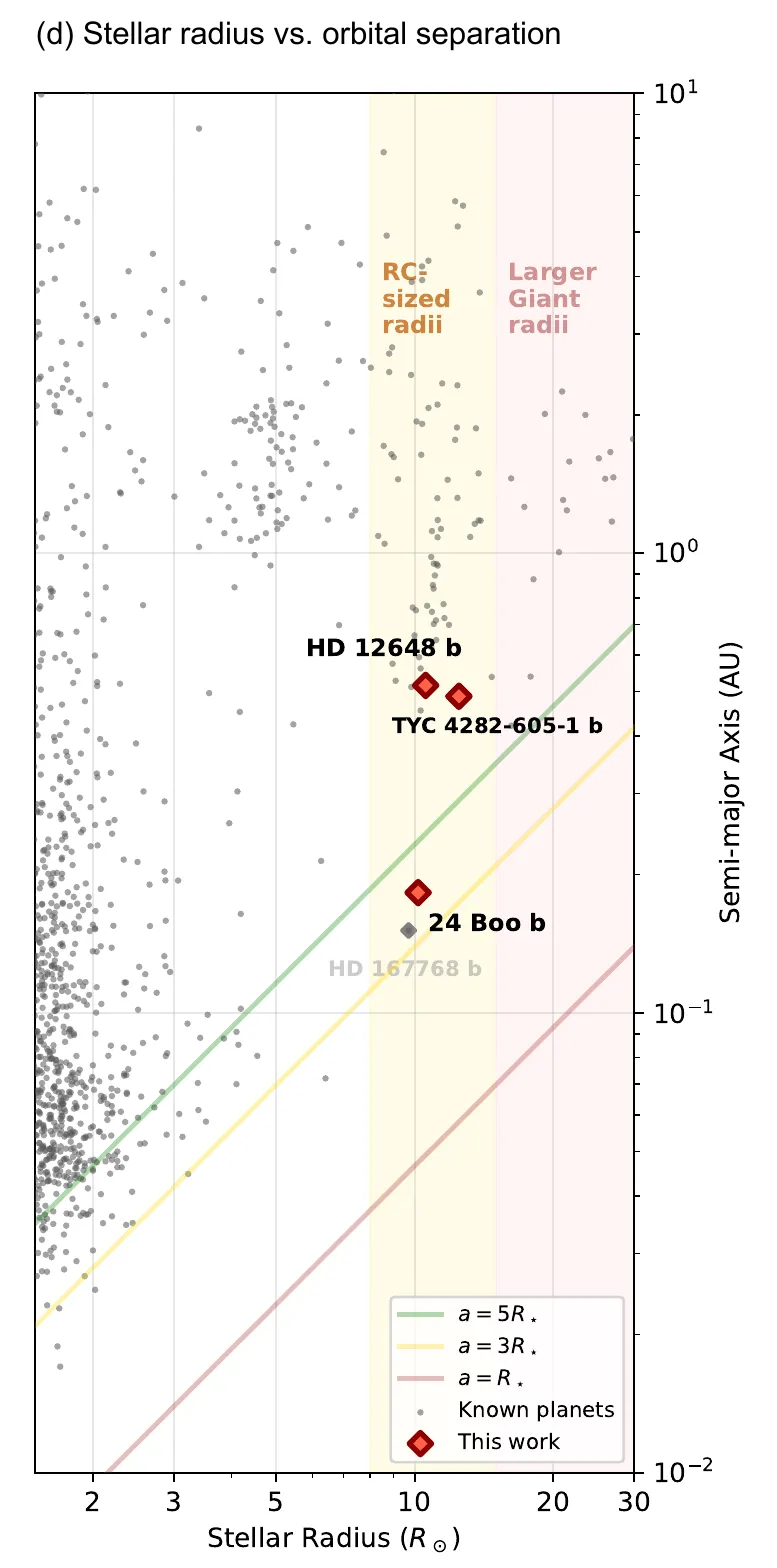
Orbital distance against the radius of the host star for confirmed planets: the three planets of this study (red diamonds) sit among red-clump-sized stars, unusually close in. — Figure 2d, Lin et al. (2026), arXiv:2611.04544.
How could they survive?
The authors list possibilities, explicitly as ideas rather than mechanisms they demonstrate:
- A binary past. If a host star once exchanged mass with a companion, or merged with it, its envelope may never have swelled as much. In the oscillations of 24 Boo, the link between the vibrations of the core and those of the outer layers is unusually weak for a star so poor in heavy elements, a hint that its history may not be that of a single star. A merger product can also keep or rebuild a disk where “second-generation” planets might form.
- A disk from a swallowed planet. If an inner planet was engulfed, the energy it dumped into the star could have ejected gas into a temporary disk, which might then have pulled an outer survivor inwards once the star had shrunk.
- A narrow escape. A planet may have dipped into the swollen envelope near the top of the branch, then found itself outside again because the envelope retreated faster than its orbit decayed.
Capture of a free-floating planet or reshuffling within a multi-planet system are judged less likely.
One forbidden planet was an anomaly. With three, the authors speak of a new class of evolved planetary systems — and of physics around ageing stars that current models do not yet contain.