FOREVER CHEMICALS RECHARGE MEMBRANES, THEN STRIP THEM
PFAS — per- and polyfluoroalkyl substances — are often called “forever chemicals”. Their carbon chains are wrapped in fluorine, which makes them extremely stable and resistant to breaking down, and their spread has raised environmental and health concerns. Like soap molecules, they have a water-loving head and a water-shy tail, and studies have shown that they slip readily into the fatty membranes that surround cells. What they do there is still being worked out.
Seungsu Han, Gbassey Oteme, Prathima Nalam and Sangwoo Shin, at the University at Buffalo in the United States, looked at one consequence: how PFAS change the way tiny membrane bubbles move.
Bubbles that surf on salt
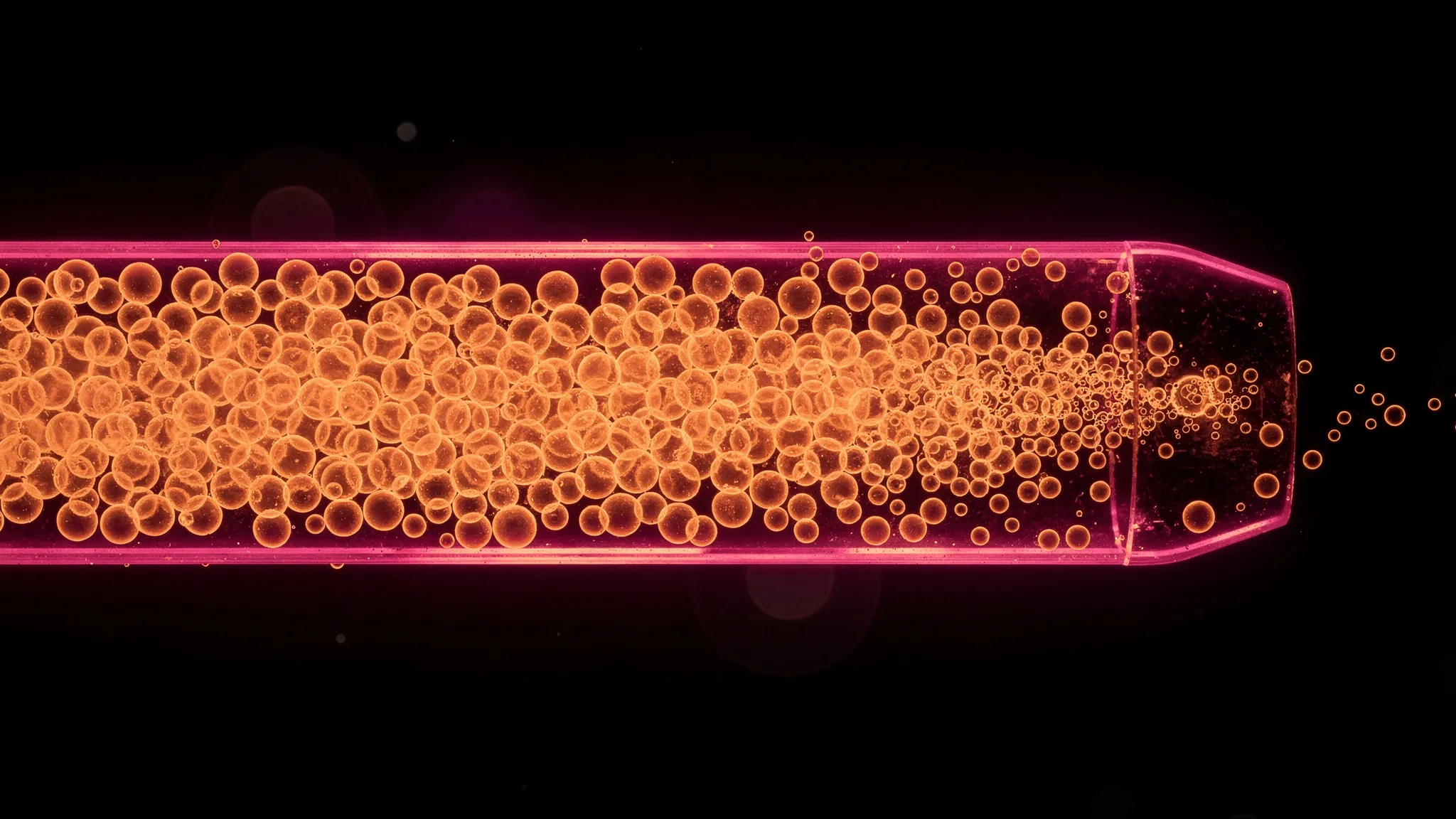
The team used vesicles, small spheres of lipid membrane, as simple stand-ins for cells. They are made almost entirely of one electrically neutral lipid, plus 0.5% of a fluorescent lipid that carries a negative charge. The membrane therefore has a slight negative charge, measured as a “zeta potential” — the electric voltage between the vesicle’s surface and the surrounding water, more negative when the surface carries more negative charge: about −28 millivolts here.
Charged particles in water can move without any push, simply because the concentration of dissolved salt varies from place to place. This drift, called diffusiophoresis, has been linked to many processes in living things, which often maintain such gradients. The more charged the particle, the stronger the drift.
The PFAS studied here are negatively charged at the body’s pH. So the authors expected them to add charge to the membranes they enter, and to speed up the vesicles.
Longer chains, stronger effect
That is what they measured. Adding PFAS made the vesicles’ charge more negative, and the effect grew with concentration and with the length of the fluorinated chain:
- PFDA, with 10 carbons, pushed the potential from −28 to −44 millivolts at 100 micromoles per litre.
- PFOA, with 8 carbons, only reached about −34.
- PFHxA, the shortest, with 6 carbons, changed nothing measurable.
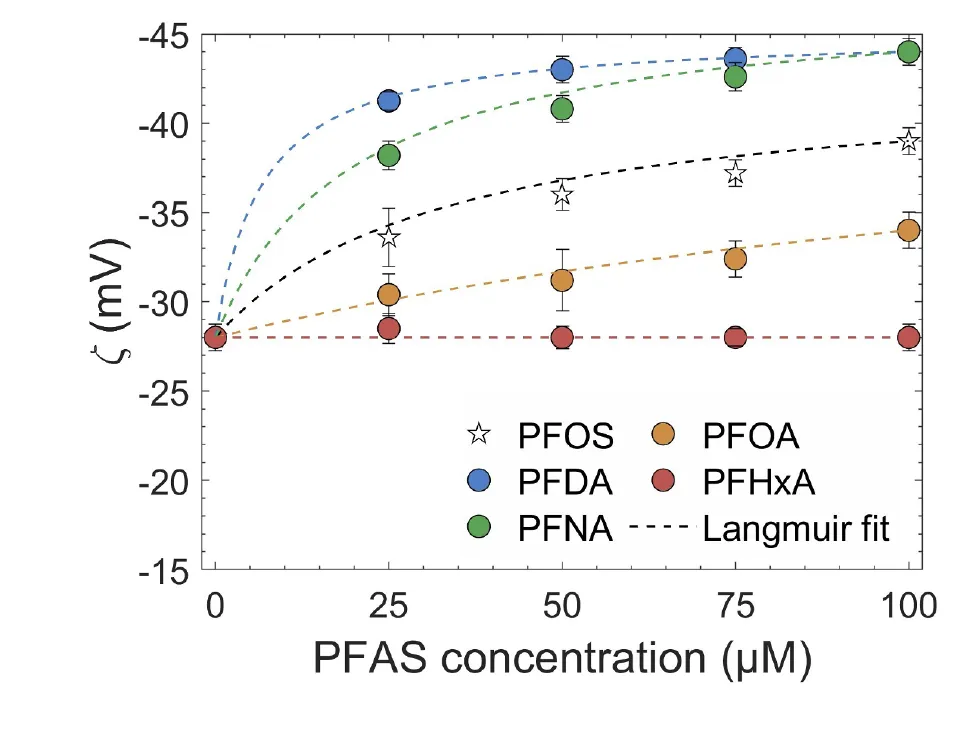
Vesicle zeta potential versus PFAS concentration: longer fluorinated chains make the membrane more negative; dashed lines are fits of an adsorption model. — Figure 2, Han et al. (2026), arXiv:2611.07075.
The head of the molecule matters too. PFOS and PFOA have chains of the same length, but PFOS, with a sulfonate head, enters membranes more readily and makes the vesicles more negative than PFOA does; its reported partition coefficient, a measure of how strongly a molecule prefers the membrane over the surrounding water, is about ten times larger.
Then the team watched vesicles in microscopic dead-end channels. A salty solution containing PFAS was released at the entrance, and the vesicles drifted towards it. With every PFAS except PFHxA, they moved faster than without it, and a model combining ion diffusion with the gradual uptake of PFAS reproduced their paths closely.
The membrane loses lipids
The surprise came when the PFAS were rinsed away. If the molecules had simply left, the vesicles should have returned to −28 millivolts. Instead, their potential ended up less negative than −28 millivolts: the membrane now carried less charge than before any exposure, and the longer the PFAS chain, the larger the loss.
The authors’ explanation: PFAS had pulled lipids out of the membrane. Fluorinated chains repel not only water but also the fatty tails of lipids, especially saturated ones. The charged lipid in these vesicles has such saturated tails, so it was removed preferentially, leaving a less charged membrane.
A second instrument confirmed it. A quartz crystal coated with a lipid membrane vibrates at a frequency that drops when mass is added and rises when mass is removed. When PFOA was added, the membrane gained mass; after rinsing, the frequency settled above its starting point: the membrane had lost material. All the PFAS tested did this, except PFHxA.
A simple membrane, a possible mechanism
The vesicles contain just two kinds of lipid, while real cell membranes also hold cholesterol, proteins and many other components. The authors stress that studies with more realistic membranes are needed before concluding anything about living cells. But their results point to a mechanism by which PFAS could weaken membranes, by removing some of their lipids. They also suggest a new way to measure how strongly a PFAS binds to membranes: simply watch how fast the vesicles drift.