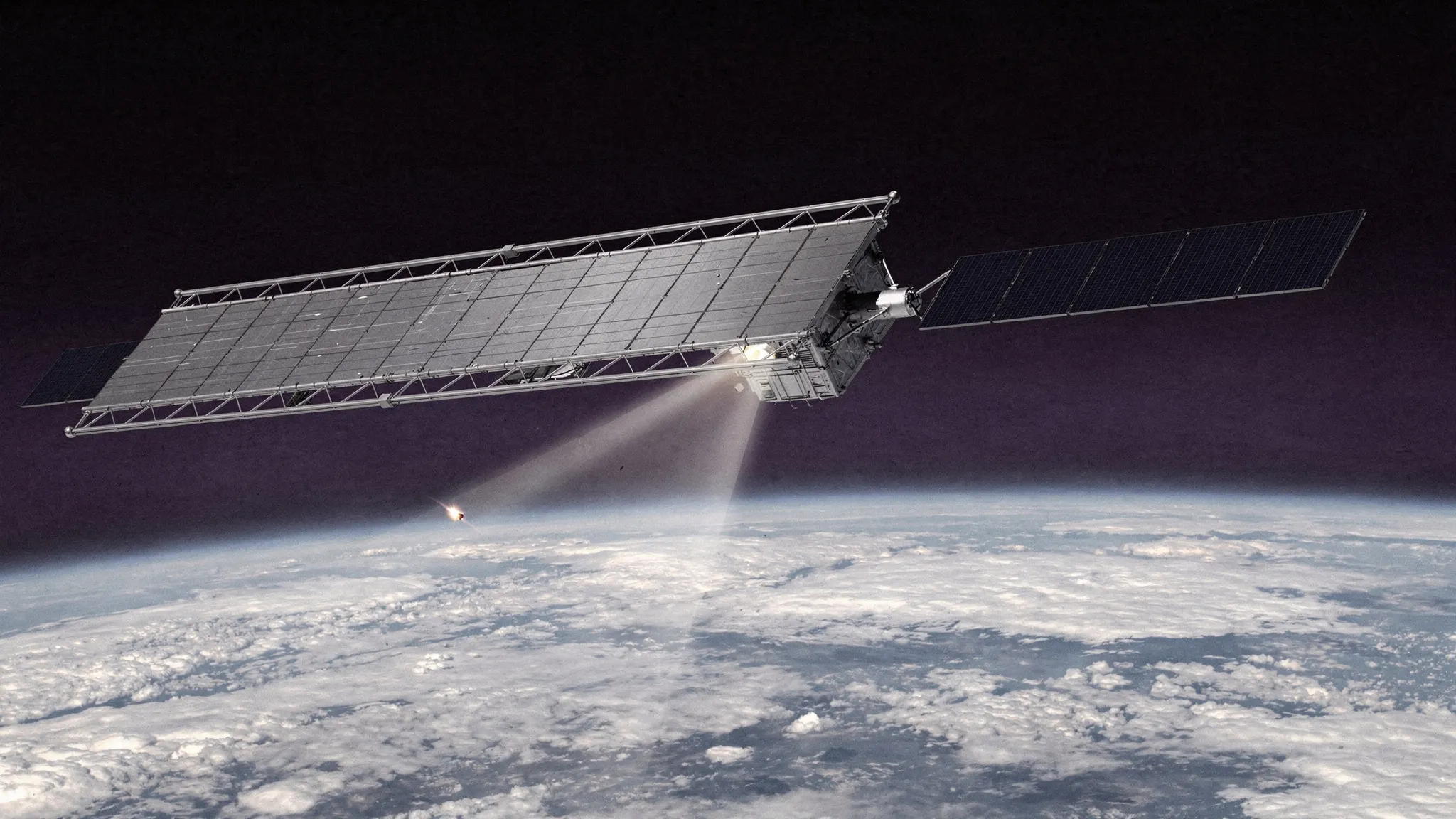
AN EARTH-WATCHING RADAR THAT ALSO SEES SPACE JUNK
On 23 August 2016, something hit the solar array of the European satellite Sentinel-1A. Its orbit and orientation jumped, and it permanently lost part of its power. The investigation pointed to a man-made fragment about 1 centimetre across. Debris between a millimetre and a centimetre is a real hazard for every spacecraft, but it is far too small to be tracked object by object. What is known about it comes from statistical surveys, such as the Haystack and Goldstone ground radars, which sample debris down to about 5 and 3 millimetres.
A radar in orbit would have a decisive advantage: proximity. The power of a radar echo falls with the fourth power of distance, so an object ten times closer returns an echo 10,000 times stronger.
A ground-imaging radar, read differently
Sentinel-1 already carries such a radar. It is a synthetic aperture radar — one that combines the echoes collected as the satellite moves along to build sharp images of the ground — working at 5.405 gigahertz, with a 12.3-metre antenna and about 4 kilowatts of peak power, built to map the Earth’s surface. Its rawest data products, openly available, keep the actual echo waveforms. Standard processing brings the motionless ground into focus. Juha Vierinen, of UiT The Arctic University of Norway, and colleagues in Norway and Sweden reprocessed the same signals assuming instead an object on its own orbit, crossing the beam.
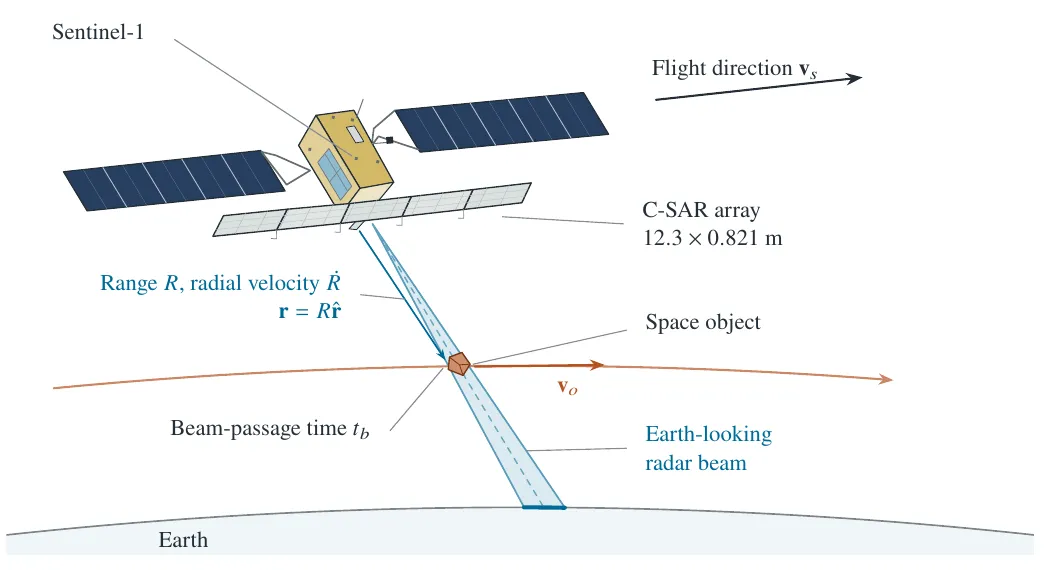
A space object crosses Sentinel-1’s Earth-looking beam, which measures its distance, its radial speed and the moment it passes. — Figure 1, Vierinen et al. (2026), arXiv:2611.12158.
The method adds up 16 successive pulses, shifting each one to follow the target’s motion, so that its faint echoes reinforce one another instead of blurring. For each trial trajectory — distance, radial speed (how fast it approaches or recedes from the radar), acceleration — the software computes the echo it should produce and compares it with the recording. Close encounters are demanding: an object crossing the line of sight at 16 km/s crosses the narrow beam in about 2.5 milliseconds at 10 km.
Seventy-six objects in 21 minutes
The team analysed about 21 minutes of raw signals from Sentinel-1C and Sentinel-1D, recorded over six days at the turn of November 2026. Guided by public orbit catalogues, they validated by hand 76 distinct objects, between 41.7 and 492.9 km away: operating satellites, rocket bodies and debris. The closest was a fragment catalogued as FENGYUN 1C DEB, at 41.7 km; STARLINK-5265, at 277.9 km, returned a strong echo.
The harder test was a blind search, without any orbit prediction. Each 16-pulse window then means about 4.6 billion trial motions. Both debris fragments tested were recovered. But the ground gets in the way: over the 2.2 seconds of the two excerpts, echoes from the Earth’s surface produced 676 false alarms, all of them in one excerpt; the other produced none.
One short passage also improved a debris orbit. For the fragment DELTA 1 DEB, the uncertainty of its predicted position half an orbit later was 500 metres. Distance and Doppler — the frequency shift caused by its motion — brought it down to 406 metres; adding the timing of its beam crossing, to 354 metres.
Down to the millimetre
How small could such radars go? Ignoring ground echoes and assuming ideal conditions, the authors computed the smallest metal sphere each instrument would detect at 10 km: 3.4 mm for Sentinel-1, and 0.56 mm for the cloud radar of the EarthCARE satellite, which works at 94 gigahertz.
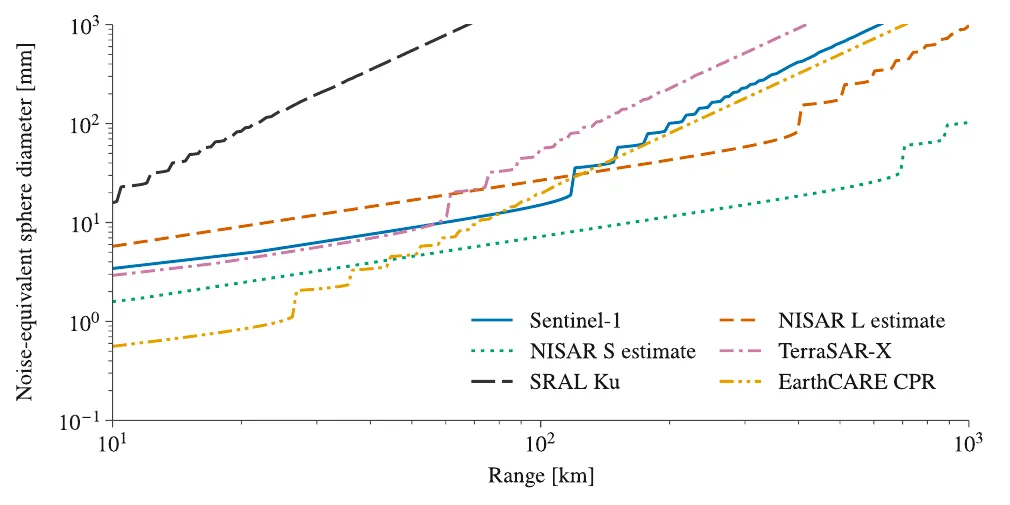
Smallest detectable conducting sphere versus distance, under ideal receiver-noise assumptions, for six radars in orbit; EarthCARE’s cloud radar (orange) is the most sensitive at short range. — Figure 7, Vierinen et al. (2026), arXiv:2611.12158.
The authors see two uses. Routine recordings could add tracking measurements for objects involved in collision warnings, without changing what the satellites observe. And radars pointed away from Earth, with receivers set for nearby targets, could run statistical surveys of millimetre debris from orbit. The detection efficiency itself remains to be measured: this sample was chosen and checked by hand.