A TINY GAP THAT BREAKS MOLECULES
Carbon dioxide and water matter a great deal, one for the greenhouse effect, the other for producing clean hydrogen, and chemists would like to break their bonds cheaply. Today this usually takes ultraviolet or visible light that excites the molecule’s electrons, sometimes with several laser pulses. Using infrared light, which shakes the atoms directly, would seem more natural, but it is very costly in energy.
The obstacle has a name: anharmonic blockade. A chemical bond is not a perfect spring. As it vibrates harder, its energy levels get closer together, so a laser tuned to the first step of the ladder falls out of tune on the higher steps. Many photons must pile up to climb to the top and break the bond.
Light trapped in a gap
Johan F. Triana, of the Catholic University of the North in Antofagasta, and Felipe Herrera, of the University of Santiago, Chile, looked at another route. Recent experiments have shown that a few molecules placed in an infrared nanocavity — here a narrow gap between two metal nanostructures — can couple strongly to the light trapped there — trading energy back and forth with it — at room temperature. Light and vibration then merge into hybrid states called vibrational polaritons.
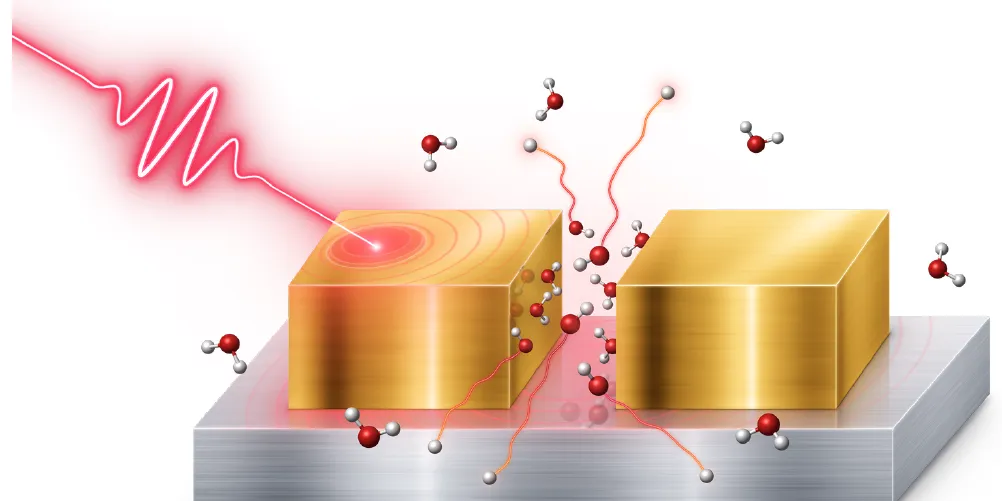
A continuous laser drives both the molecules around the metal nanostructures and the gap between them, where light is trapped; molecules inside the gap break apart more readily. — Figure 1, Triana & Herrera (2026), arXiv:2611.15450.
The team simulated one molecule in such a gap, with its bond vibration coupled to one mode of trapped light (a single frequency the gap holds), under a continuous infrared laser. They compared two ways of feeding in energy: shining the laser on the molecule, and pumping photons into the gap. For the molecule they used detailed quantum-chemistry curves of two bonds: the stretch of one C–O bond in carbon dioxide, which holds 44 vibrational levels before breaking, and the stretch of one O–H bond in water, which holds 21.
A thousand times less energy
For carbon dioxide outside any cavity, almost nothing happens below a “driving energy” of about 0.015 attojoules — the paper’s measure of how strongly the laser acts, which grows with the laser’s field rather than counting the energy delivered; above it, the chance of breaking the bond jumps to about 25% and then climbs towards certainty. Driving the molecule inside the cavity already helps. But pumping the cavity does far better: it breaks the bond with energies two orders of magnitude below the free-space ones, which corresponds to laser intensities up to five orders of magnitude lower.
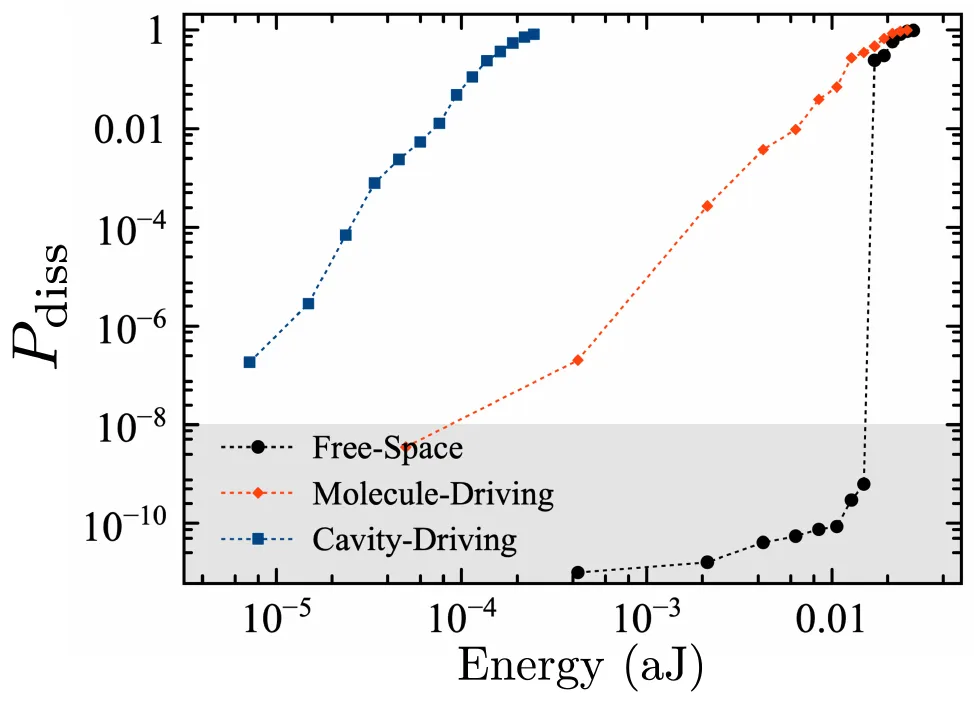
Probability of breaking the C–O bond after 2 picoseconds, against the driving energy: free space (black), laser on the molecule in the cavity (red), photons pumped into the cavity (blue). — Figure 3, Triana & Herrera (2026), arXiv:2611.15450.
Water shows the same trend. In free space, its bond breaks with a probability above 0.1% only beyond 0.03 attojoules, and never more than about 1%. Pumping the cavity starts breaking bonds from about 2 × 10⁻⁵ attojoules. Overall, the authors find that injecting photons into the cavity can lower the energy needed by up to three orders of magnitude compared with driving the molecule directly.
Why the gap helps
The trick lies in the light itself. The trapped light behaves like a perfect spring, with evenly spaced energy levels, so it suffers no blockade: the laser can pour many photons into it. Coupled to the molecule, it then acts as a helper that lets the vibration climb a dense ladder of hybrid states, much as the many vibrations of a large molecule make it easier to break.
The two molecules also differ in an instructive way. Water’s O–H bond has fewer levels and a permanent electric dipole — an uneven spread of electric charge along the bond. In the simulations, after about 400 femtoseconds, a stronger coupling — a tighter link between the trapped light and the vibration — makes its bond break less often, the opposite of carbon dioxide. The authors trace this to the ladder of hybrid states thinning out below the breaking energy.
The model is deliberately simple: one molecule, fixed in place, one bond, one light mode, and no loss of photons from the gap, whereas real infrared nanocavities keep their light for only hundreds of femtoseconds, shorter than the simulated breaking times; the authors argue that a stronger laser could compensate. They see the model as a guide for experiments with nanocavities holding just a few molecules, and as a contribution towards what they call vacuum-assisted chemical reactors.