
HOW FOUR ATOMS ARRANGE THEMSELVES
At low temperatures, atoms arrange themselves into periodic structures and regular shapes. Explaining how the forces between them produce those shapes is a fundamental problem of statistical and solid mechanics. Mathematicians strip it down to a puzzle: place N points in the plane so that the sum of their pairwise interaction energies is as low as possible.
A solved case and an open one
For one idealised force, the answer has long been known. With the Heitmann–Radin potential (the rule giving the energy of a pair of points from their distance), points behave like hard discs that only stick when they touch at exactly one unit apart. A 1980 theorem by Heitmann and Radin shows that every best arrangement is a piece of the triangular lattice. For four points, that means a diamond made of two equilateral triangles, with an angle of 60 degrees.
A widely used force for atoms is softer: the Lennard-Jones potential, strongly repulsive up close and gently attractive further away. It approaches the hard-disc case in a limit, but what its best arrangements look like has remained open. Senping Luo, of Jiangxi Normal University in Nanchang, settles it completely for four points.
A square or a diamond
The paper takes the general form of the force, V(r) = r^−p − b·r^−q, where r is the distance between two points, p and q set how fast the repulsion and the attraction fade with distance (p > q > 0) and b sets the strength of the attraction.
The result is a full classification. If b is zero or negative, there is no attraction, and no best arrangement exists: spreading the points ever farther apart lowers the energy towards zero without ever reaching it. If b is positive, the best arrangement always exists, is unique up to rotation and shifting, and is a rhombus — a diamond with four equal sides.
Which rhombus depends on a single number built from p and q:
D = 2^(−(p−q)/2) × [1 + (p − q)/(q + 2) × (1 + 2^(−(q+2)/2))]
If D is 1 or more, the rhombus is a square. If D is below 1, it is a diamond whose angle lies strictly between 60 and 90 degrees. In particular, the angle is never exactly 60 degrees: the softer force never quite produces the two equilateral triangles of the hard-disc case.
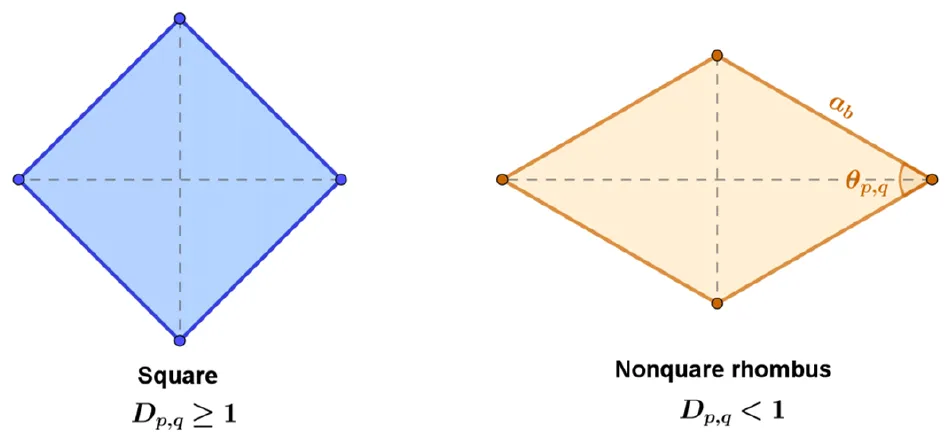
The two possible minimal shapes: a square when D ≥ 1, a non-square rhombus when D < 1. — Figure 1, Luo (2026), arXiv:2611.16990.
The boundary D = 1 cuts the plane of possible (p, q) values into two regions. It runs from p = 4, q = 0 to the point where p = q ≈ 1.68887. Squares thus only occur for soft forces that fade slowly with distance (small p and q); steeper forces give diamonds.
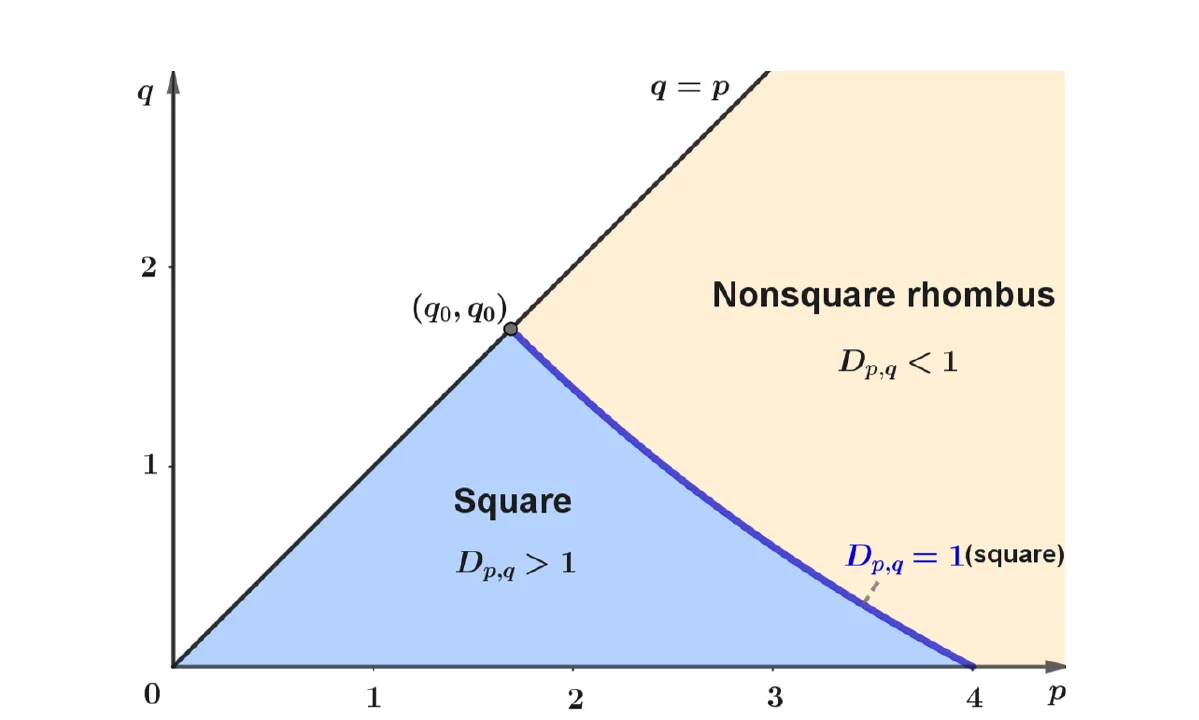
Phase diagram for p > q > 0: squares below the curve D = 1, non-square rhombi above it. — Figure 2, Luo (2026), arXiv:2611.16990.
The classic case: 115/512
The best-known version of the Lennard-Jones force uses p = 12 and q = 6. There, the formula gives D = 115/512, well below 1. Four such atoms therefore form a non-square diamond. Its angle comes from a polynomial equation printed in the paper, 397 − 1585u − 336u² + 1008u³ − 512u⁴ = 0, whose solution is u ≈ 0.2459, the square of the cosine of the angle. Converted, that gives an angle of about 60.27 degrees: very close to two equilateral triangles, yet not equal.
The proof goes through geometry. Any arrangement with one point inside the triangle of the other three loses to a well-chosen square. For the others, a classical tool on the balance of forces shows that the diagonals must cross at right angles and cut each other in half — the signature of a rhombus. What remains is to find the best rhombus.
The paper also shows how the hard-disc picture re-emerges. In the classic family of Lennard-Jones forces, where p is twice q as in (12, 6), as the force gets steeper and steeper, the best diamond tends towards the 60-degree one of Heitmann and Radin. Four points are only a toy model, the author writes; yet they already show a case where the best arrangement is neither triangular nor perfectly regular.