THORIUM HELPS A SUPERCONDUCTOR HOLD TOGETHER
A superconductor carries electric current without any resistance, but only below a critical temperature, Tc. Among the materials with the highest Tc are superhydrides: crystals packed with hydrogen, formed only under enormous pressures between the tips of two diamonds. Lanthanum decahydride, LaH₁₀, superconducts at 250 kelvin or more — but above 150 gigapascals.
One known trick lowers that pressure. Replacing part of the lanthanum with cerium keeps the same cubic, cage-like structure stable at 95 to 130 gigapascals, with a Tc of up to 180-190 kelvin. Cerium has a drawback, though: its atoms carry a magnetic moment, which breaks up the electron pairs responsible for superconductivity. Cerium decahydride reaches only 115 kelvin, against 250 for lanthanum’s.
Thorium instead of cerium
Dmitrii Semenok, of the HPSTAR high-pressure research centre in Beijing, Viktor Struzhkin, Ivan Troyan and colleagues in China, Russia and Germany tried thorium instead. Its outer electrons are of a different kind from cerium’s, and theoretical studies suggested it could raise Tc by 20 to 30 kelvin at around one megabar (100 gigapascals). In a related system, yttrium-thorium hydride, Tc had already climbed to 184 kelvin, compared with 161 for pure thorium hydrides.
Crystals made between diamonds
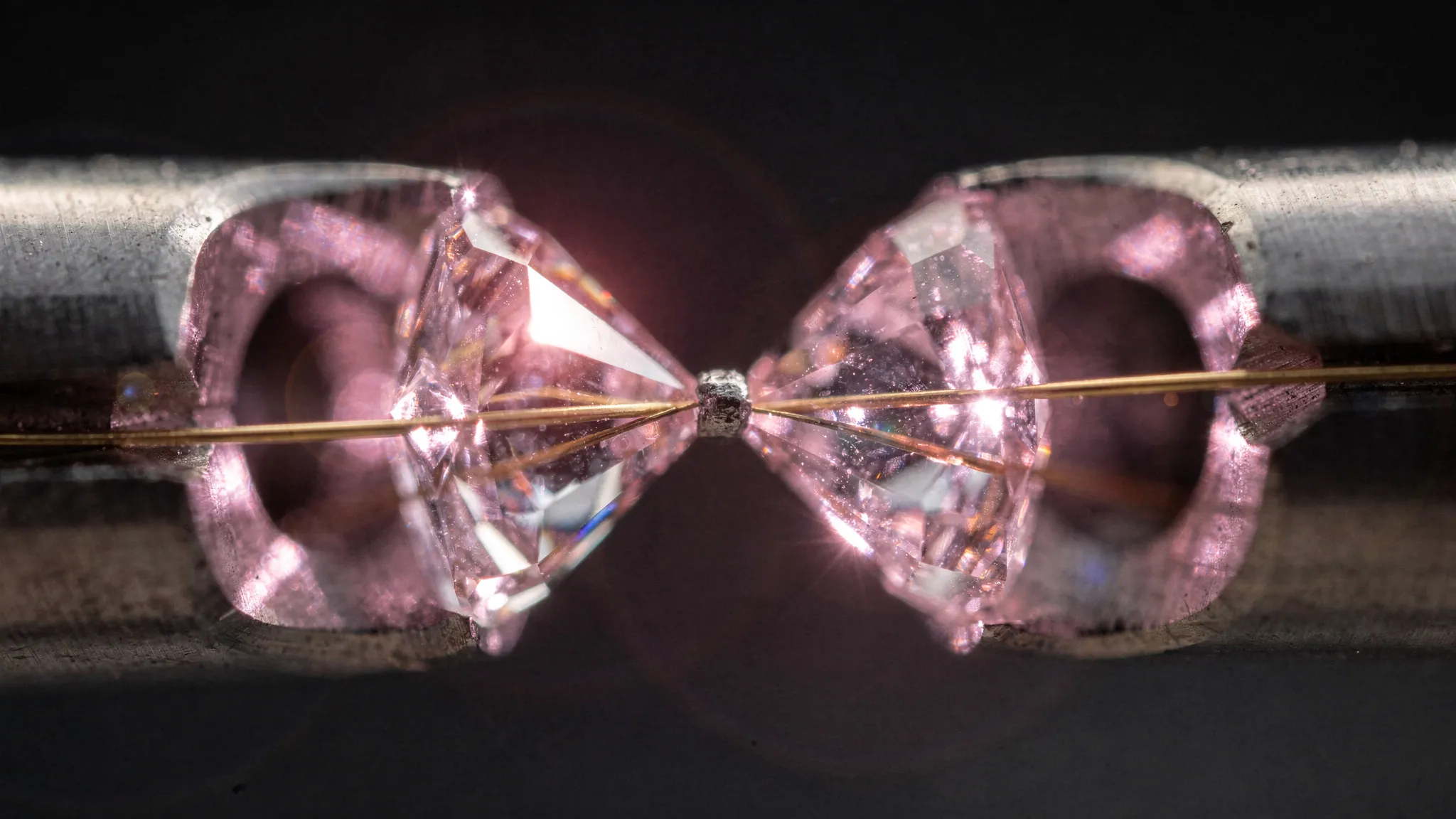
The team melted lanthanum and thorium together into three alloys, La₂Th, La₃Th and La₅Th. Tiny pieces were loaded into diamond anvil cells with ammonia borane, a solid that releases hydrogen, then compressed and heated by short laser pulses.
X-ray diffraction at the Sirius synchrotron in Brazil identified the main products: a cubic (La,Th)H₁₀ in the centre of the heated spot and a hexagonal (La,Th)H₉ at its edges, with the lanthanum and thorium atoms mixed on the same sites. On decompression, the cubic phase holds down to about 93-95 gigapascals, the hexagonal one to about 90.
Up to 232 kelvin
Made at around 100 gigapascals, the cubic hydride already has a Tc above 190 kelvin. Synthesised at 134 gigapascals, it reaches Tc = 232 kelvin; at higher pressures, Tc slowly declines again. The resistance drops to almost zero, and a magnetic field pushes the transition down by 1.65 kelvin per tesla, as expected for a superconductor.
A second, contact-free method confirms the superconductivity. Radio waves sent through the sample, via tiny metal “Lenz lenses” deposited on the diamonds, change abruptly near 203 kelvin in a sample held at about 123 gigapascals, below the pressure of the 232-kelvin record, and this signal also shifts in a magnetic field. Another signal, near 253 kelvin, hints at an even richer hydride, possibly (La,Th)H₁₆, glimpsed in the X-ray data. In the range from 100 to 140 gigapascals, thorium beats cerium by 20 to 40 kelvin.
A gap measured with a current pulse
Using a record pulsed current of 380 milliamperes, the team pushed the hexagonal hydride at 173 gigapascals out of its superconducting state at temperatures down to 10 kelvin. From how the critical current — the current that does this — varies with temperature, they derived the energy gap that binds electron pairs: 37 millielectronvolts. Twice this gap equals 4.9 times the thermal energy at Tc. In the formula the authors use, this ratio starts from 3.53 and grows as Tc gets closer to the crystal’s vibration frequencies (which the authors also express in kelvin); it predicts 36 to 41 millielectronvolts here, in acceptable agreement.
Easier to handle
Thin films of the La₂Th alloy stay stable in air for hours, unlike lanthanum or cerium, so they can be prepared outside a glove box. At lower pressures, the team also made hydrides with less hydrogen, which superconduct at about 83 kelvin at 81 gigapascals — above the cerium version, 68 kelvin at 67 gigapascals. Below about 70 gigapascals, diamond anvils survive decompression and can be reused, which makes experiments much cheaper.
A ceiling set by pressure
The authors close with a sobering rule. Across all superhydrides measured so far, the best Tc in kelvin never exceeds about twice the pressure in gigapascals. The authors’ explanation: Tc follows the vibration frequencies of the crystal, which depend on how tightly its atoms are squeezed. It follows, they argue, that superhydrides cannot keep a Tc well above 140 kelvin below 70 gigapascals — so at the pressures where diamond anvils can be reused, they will remain behind two other families of superconductors, the cuprates (copper oxides) and the nickelates.