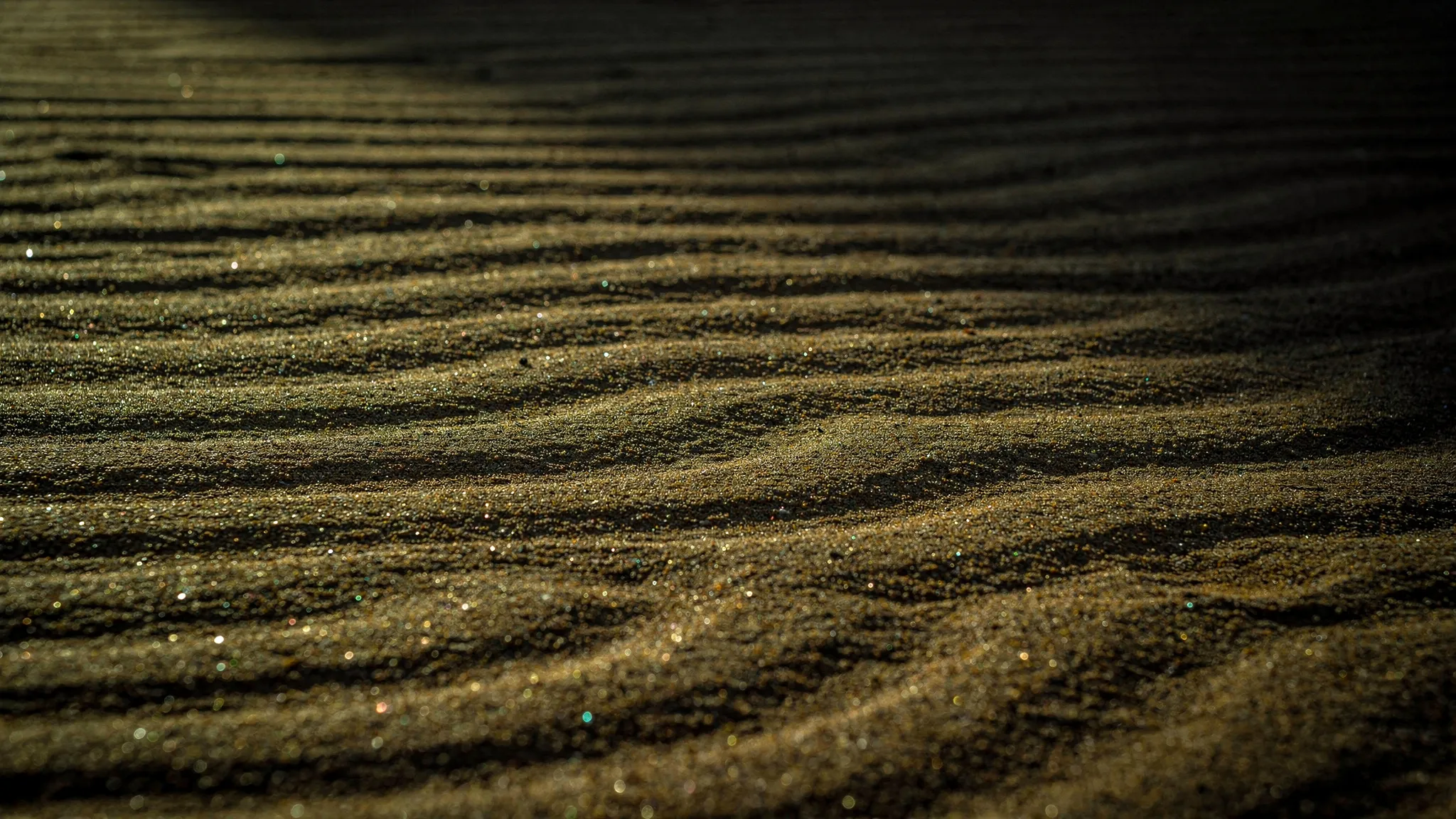
ON VENUS, SAND RIPPLES WOULD CRAWL INTO THE WIND
Wind-blown sand arranges itself into ripples in deserts on Earth and on Mars. Their spacing ranges from centimetres to decimetres, and even metres on Mars. These differences are usually put down to the density of the atmosphere, the size of the grains and the strength of the wind — but how exactly they depend on each remains unclear, and observations often seem to contradict one another.
Two kinds of ripples
Recent wind-tunnel experiments with fine grains, about 100 micrometres across, revealed that two ripple sizes can coexist. Small ripples, about a centimetre apart, are thought to be impact ripples: they form because grains carried by the wind hit the sand bed and kick other grains out. Larger ripples, about ten centimetres apart or more, look like the ripples that form under water and are thought to be shaped by the airflow itself, the hydrodynamic ripples. On Mars, small ripples also sit on top of much larger bedforms, a metre or more apart.
On Earth, the two kinds can overlap in size, which makes field observations hard to interpret.
A model that only makes the small ones
Conner W. Lester and A. B. Murray, of Duke University, and O. Duran, of Texas A&M University, used a computer model that follows every grain and its collisions, coupled to a simplified wind. That model cannot produce hydrodynamic ripples, which makes it ideal for studying impact ripples on their own.
They varied the ratio between the density of the grains and that of the surrounding fluid over a huge range: about 100,000 for Mars-like air, 2,000 for Earth, 200 for Titan, 50 for Venus, down to 2.65 for water. Grain sizes went from about 20 micrometres to 2 millimetres. In every case, starting from a flat bed, ripples formed — even in water-like conditions.
200 grains, from Mars to Venus
When the wind is just strong enough to keep sand moving, the simulated ripples are about 200 grain diameters apart, even as the density ratio changes by a factor of 100,000. For fine sand, that means a ripple spacing of a few centimetres on any of these worlds. The length that sets it is the small gap between where a grain lands and where the grains it splashes up take off, comparable to the size of a grain. This matches the smaller ripples seen in experiments with two coexisting ripple sizes, while the larger ones follow the scaling expected for hydrodynamic ripples.
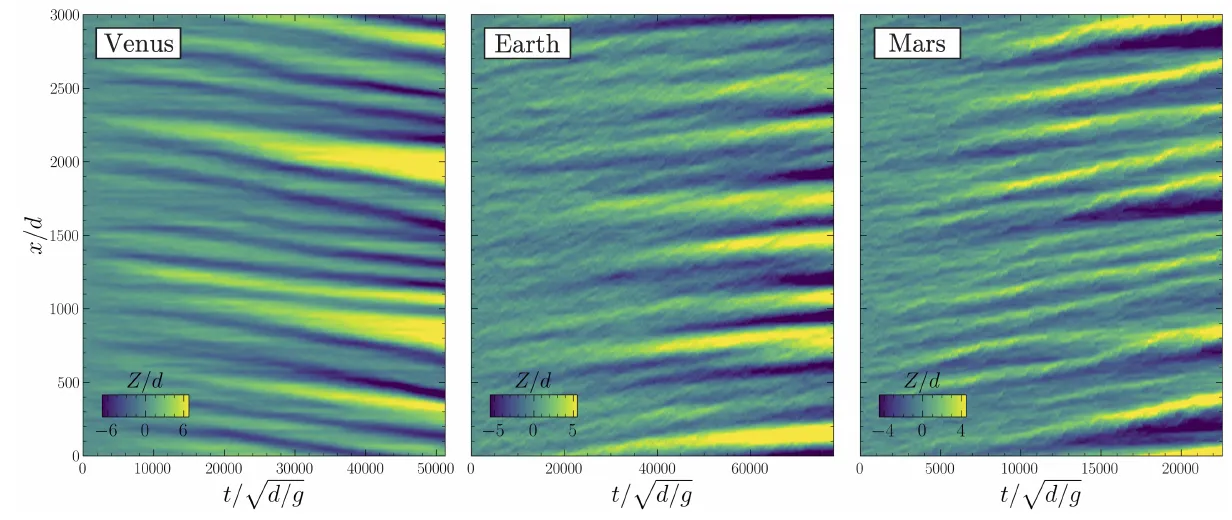
Simulated ripples over time for grains about 100 micrometres across, under Venus-like, Earth and Mars-like conditions; each slanted stripe is a ripple crest moving, and on Venus the crests drift the other way, against the wind. — Figure 2, Lester et al. (2026), arXiv:2611.21575.
With stronger winds, grains collide in mid-air more and more, and the rule changes: the spacing then follows the average length of the grains’ hops, and grows with the wind.
Ripples that walk upwind
The speed of the ripples varies far more than their size. It depends strongly on the density of the atmosphere, the grain size and the wind. Ripples move downwind in Mars-like and Earth conditions, almost stand still for Titan-like conditions — and move upwind for Venus-like conditions. The authors call them antiripples.
The switch happens when the grains’ average hop becomes shorter than about 67 grain diameters. Dense air, as on Venus, shortens the hops; so do large grains.
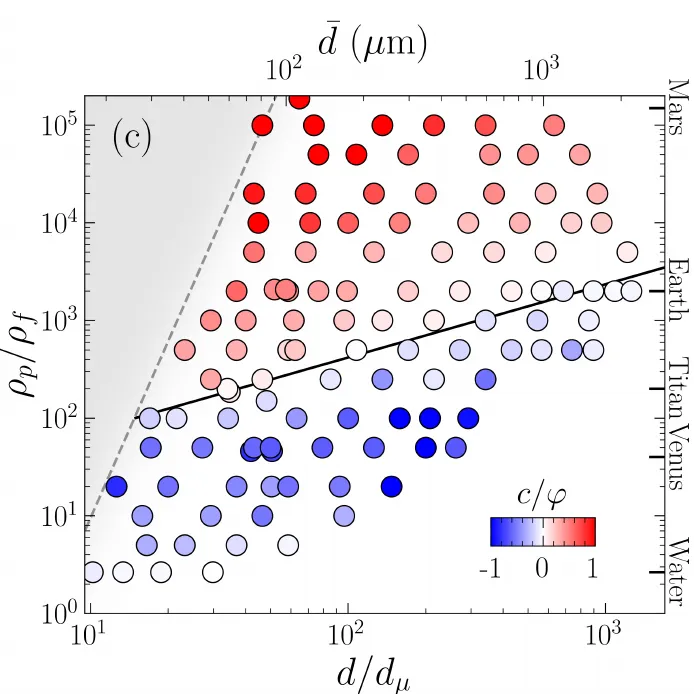
Where ripples move downwind (red) or upwind as antiripples (blue), depending on the grain-to-fluid density ratio (with Mars, Earth, Titan and Venus marked on the right) and on grain size; the black line marks the switch. — Figure 7c, Lester et al. (2026), arXiv:2611.21575.
Where to look for the first antiripples
Antiripples have never been observed in nature or in the laboratory. But the simulations say where to look, even without going to Venus. On Earth, with ordinary sand, they should appear for grains larger than about 1 millimetre. With lighter grains — half the density ratio, like the crushed nut shells already used in one wind-tunnel study — the switch should come at about 0.5 millimetre.
The authors present their work as a framework to sort out which kind of ripple an observation shows, and a list of predictions to test: that impact ripples simply scale with grain size near the threshold, and that somewhere, sand ripples can crawl into the wind.