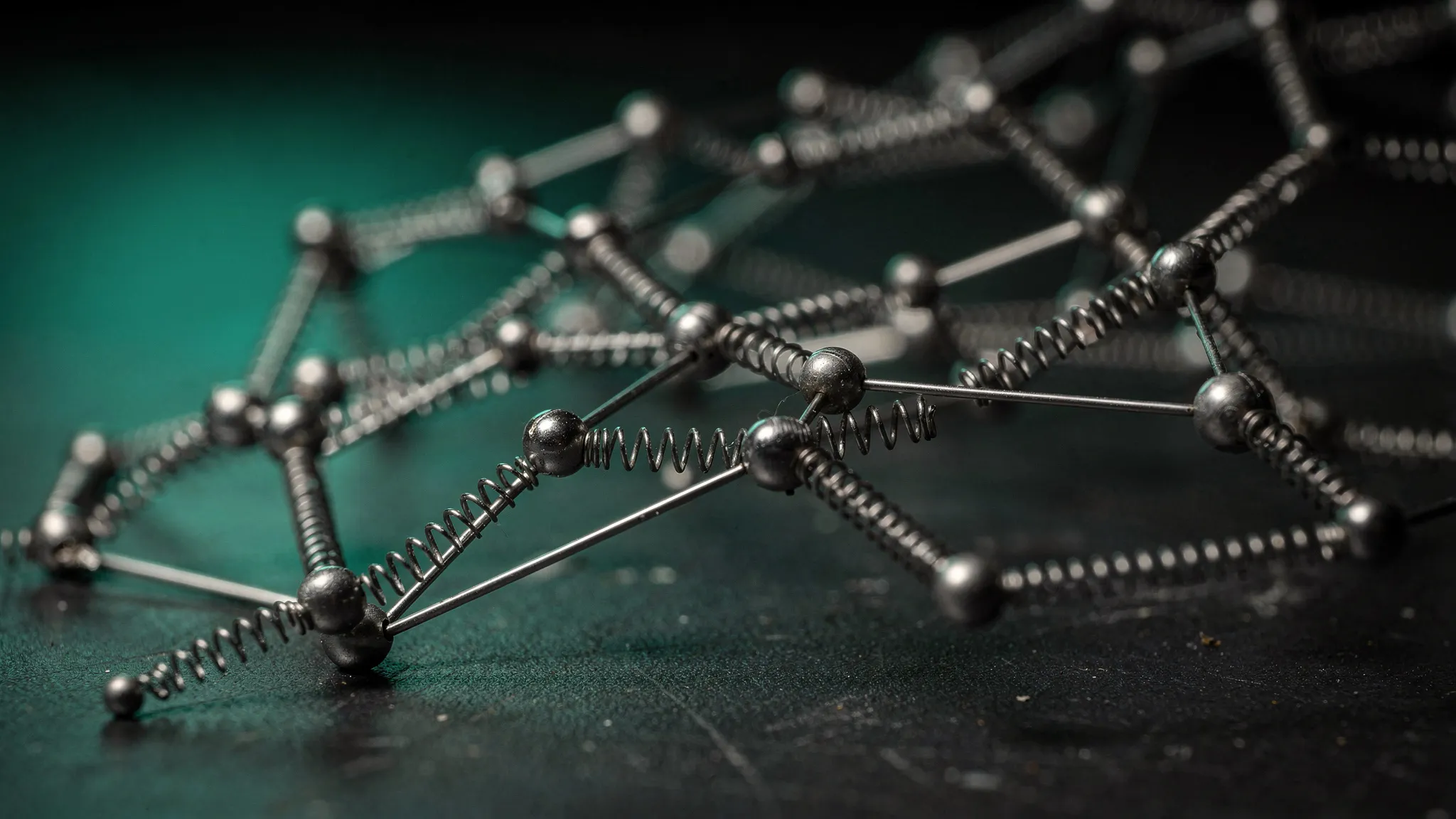
WHY WOULD A NETWORK OF SPRINGS NEED TO SLEEP?
What is sleep? It is identified as a reversible state of rest in which an animal responds less to its surroundings — and needs more of it after being deprived. Defined that way, sleep turns up across the animal kingdom: in mammals and birds, fish and worms, and even in animals with no centralized nervous system, such as jellyfish and hydra. That breadth raises a question asked by Nada Elmeligy, Nidhi Pashine and J. M. Schwarz at Syracuse University: could the need for sleep come from learning itself, whatever the system that learns?
Artificial intelligence has a partial answer: since the “wake–sleep” algorithm, sleep-like phases have helped neural networks learn new things without forgetting old ones. But those networks follow mathematically prescribed learning rules. The team wanted something simpler and purely physical — a material that learns through its own mechanics.
Springs that learn
Their learner is a disordered network of springs: 128 nodes joined by 354 to 366 springs. The task it must learn is a mechanical one. When a pair of forces pulls on one spring (the input), another spring further away (the output) must respond with a precise tension. Learning happens locally: each spring adjusts its own stiffness from tensions it feels, with no central processor.
The team trained 50 such networks on a stream of 23 visits: nine new tasks, mixed with 14 repeats of earlier ones. As the stream went on, a smaller and smaller fraction of networks managed to learn the new tasks. The tasks themselves were not to blame: trained first, from the starting state, the same tasks were learned more often.
Learning uses up the capacity to learn
The explanation lies in a quantity the authors call dominance. Pull on the two ends of a spring and the load spreads out: part stays in that spring, the rest goes through the network around it. A spring’s dominance is the share it keeps, between 0 and 1. A spring that carries all the load can no longer pass changes on to the rest of the network; a spring that carries nothing has nothing to pass on. Its usefulness for learning, which the authors call its plasticity, is the product f(1 − f): zero at both extremes, largest at one half.
Before training, the springs’ dominances sit close to the average. Training polarizes them: some springs end up carrying almost all of the load across their ends, others almost none. And here the team proves an exact law. Add up the plasticity of all springs to get the network’s learning capacity C; measure how far dominances stray from the average to get the polarization P. Then C + P is a constant, set by the network’s structure alone. Every bit of polarization gained is learning capacity lost. The authors call P the network’s “sleep pressure”. In the simulations, tasks that arrived when C was high were learned far more often.
Listening to the noise
Can the damage be undone? In principle, yes: weaken springs that are too dominant, strengthen those that are too weak. The difficulty is that a spring’s dominance depends on the whole network. The team found a local shortcut: shake the network with small random forces from inside, and each spring’s average stored energy reveals its dominance. Every spring then only needs its own stiffness and stretch.
Inserted between task visits, this repair kept the networks learning across the stream. It beat a blind relaxation towards rest stiffness in 49 of the 50 networks. It also echoed several features of animal sleep. Repair hurt when nothing new was being learned, and helped most when about 40% of visits brought a new task. Skipping the last three repair sessions let “sleep pressure” build up, and catching up took an extra dose — though only 75.3% of what had been skipped, and 52.2% after six missed sessions.
Why repair has to wait
Why not repair while learning? Because a task under way adds strain to the springs carrying it. Their energy readings go up — in all 50 networks — so repair mistakes busy springs for overly dominant ones and softens the very pathways in use. Repair done during the task gave much poorer results than repair done offline.
Since the bias only ever pushes readings upwards, a spring that still reads as weak during a task really is weak. So the team tried a split: strengthen during “wake”, weaken only during “sleep”. It worked almost as well as fully offline repair. The reverse split hurt performance in every network. The authors note a parallel in rats’ visual cortex, where activity is adjusted upwards during wakefulness and downwards during sleep — a possible physical explanation that they present as a hypothesis to test.
A switch still flipped from outside
The networks do not decide to sleep on their own: an external supervisor schedules learning and repair, and sets the recovery target. And because the repair knows nothing of past tasks, it erodes memories, unlike biological sleep, which also reactivates the day’s experiences. The authors’ next questions are when a learner would switch to an offline phase by itself — and whether a physical form of dreaming could protect what it has just learned.