A NEW RULE FOR HOW DENSE A FUSION PLASMA CAN GET
In a fusion reactor, density is power: the fusion output grows with the square of the plasma density. But in a tokamak, a machine that holds hot plasma in a magnetic field, density cannot rise indefinitely. Beyond a certain point, the temperature at the edge of the plasma collapses, and the discharge either loses much of its energy confinement or turns unstable. What sets this “density limit” is still debated.
In practice, operators rely on the Greenwald limit, a simple empirical formula: the maximum density is proportional to the plasma current divided by the square of the machine’s minor radius. It was always meant as a rough boundary, not a precise predictor, and real limits can differ from it by 50% or more. For future machines such as ITER and ARC, that uncertainty matters.
Five machines, one database
A. D. Maris and colleagues at MIT’s Plasma Science and Fusion Center, Columbia University and the Swiss Plasma Center at EPFL, together with the teams running each machine, assembled a new database from five tokamaks: Alcator C-Mod, ASDEX Upgrade, DIII-D, JET and TCV. The machines differ widely — in size, magnetic field (1.4 to 7.6 tesla), heating method, plasma shape and wall material (carbon, molybdenum, tungsten, beryllium).
The database holds 325 density limits in the two main confinement regimes, called L-mode (243) and H-mode (82), and 4,359 stable discharges. For each limit, the team isolated the warning phase just before the collapse.
Searching for the best dividing line
The team then let an interpretable machine-learning method — a linear classifier — search for the simple power law that best separates warning phases from stable operation. Candidate ingredients were dimensionless quantities that describe turbulence at the plasma edge. The score used is the AUC, which equals 1 for a perfect separation.
As a benchmark, the Greenwald fraction (density divided by the Greenwald limit) scores 0.918. The algorithm’s first pick was the edge collisionality — a measure of how often particles collide at the edge — which on its own already matches Greenwald. Nearly all warning points sit in the collisional regime. Adding the edge pressure, normalized by the magnetic pressure, lifts the score to 0.956; adding the safety factor, which describes how the magnetic field lines twist, gives 0.962. Further ingredients, including radiation, brought nothing. L-mode and H-mode limits fall on a single continuous band.
A threshold that theory had predicted
Recent theory had proposed that turbulent energy losses should surge when the product of these three quantities, written ν*βq*, exceeds a certain level. The team tested that simple product directly: it scores 0.965, as good as the best machine-learning combinations.
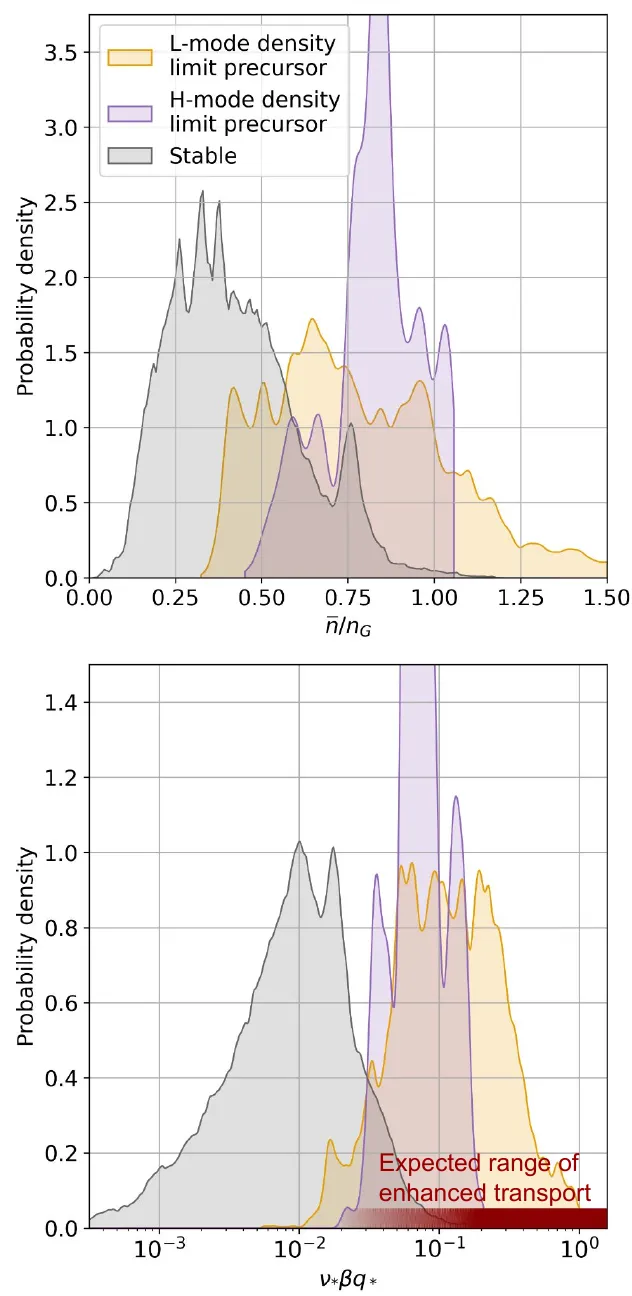
Stable discharges (grey) and warning phases before L-mode (orange) and H-mode (purple) density limits, sorted by the Greenwald fraction (top) and by the combined quantity ν*βq* (bottom). The red band marks the range where theory expects enhanced transport. — Figure 5, Maris et al. (2026), arXiv:2611.21899.
The gain shows up in false alarms. Tuned to catch 95% of real limits — the requirement set for ITER — the new gauge raises a false alarm in 16.6% of stable cases, against 27.0% for the Greenwald fraction. Tuned to catch 90%, it is 8.6% against 22.2%. Rewritten in terms of density, the threshold grows with the temperature of the plasma edge, and hence usually with heating power — which may explain why past studies reported so many different dependences on power.
Room for future reactors
This is where the result turns practical. ITER’s planned operating point sits at 85% of the Greenwald limit, well within the range where limits occur in today’s machines. But its edge is expected to be hot — around 6 kiloelectronvolts — which puts its value of ν*βq* far below where density limits occur in the database. The same holds for the reactor designs ARC, MANTA and EU-DEMO, all with high Greenwald fractions but very low values of the new quantity. The authors read this as a “substantial margin of stability”, while warning that extrapolation to reactor conditions “must be treated with caution”.
Still some misfires
The gauge is not perfect: some stable and unstable cases remain mixed up, especially in H-mode, where other mechanisms may play a role. Edge conditions are averaged over a band of the plasma rather than measured exactly at its boundary, and the plasma is assumed to be pure deuterium. Yet that averaging is also what makes the method easy to apply in real time. If the picture holds, the density limit is less a critical density than a threshold in the collisions and pressure at the plasma’s edge.