THE STAR THAT OUTLIVED THE SUPERNOVA OF 1181
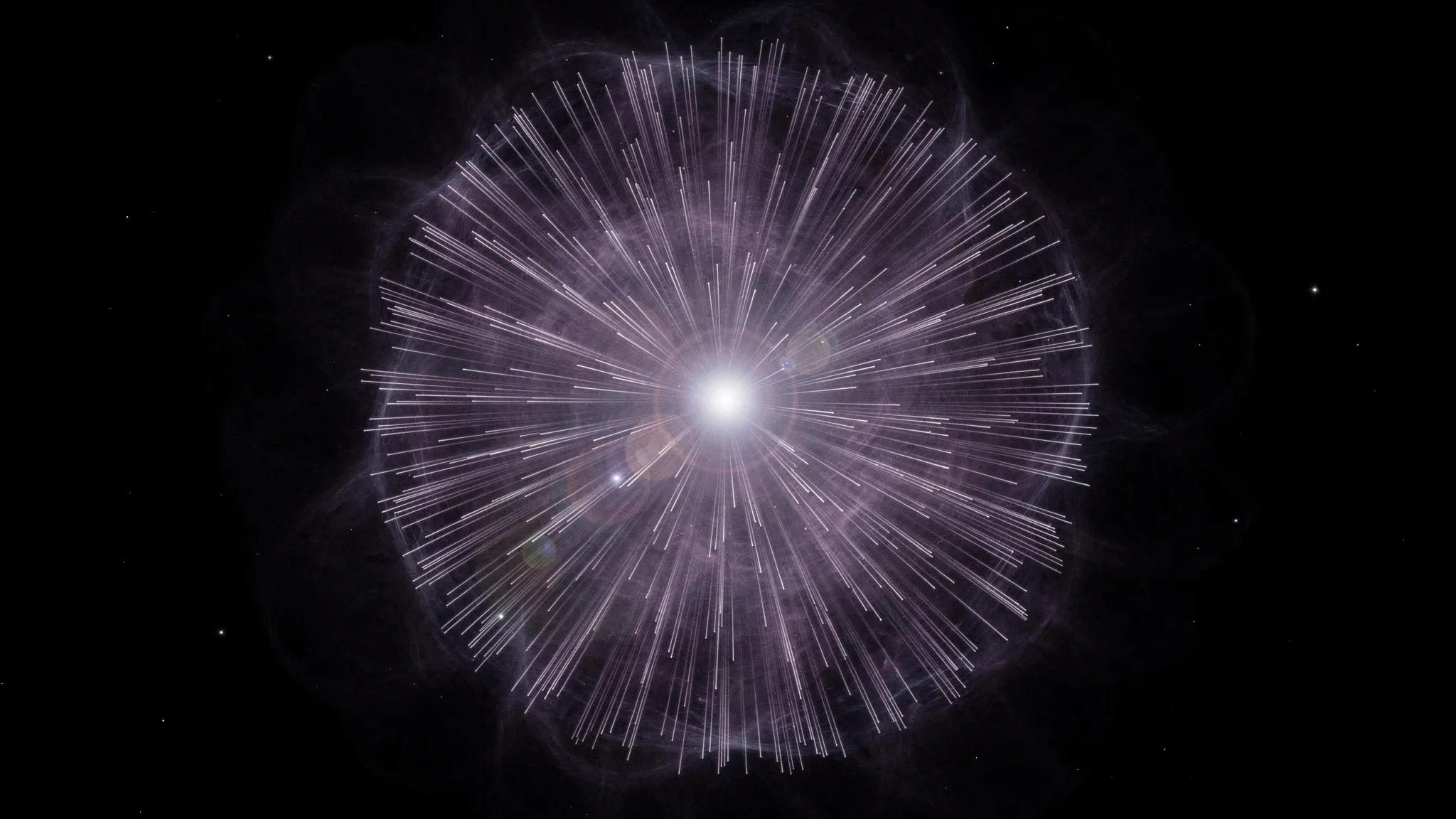
In August 1181, a “guest star” appeared in the sky and was widely observed in China, Japan and Egypt. Astronomers now link it to Pa30, a strange nebula: a “firework” of narrow, straight filaments with a radius of about 90 arcseconds on the sky (a measure of apparent size), rich in sulphur and argon, nearly free of hydrogen and helium. At its centre sits a tiny star at about 211,000 K, blowing a wind of some 16,000 km/s, according to earlier studies.
A supernova that did not finish
Pa30 is thought to be the remnant of a Type Iax supernova, a weaker cousin of the Type Ia explosions that destroy white dwarfs. In a Type Iax, the thermonuclear flame fails: the explosion “stutters”, does not fully unbind the white dwarf, and leaves behind a surviving, extremely hot star. Such events are fainter than normal Type Ia supernovae and expand more slowly.
Until now, nobody had published an infrared spectrum of Pa30’s central star: its infrared light spread out by wavelength, in which each chemical element leaves its own lines.
Four telescopes, one hot star
D. P. K. Banerjee, at the Physical Research Laboratory in Ahmedabad, A. Evans, at Keele University, and colleagues in India, the United Kingdom, the United States and Italy combined:
- a spectrum from 0.75 to 5 micrometres taken in 102 colour bands by the NASA space telescope SPHEREx, between July 2025 and February 2026;
- sharper spectra from 0.7 to 2.5 micrometres from three ground telescopes: Gemini North on Maunakea, the Italian Telescopio Nazionale Galileo in La Palma, and India’s Devasthal Optical Telescope.
All four agree. The spectral lines are extremely broad. Gas moving towards us and away from us shifts its light in opposite directions, so a line’s width is given as a speed: here about 30,000 km/s from edge to edge, a sign of very fast-moving gas. The SPHEREx images showed no glow from the filaments or from dust: the light comes from the central star.
Oxygen, and a hotter outer layer
To decode the lines, the team used two computer models.
- A model of the star’s wind, with an atmosphere of carbon, oxygen and neon and no hydrogen, a wind of 15,000 km/s and a luminosity of 36,000 Suns, matches most features. Most lines come from oxygen stripped of five electrons (O VI).
- A second model, of gas heated to about one million kelvin by shocks, with the element mix expected for the leftover of a Type Iax explosion, adds lines of silicon, sulphur, magnesium and aluminium that coincide with several features of the SPHEREx spectrum.
The authors read the spectrum as two layers: an oxygen-rich wind close to the star, and further out, hot, shock-heated gas glowing in so-called “coronal” lines, typical of gas at about a million kelvin. Such intermediate-mass elements, brought to the surface by the explosion, are expected in Type Iax supernovae, and the star already shines in X-rays from similar elements. The authors conclude that the spectrum strengthens the case that Pa30 is a Type Iax remnant.
What comes next
The modelling is exploratory, the authors stress: the lines overlap, many wavelengths are poorly known, and a larger set of models is needed. The next step they call for is a spectrum from the James Webb Space Telescope in the mid-infrared, where many lines of sulphur, silicon, magnesium and aluminium lie. It could separate the oxygen wind from the hot shocked gas, and tell more about the star that came through the explosion of 1181.