هنوز ترجمه نشده است: متن اصلی به انگلیسی.
GEL GRAINS THAT CRAWL THROUGH SOLID ICE
Hydrogels are networks of polymer chains soaked with water. They can swell and shrink dramatically, and they are everywhere: superabsorbents that soak up spills, drug-loaded gels that release their medicine at a controlled rate, soft robots, tissue engineering, food, cosmetics — even the cartilage in our joints behaves like one.
All of this depends on one thing: how water moves through the gel. Three properties describe it — the permeability, the stiffness when the gel is squeezed, and the poroelastic diffusivity, which sets how fast swelling spreads. They are notoriously hard to measure, because water crawls through gels extremely slowly. The authors give an example: push water through a 1 mm gel membrane with a pressure difference of 1 kilopascal, and it flows at about one nanometre per second. Measuring stiffness takes about three hours per data point on a 1 mm sample.
Grains that move through ice
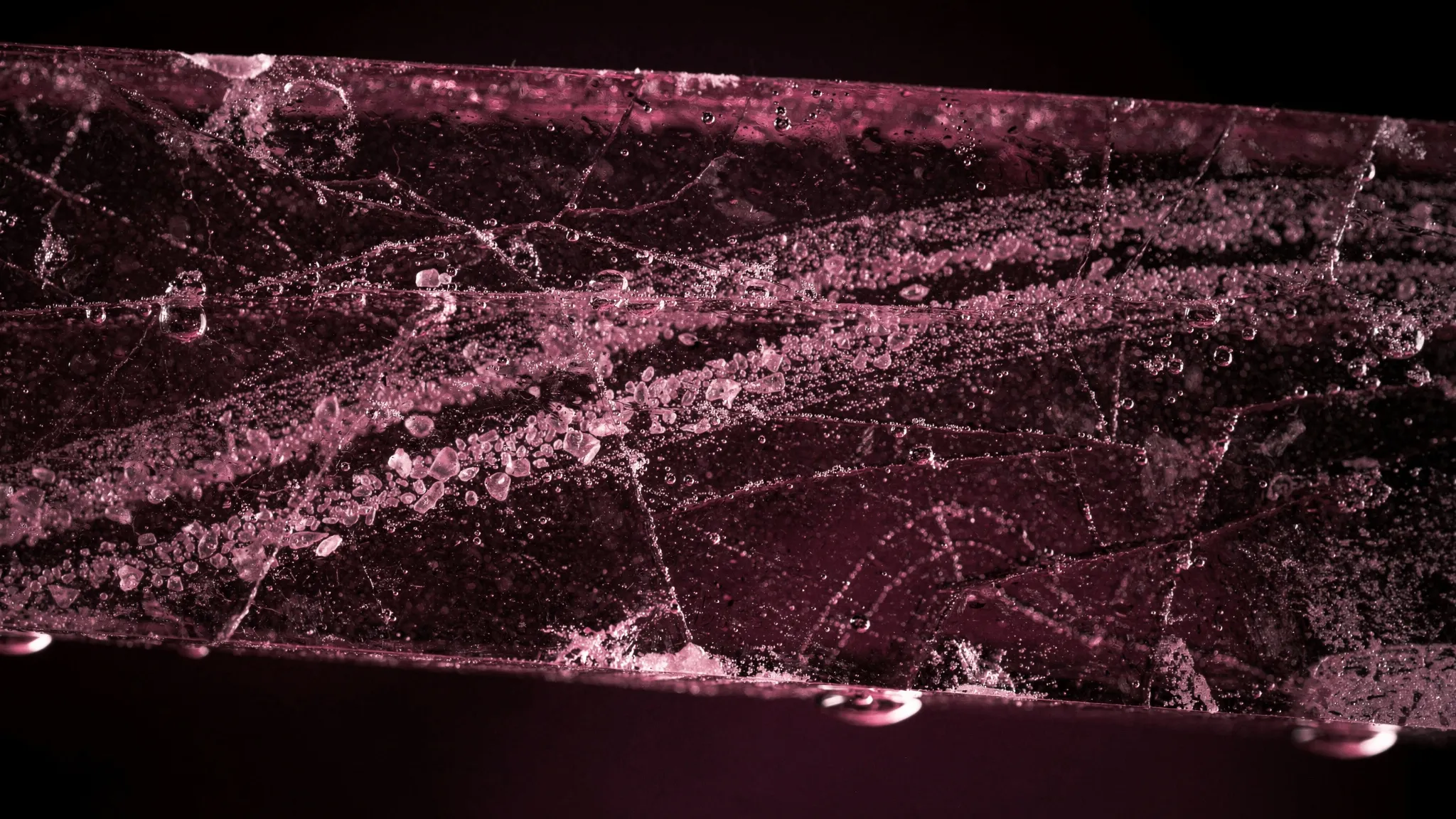
The team of Robert Style at ETH Zurich made gel particles with a radius of 8 to 14 micrometres — far smaller than a grain of fine sand — from a common polymer, PEGDA. They froze them in a thin cell between two copper blocks and watched them under a microscope.
First surprise: in ice, the grains shrink. Ice surrounds each grain but cannot enter its tiny pores. Instead, it pulls water out of the gel, just as dry air would. This is called cryosuction, and it is strong: the suction grows by about 1 megapascal for every degree below zero. Between 0 and −2 °C, the grains lose about 20 % of their radius — half their volume.
Second surprise: when one side of the cell is warmer than the other, the grains start moving through the solid ice, towards the warm side, at about 0.1 micrometre per second, swelling as they go.
The mechanism: suction is stronger on the cold side of a grain. Ice melts on the warm side, the water flows through the gel and refreezes on the cold side. That new ice pushes the grain forward. The control experiment is clear: particles that water cannot pass through do not move at all.
A measuring tool
Because the speed is set by how easily water flows through the gel, measuring the speed gives the permeability directly. And because the grains shrink as they get colder, one single grain can be measured at many different water contents.
- Speed is proportional to the temperature gradient and independent of grain size, as the theory predicts.
- Permeability drops by almost a factor of 100 as the polymer fraction rises from 20 % to 45 %.
- Stiffness rises from about 1 to about 30 megapascals over the same range.
- Diffusivity stays almost constant, at about 1.5 × 10⁻¹⁰ m²/s.
- The values agree with the few existing measurements on similar gels.
The textbook is wrong
The high resolution let the team test the classic formulas, which assume an ideal, uniform polymer network. They do not work: the measured trends are far steeper than predicted. The likely reason is that real gels are uneven, with large and small pores. When the gel dries, the large pores collapse first, making it much less permeable and much stiffer than an ideal network would be.
A tool for real gels
The method needs only picolitre volumes instead of microlitres, measures a single sample at many water contents, and yields thousands of data points per experiment instead of one. The authors plan to extend it to pieces of bulk gels — including biological materials — to polymer solutions and to porous solids, and call for new theories of how water moves through real gels.