এখনও অনুবাদ হয়নি: মূল ইংরেজি সংস্করণ।
A STAR TORN APART AT COSMIC DAWN
When a star wanders too close to a massive black hole, tidal forces tear it apart. Part of its gas falls back onto the black hole and shines for months or years: a tidal disruption event. These flares reveal black holes that would otherwise stay hidden, and the surroundings they live in.
In the very early universe, catching one is hard. Time itself works against astronomers: at redshift 7.19, events unfold 8.19 times more slowly as seen from Earth, so a two-year flare takes well over a decade to watch. Until now, spectroscopically confirmed tidal disruptions stopped around redshift 1.2. A search through 531 known quasars beyond redshift 5.3 had found only small flickers, below about 0.2 magnitude.
A quasar that went dim
Seiji Fujimoto of the University of Toronto and 43 colleagues across Europe, North America, Asia and Australia found theirs by chance. Comparing new James Webb Space Telescope images of the GOODS-North field with archival Hubble images, they noticed that GNz7q had become about one magnitude fainter.
GNz7q is a strange quasar at redshift 7.19 — about 700 million years after the Big Bang, according to the paper. Its black hole weighs roughly 30 million suns and swallows matter faster than the usual “Eddington” limit. It sits in a compact, dusty galaxy that forms some 330 solar masses of stars per year.
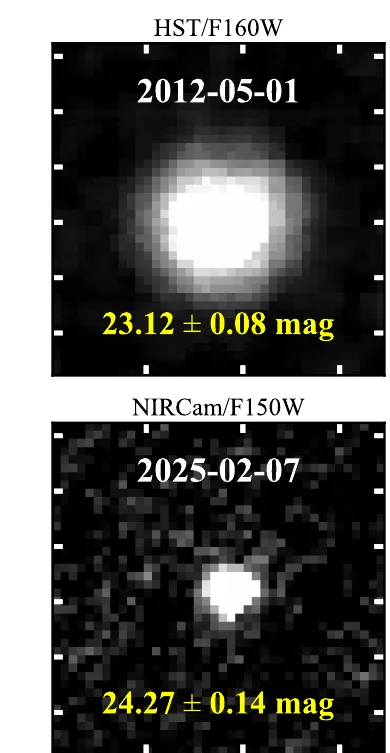
GNz7q seen by Hubble in 2012 (top, magnitude 23.12) and by Webb in 2025 (bottom, magnitude 24.27). — Figure 1, Fujimoto et al. (2026), arXiv:2609.30441.
Twenty years of archives
The team gathered every image they could find: Subaru (2006), Spitzer (2004–2016), Hubble (2012–2013), and Webb (2023 to 2026), plus two Webb spectra a year apart. Four nearby sources measured the same way showed no comparable change, ruling out a calibration artefact.
From about 2012 to 2025, all bands from 1 to 5 microns fade together, more strongly at shorter wavelengths. In the quasar’s own time, the light rose fast, then dropped by about 1.1 magnitudes in the ultraviolet over roughly two years — a factor of about three. Only about 0.1% of quasars vary this much.
Not a supernova, not a flicker
A model with a fast rise and a decline following t^−5/3 — the classic prediction for gas falling back after a tidal disruption — fits all the light curves. It gives a peak temperature of about 14,000 K, a peak power of about 3 × 10⁴⁵ erg per second, and a total of about 1.5 × 10⁵³ erg radiated.
The alternatives fail. Even a slowly fading superluminous supernova declines too fast and falls short in energy by a factor of ten. Random quasar flickering reproduces this smooth, coordinated fade in fewer than one in 100,000 simulations.
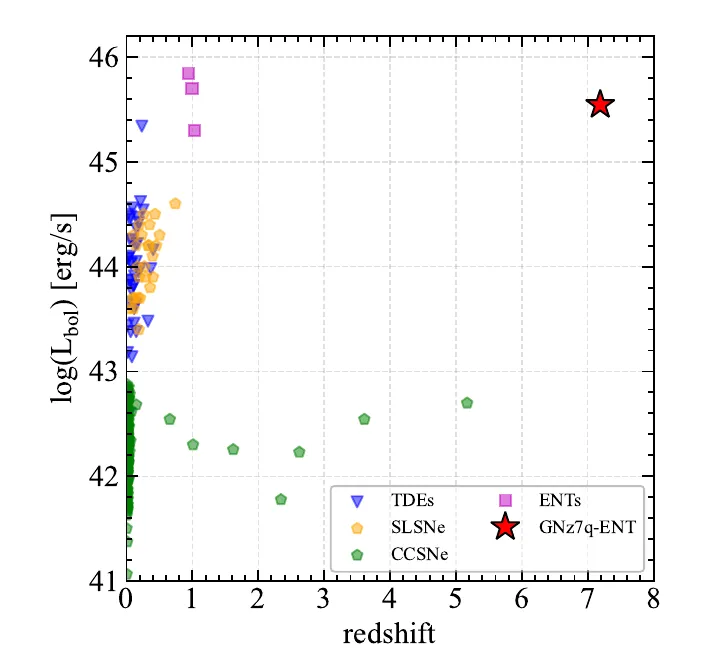
Peak luminosity of known transients — tidal disruptions, superluminous and ordinary supernovae, extreme nuclear transients — versus redshift. GNz7q’s flare (red star) is far more distant and among the brightest. — Figure 4, Fujimoto et al. (2026), arXiv:2609.30441.
The victim and the echo
From the energy released, the shredded star had a few solar masses at least. Black-hole size points the same way: to be torn apart outside the event horizon, the star needed around 3 solar masses or more — a short-lived B-type star, natural in a galaxy forming stars this fast.
Webb’s mid-infrared camera adds a second clue: dust at about 1,500 K, the temperature at which grains evaporate, glowing roughly half a parsec from the black hole. It looks like an echo: dust heated by the flash, shining after it. A very broad hydrogen line, shifted by about 2,500 km/s, also matches gas stirred up by the event.
What the next surveys may reveal
The authors suggest the conditions were ideal: a relatively light black hole in a nucleus packed with young stars. Wide surveys by the Roman and Euclid telescopes, and by LSST closer to home, could find many more. Confirmation still requires a longer watch — and the dust model rests on three infrared points from a single epoch. If the flare was not a tidal disruption, the paper notes, the alternatives would be just as extraordinary: a supernova beyond any known class, or a young quasar changing its ultraviolet brightness threefold within two years.