A FLY'S WIRING DIAGRAM LEARNED TO SEE AND TO COUNT
How much of what a brain can do is already written into its wiring? The question has become testable for one animal: complete wiring diagrams — connectomes — of the adult fruit fly brain are now available. According to the authors, they offer the first complete map of a brain capable of complex behaviour. One idea to test is wiring economy: evolution should favour circuits that perform well while keeping costly long connections to a minimum.
A brain in a computer, an eye in front
Eudald Correig-Fraga, Roger Guimerà and Marta Sales-Pardo, at Rovira i Virgili University in Tarragona, Catalonia, started from the proofread connectome of Drosophila melanogaster: 139,255 neurons and 54.5 million synaptic connections.
They first rebuilt the fly’s compound eye from the same data. From the positions of the photoreceptors, they reconstructed each ommatidium — one of the small units of the eye — and how much of the visual field it sees. Each type of photoreceptor received its measured colour sensitivity, shifted by 200 nanometres so that ordinary red-green-blue images could be used, which turns the fly’s ultraviolet channel into blue.
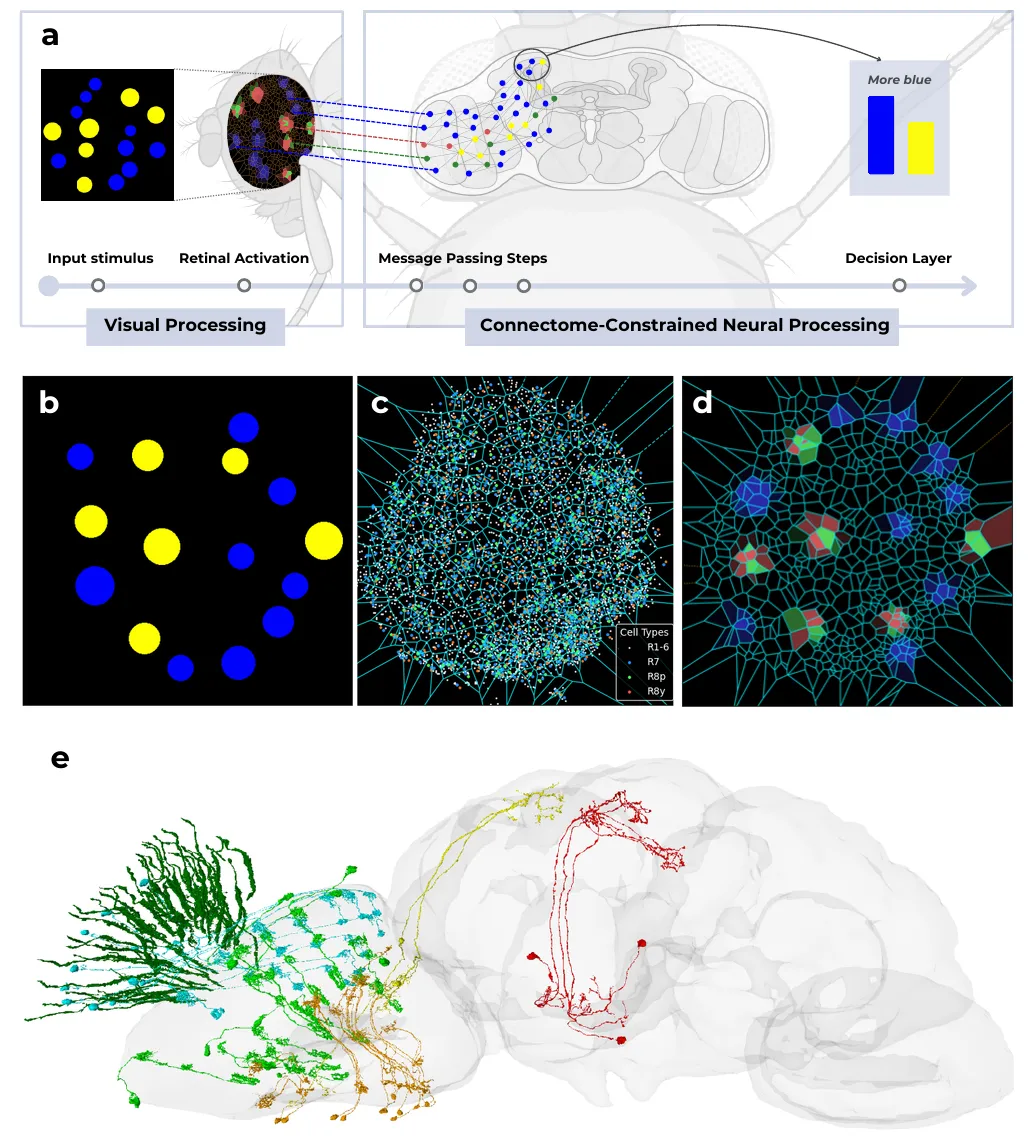
From image to decision: coloured dots are sampled by a reconstructed compound eye, then activity flows through the real wiring to the Kenyon cells. — Figure 1, Correig-Fraga, Guimerà & Sales-Pardo (2026), arXiv:2610.10023.
Light then activates the retinal neurons, and activity spreads through the real wiring, step by step, to the Kenyon cells of the mushroom body, where a single simple unit reads out a decision. Nothing is added to the brain. The only thing the model may learn is one strength per existing connection, capped so that it can never exceed the number of synapses actually observed.
Colour, shape, number
The team tested three visual tasks:
- Colour. Is the circle blue or yellow? Every model scored close to 100%. The real wiring reached 92% with no training at all.
- Shape. Circle or star? Trained on images in the left half of the visual field and tested on the right half, the real wiring reached 64%.
- Number. Which colour has more dots, with the total area of each colour made equal so size cannot give the answer away? The model was never told how many dots there were. Its accuracy rose with the ratio between the two numbers, from 64% at a ratio of 1.5 to 85% at a ratio of 5. That pattern is the signature of an approximate sense of number, which the paper notes has been seen in real fruit flies.
Shuffled brains
To test whether the precise wiring matters, the researchers built four scrambled versions of the brain, all with the same neurons:
- an unconstrained one, where each neuron’s outgoing connections go to random targets, creating many long wires;
- a pruned one, cut back until its total wiring cost matched the real brain, but with longer connections on average;
- two distance-matched ones, which keep the real distribution of wire lengths and total wiring cost.
In the scrambled brains with long wires, activity floods almost the whole brain by the second step; in the real one, it moves more gradually from the eye inwards.
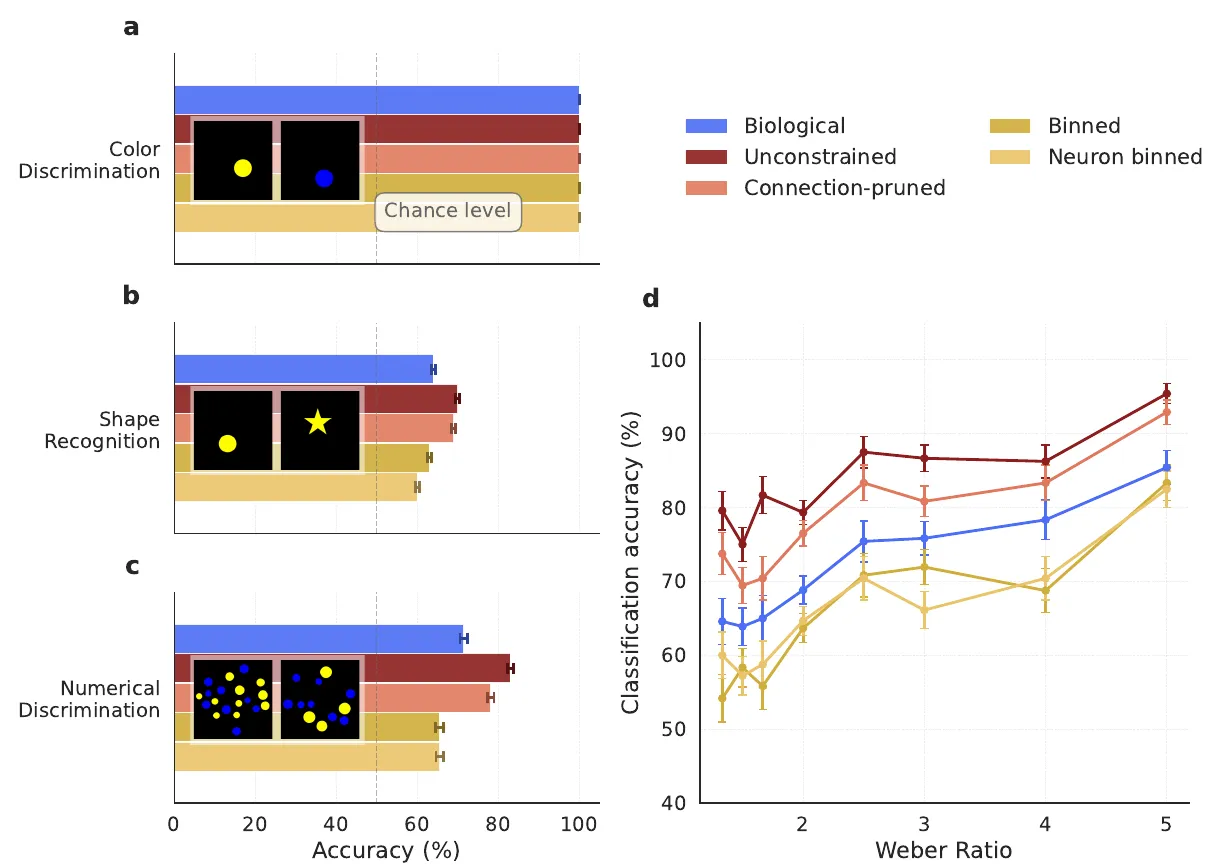
Accuracy of the real connectome (blue) and four shuffled versions on the three tasks; right, number discrimination improves as the ratio between the two quantities grows. — Figure 3, Correig-Fraga, Guimerà & Sales-Pardo (2026), arXiv:2610.10023.
Paying for long wires
The unconstrained and pruned brains scored higher, for example 70% on shapes against 64%. They gain by reaching more neurons faster through long connections — the very connections that, the authors argue, would cost a real animal energy and developmental complexity. When the comparison is fair, with the same wiring budget and the same distribution of wire lengths, the real fly brain beat both scrambled rivals on every task. The authors read this as an efficient evolutionary trade-off between performance and wiring cost.
A deliberately simple model
The model ignores most of the biology of real neurons: there are no firing rates, no time constants, and the readout through Kenyon cells is a convenient choice rather than the fly’s full decision circuitry. Each scrambled brain was generated only once. The authors present the work as a starting point: a way to ask what a measured wiring diagram can do on its own, before adding richer neuronal dynamics.