COULD MICROBES ON ENCELADUS LIVE ON ANCIENT ORGANIC MATTER?
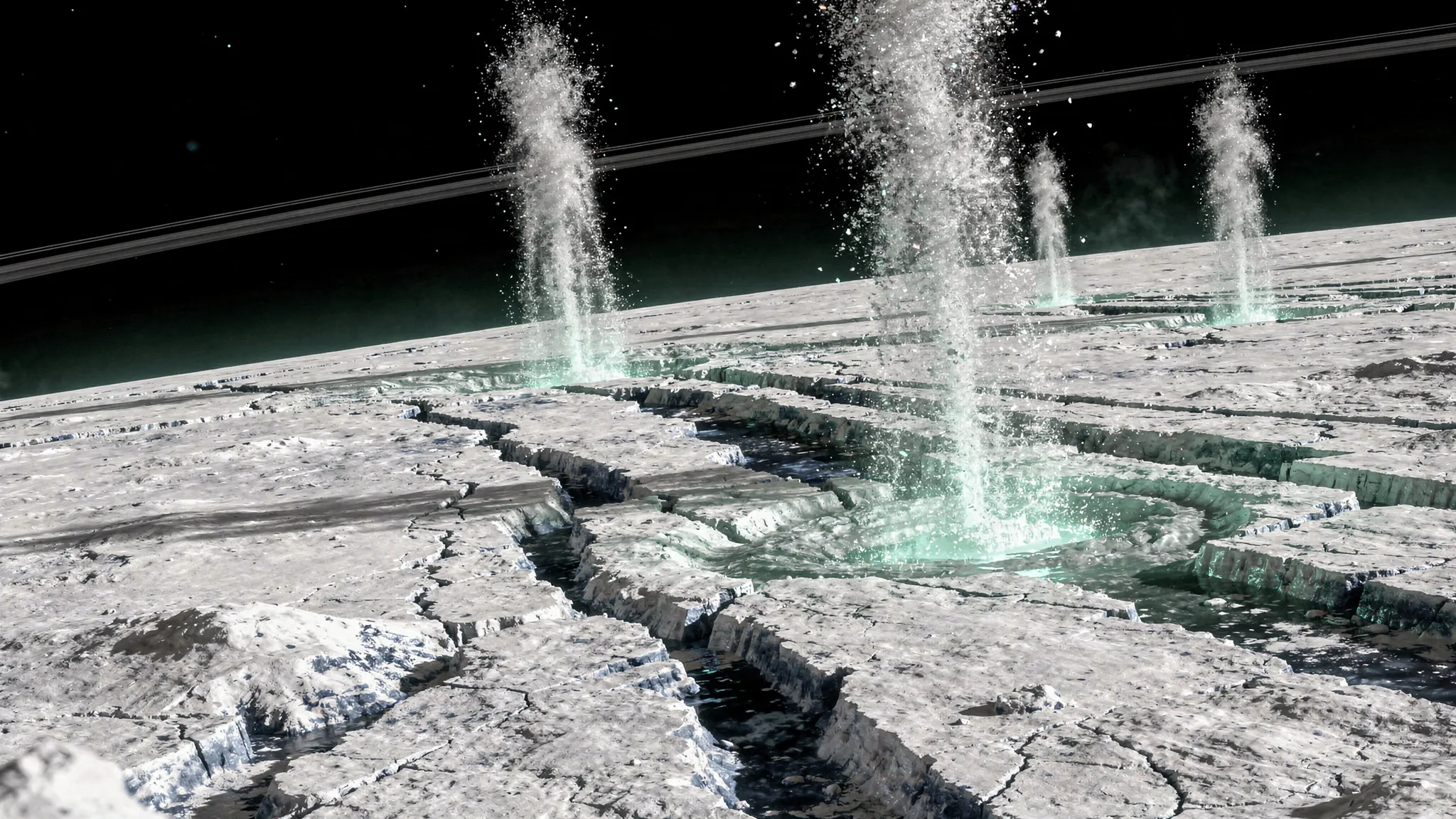
Enceladus is a small, icy moon of Saturn. NASA’s Cassini mission revealed that it hides a global ocean of liquid water beneath its ice, and flew through the jets erupting from its south pole — the first ever analysis of material from a liquid-water environment beyond Earth. The jets contained plenty of hydrogen (H₂) and methane (CH₄).
The leading explanation involves the moon’s rocky core. On Earth, hot water reacting with certain rocks — serpentinisation — releases hydrogen, and at hydrothermal vents, microbes called methanogens combine that hydrogen with carbon dioxide to make methane. The same could happen on Enceladus.
But there is a snag. To keep supplying the hydrogen lost through the jets for billions of years, the rock reaction would need to stay vigorous for a very long time — while the minerals it consumes may run out much sooner. Could something else be feeding the ocean?
Food from the beginning of the Solar System
Bodies of the outer Solar System are thought to have formed from material rich in organic matter, like comets and carbon-rich meteorites. Samples brought back from the asteroids Bennu and Ryugu contain amino acids, sugars and other organics. Enceladus’s core may hold such material too, slowly dissolving into the ocean.
In an ocean with no light and no oxygen, one way to live off organic matter is fermentation, which releases energy without needing oxygen or another outside chemical to “breathe”. Sam Nasreldine and Régis Ferrière of the University of Arizona, with colleagues at ETH Zurich, Queen Mary University of London, the Natural History Museum in London, Aix-Marseille University and the National Museum of Natural History in Paris, chose a simple test case: glycine, the simplest amino acid. Fermenting it produces hydrogen, acetate and ammonia. Microbes that ferment glycine are known from deep-sea vents on Earth.
A virtual vent with three kinds of microbes
The team simulated a small community living around a hydrothermal vent on Enceladus’s seafloor, where hot fluid mixes with ocean water:
- glycine fermenters, which produce hydrogen and acetate;
- hydrogen-eating methanogens, which turn hydrogen and CO₂ into methane;
- acetate-eating methanogens, which turn acetate into methane.
The model tracks the energy each group can extract, its growth, and how it changes the water for the others. The team ran 30,000 random sets of conditions for each of three scenarios — almost no hydrogen or methane from the rocks, a limited supply, or a stronger one — and compared the gases exported with what Cassini measured: about 1.2 to 7.4 billion moles of hydrogen and 0.3 to 1.6 billion moles of methane per year.
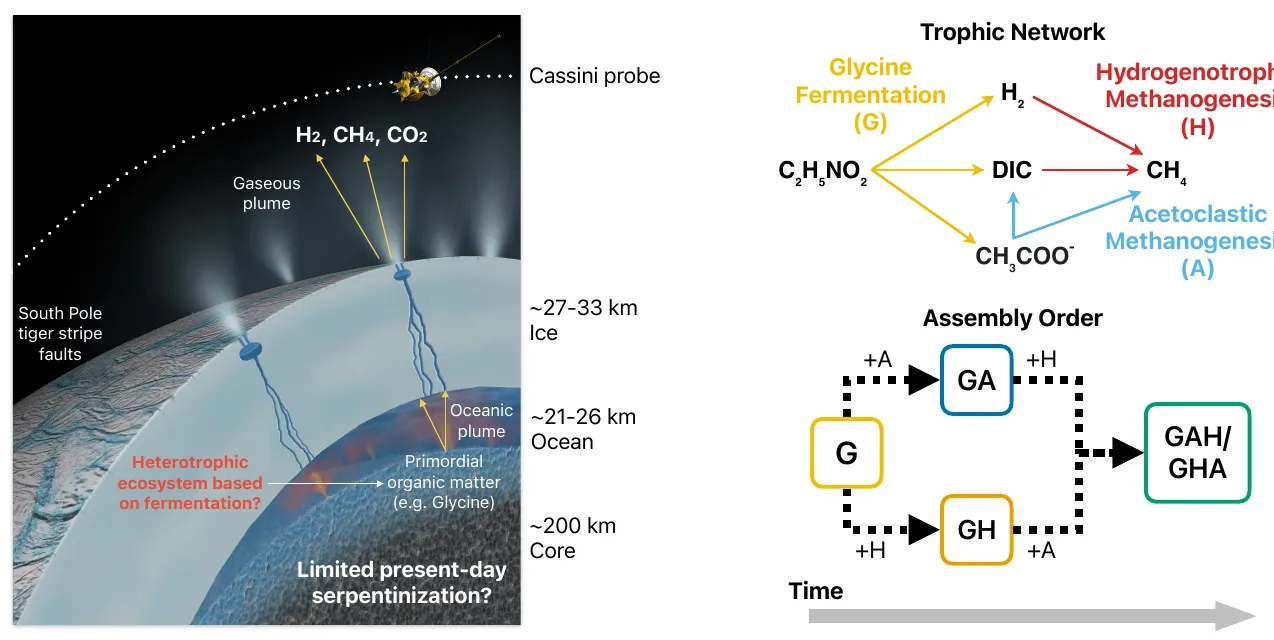
The hypothesis: microbes fermenting primordial organic matter on the seafloor, feeding methane-producing partners (a); how the three groups of microbes are linked and assembled in the model (b). — Figure 1, Nasreldine et al. (2026), arXiv:2610.13434.
The acetate eaters win
- With almost no help from the rocks, fermentation alone reproduced both of Cassini’s gas measurements — provided enough glycine-like material reached the vent.
- With a limited rock supply, 91 runs with acetate eaters, and 91 with all three groups, out of 30,000, matched both gases. None with only hydrogen eaters did. A statistical comparison favoured communities with acetate eaters in more than 90% of cases.
The reason is simple: hydrogen eaters consume the very hydrogen that should escape into the jets. Acetate eaters make methane without touching it. In the limited-supply scenario, the hydrogen eaters were pushed out of the final community in every run.
The model also shows life changing its own habitat: fermentation opened up new places around the vent where methanogens could grow, in two thirds of the runs of the first scenario.
How much food is there?
A rough upper estimate puts Enceladus’s original stock of glycine at up to about 1.3 × 10¹⁷ kilograms — enough to supply the observed hydrogen for 0.2 to 1.4 billion years, if all of it were available to microbes.
The catch: the simulations that work best need more dissolved organic matter than glycine levels in Bennu’s samples allow. Even if all of it dissolved, the concentration would stay below what the model requires. The scenario therefore depends on other fermentable compounds being present, or on some extra hydrogen still coming from the rocks.
A testable prediction
The authors present fermentation not as proof of life but as a testable alternative. If it happens, the jets should also carry acetate and ammonium, and the carbon isotopes of the methane should bear its mark. They stress the limits of their model: a single type of fermenter, no simulation of the journey from seafloor to jets, nutrients assumed to be sufficient — and the fact that non-living chemistry could produce the same gases.