THE MEGA-EARTHS THAT PROBABLY AREN'T
Planet-formation theory sets a ceiling on rocky worlds. A growing core that passes roughly 10 Earth masses can no longer avoid runaway gas accretion: it pulls in gas from the disc around its young star and becomes a gas-rich planet. Simulations of collisions and erosion give the same limit. Measurements of real planets place the switch from bare rock to gas-wrapped worlds even lower, around 4 to 5 Earth masses.
And yet, in recent years, a few planets have turned up with the density of rock and masses well above ten Earths. Some astronomers call them “Mega-Earths”. Explaining them would require exotic histories: late collisions after the gas disc vanished, or the stripped cores of former giants.
Casey Brinkman and Nicolas Cowan, of the Trottier Space Institute at McGill University in Montreal, asked a simpler question: are these planets really that heavy?
Weighing a planet by the wobble of its star
Most of these masses come from radial velocities: as a planet orbits, it tugs its star back and forth, and the star’s light shifts very slightly in colour. The size of that wobble gives the planet’s mass.
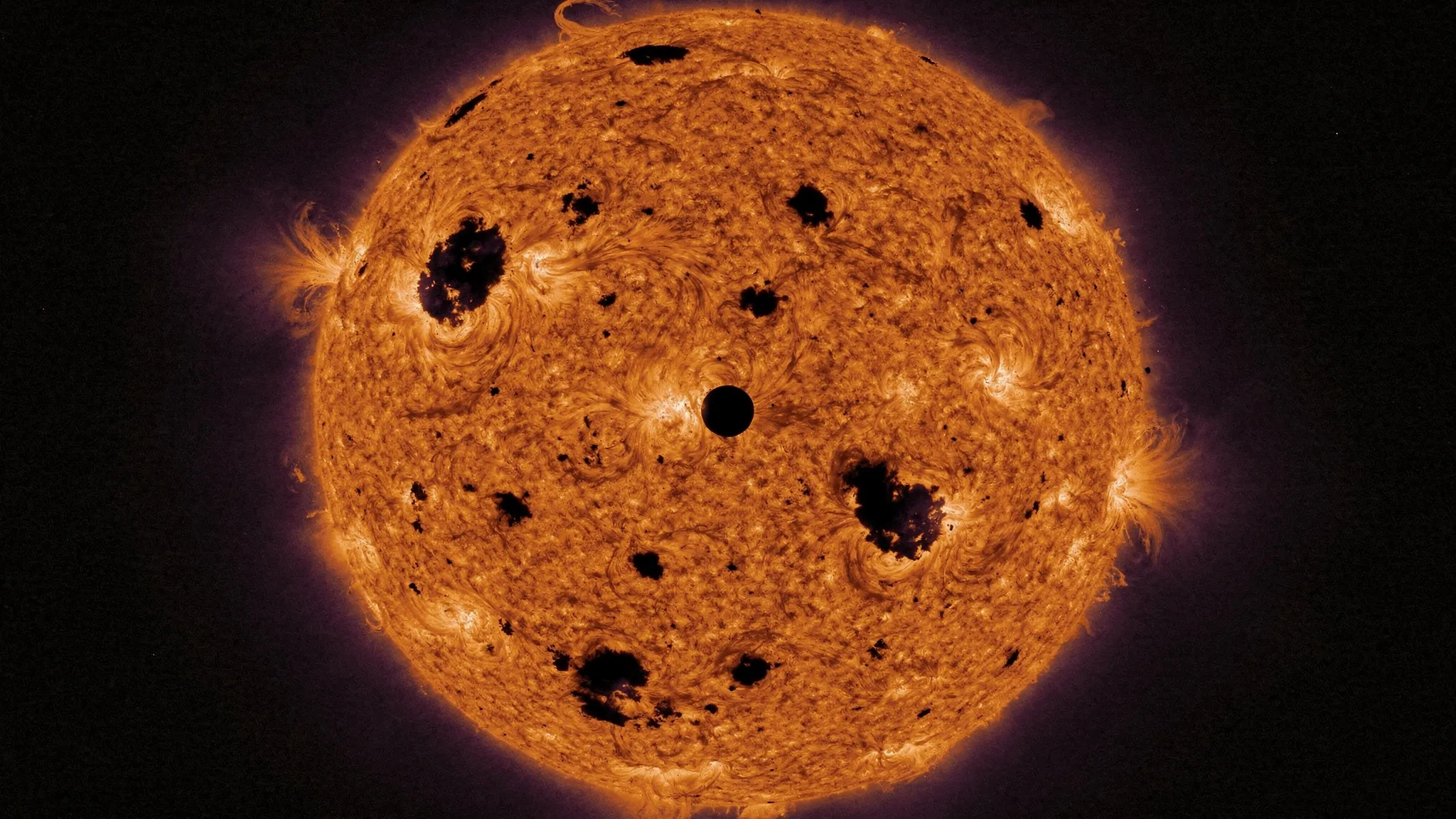
The trouble is that stars are not quiet. Magnetically active stars carry dark spots and bright patches that turn with the star. They add noise to the measurements, and a spot rotating into view can mimic — or inflate — the signal of a planet.
Eight suspects, one shared trait
The pair started from the NASA Exoplanet Archive and kept 333 planets smaller than four Earth radii with a reliable radius and a radial-velocity mass. They found:
- 4 planets with a rocky density and more than 10 Earth masses: WASP-84 c, TOI-1347 b, TOI-2322 c and HD 63433 b.
- 4 more above the limit with almost no hydrogen-helium envelope: GJ 523 b, TOI-815 c, HD 18599 b and GJ 143 b.
To measure each host star’s activity, they used an index based on calcium light emitted by the star’s hot outer layer, which brightens with magnetic heating. Above a value of −4.75, a star counts as active. Brightness measurements from the TESS mission also show each star dimming and brightening as its spots rotate.
The result: all eight orbit active stars. Among 37 stars with both a planet mass and an activity measurement, only 13 are active.
The odds of a coincidence
If Mega-Earths were spread evenly, the chance that the four rocky ones all landed around active stars would be:
p = 13/37 × 12/36 × 11/35 × 10/34 = 0.01
About 1%. Adding the four others, it drops to 0.0003.
Could young, active stars simply be better at making Mega-Earths? The authors see no reason. Building one would take extra collisions, a migration inward to orbits of 0.8 to 20 days, and perhaps the stripping of a thick atmosphere — all of which takes time. If anything, these worlds should favour older stars.
Where the masses go wrong
Every original measurement used Gaussian processes, a statistical tool that models the star’s noise so the planet’s signal can be separated. But an overly flexible model can absorb the wrong signal and produce masses that are too large. The cases look fragile:
- Around WASP-84, the star’s jitter (about 13 m/s) is larger than the planet’s signal (7.7 m/s).
- TOI-2322 rotates in 21.28 days; its planet orbits in 20.23 days.
- HD 63433 b, the heaviest at 37 Earth masses, was not detected at all by a second team, which set an upper limit of 21 Earth masses.
- Three of the planets fall below a published signal-to-noise threshold under which such models are known to be unreliable.
The authors recall a precedent: another planet whose mass turned out to be inflated by a factor of three by an untreated periodic signal.
No rocky giants — for now
Their conclusion: there is no compelling evidence for rocky planets above ten Earth masses. Radial-velocity masses of planets around active stars deserve scepticism, “particularly so when the existence of such planets would challenge our notions of planet formation.” They suggest timing the observations so that both the star’s activity and the planet are well sampled.
The argument is statistical and rests on a small sample: eight planets and 37 stars. The authors did not redo the original mass fits.