NEUTRINOS FIND NO FOAM IN SPACETIME
Physics still has no working theory of quantum gravity. But most candidates share one expectation: at the extremely small Planck scale, spacetime stops being smooth and starts to fluctuate. Physicists call it spacetime foam. One concrete picture is a background of virtual black holes, microscopic and fleeting, appearing and evaporating on the shortest possible timescales.
A single such fluctuation would be far too small to notice. But a particle that travels a long way could pile up their effects. Its quantum behaviour would slowly fade into ordinary, classical randomness — a process called decoherence.
A quantum clock that crosses the Earth
Neutrinos are the ideal test particles. They have no electric charge and feel only the weak force and gravity, so they cross whole planets undisturbed. And they carry a built-in quantum clock: a neutrino born as one “flavour” (electron, muon or tau) oscillates into the others as it travels. That oscillation is an interference effect. If spacetime foam scrambled the neutrino’s quantum state along the way, the oscillation would be damped.
The best neutrinos for this are atmospheric ones, made when cosmic rays hit the atmosphere. Those coming up from below have crossed the Earth — up to its full diameter — and they reach very high energies, where effects tied to the Planck scale are expected to be strongest.
The IceCube Collaboration tested two pictures of what a virtual black hole could do to a passing neutrino: switch it at random to a definite state, or knock its internal phase off by a random amount.
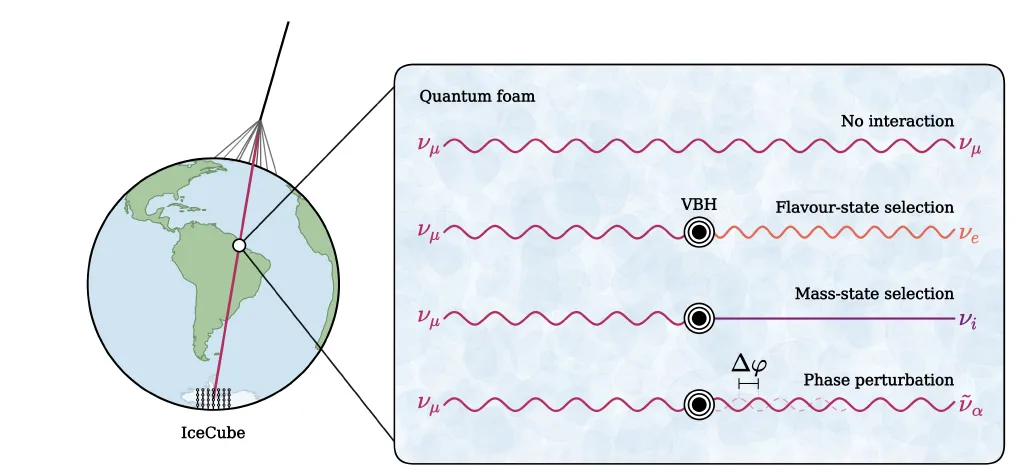
A muon neutrino from a cosmic-ray shower crosses the Earth to IceCube. Along the way, a virtual black hole (VBH) could switch its flavour, project it onto a mass state, or shift its phase. — Figure 1, IceCube Collaboration (2026), arXiv:2610.14144.
The effect is described by a standard equation for quantum systems that leak into their environment, the Lindblad equation:
ρ̇ = −i[H, ρ] − D[ρ]
The first term is ordinary oscillation; the second, D, is the damping. Its strength Γ is assumed to grow with energy as a power law, Γ(E) = Γ₀ (E/E₀)ⁿ, and the team tested n = 0, 1, 2 and 3. The case n = 2 is the best motivated, as it appears in several string-theory calculations.
368,071 neutrinos, no blur
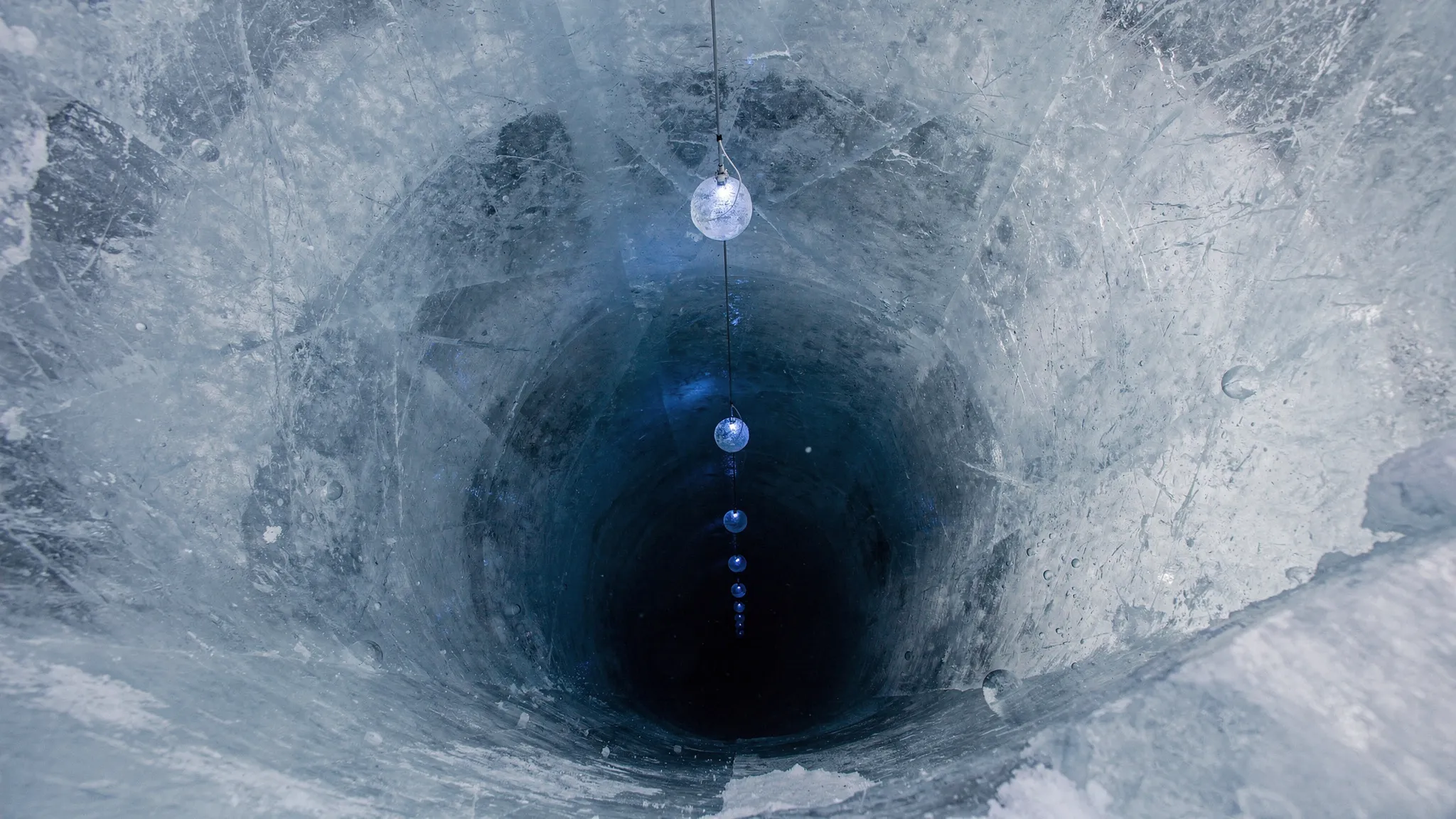
IceCube is a cubic kilometre of Antarctic ice watched by 5,160 light sensors. The team used 10.7 years of data: 368,071 muon neutrinos that came up through the Earth, with energies from 0.5 to 100 TeV — ten times higher than IceCube’s previous search for this effect. The analysis was done blind, and every check had to pass before the result was revealed.
The verdict: the data match ordinary three-flavour oscillations everywhere. There is no deficit where decoherence would bite hardest.
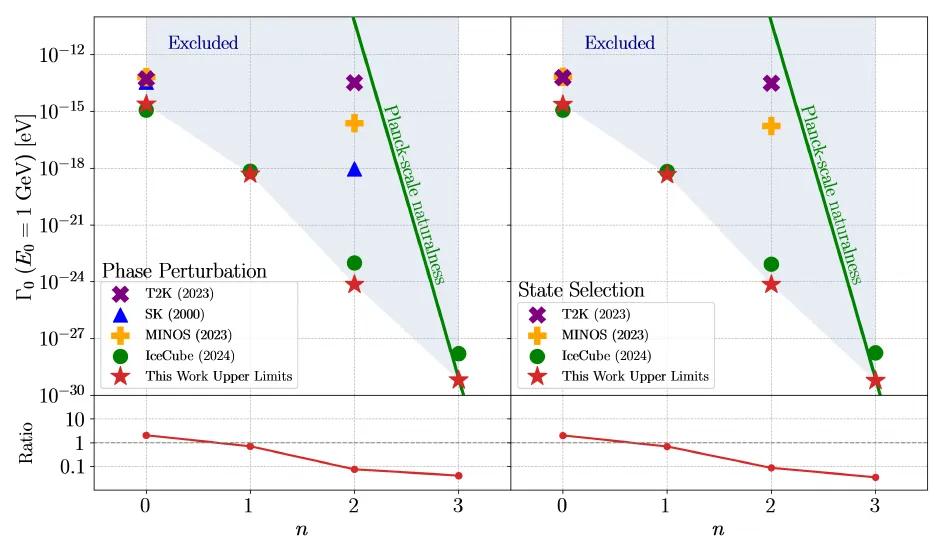
The new upper limits (red stars) compared with earlier experiments. For n = 3, the star falls below the green line marking a “natural” Planck-scale effect. — Figure 6, IceCube Collaboration (2026), arXiv:2610.14144.
- For n = 2 and n = 3, the limits improve on IceCube’s previous ones by more than a factor of ten. The gain comes mainly from the highest-energy neutrinos.
- For n = 2, the decoherence strength must be below 7.26 × 10⁻¹⁹ electronvolts at 1 TeV, in both models.
- For n = 3, the limits now reach below the “natural” Planck-scale expectation — the value obtained by assuming the effect becomes as strong as the Planck scale itself at the Planck energy. It is the first time this level is reached for n = 3.
Hiding better than expected
If spacetime foam damps neutrino oscillations in this way, it must be suppressed more strongly than a natural Planck-scale estimate predicts — through some extra mechanism, or with an energy dependence that is not a simple power law. The authors call these the most stringent constraints to date on this class of models.
The test has blind spots. IceCube cannot tell neutrinos from antineutrinos one by one, so the analysis assumes both behave the same way. And the models are deliberately simple, with a single damping parameter. Larger samples, notably from the planned IceCube-Gen2 detector, should push the search further.