GREEN LIGHT RIPS AN ELECTRON FROM NITRITE
Nitrite and nitrate are two pillars of the global nitrogen cycle. In airborne droplets (aerosols) and natural waters, light turns these fairly stable ions into reactive nitrogen compounds and oxidants — nitrite photochemistry is a major source of hydroxyl radicals and reactive nitrogen oxides.
The prevailing view is that light first excites nitrite, which then breaks one of its nitrogen–oxygen bonds, releasing nitric oxide and a hydroxyl radical. Nitrite absorbs strongly at 205 nanometres, deep in the ultraviolet, and weakly around 360 nanometres. Nothing beyond that.
Nitrate where there should be none
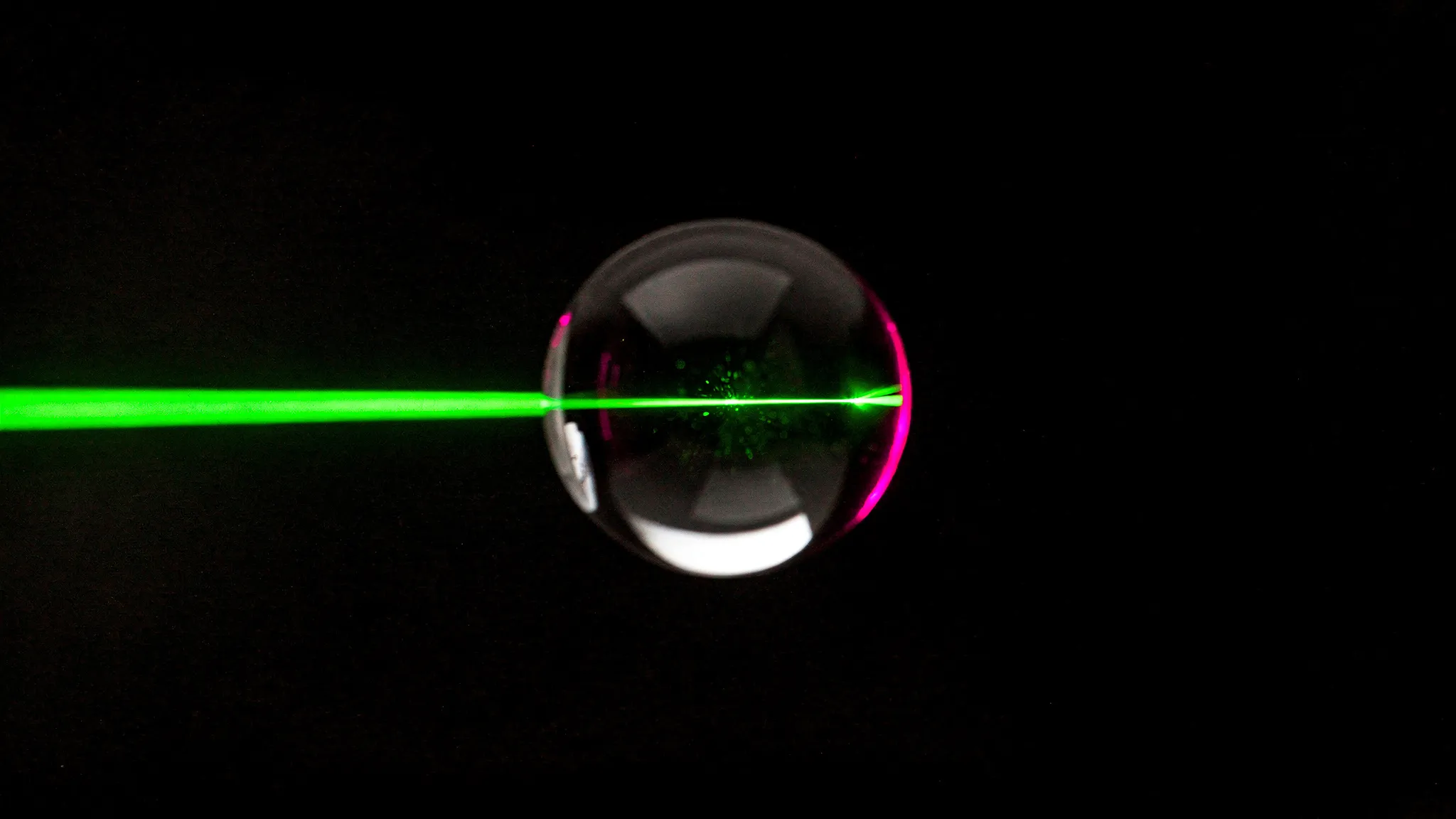
Brandon Wallace, Eric Heller, David Limmer, Kevin Wilson and colleagues at Lawrence Berkeley National Laboratory and the University of California, Berkeley, trapped single droplets of nitrite solution, a few tens of micrometres across, either in a fluorinated oil or floating in air. They lit each one with a continuous green laser at 532 nanometres — more than 150 nanometres beyond nitrite’s known absorption — and used the same laser to record the droplet’s Raman spectrum, a chemical fingerprint.
Over minutes to hours, the nitrite peak shrank and a nitrate peak grew. The team ruled out the obvious suspects:
- Ultra-pure nitrite (99.999%) reacted exactly like ordinary reagent, so trace metals are not to blame.
- The reaction ran in pure nitrogen, so oxygen is not required, although air sped it up by 50 to 70%.
- A larger sample in a microfluidic channel stayed unchanged for hours under the same light.
- The rate grew in direct proportion to laser power — one photon at a time — and as 1/R², where R is the droplet radius: the signature of a reaction inside the droplet’s volume, not at its surface.
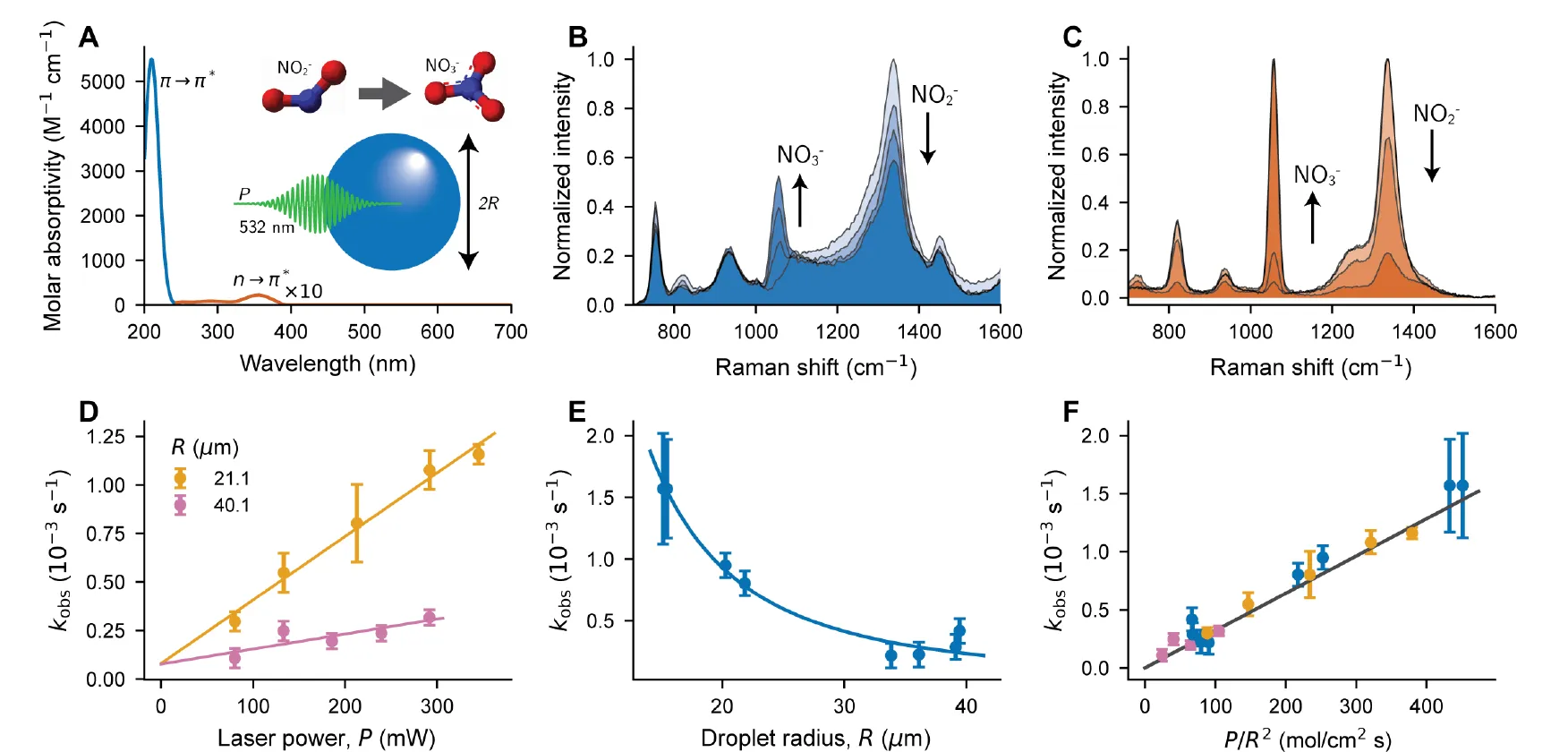
In droplets lit by a green laser, the nitrite Raman band falls while the nitrate band rises (B, C); the rate grows with laser power (D) and falls with droplet size (E), collapsing onto a single line (F). — Figure 1, Wallace, Heller et al. (2026), arXiv:2610.17021.
The authors fit everything with one formula for a light-driven reaction in a droplet:
k_obs = (P / R²) [3λ / (2πhc)] (1000 ln 10 / N_A) εϕ
where P is the laser power and εϕ combines how strongly the molecule absorbs and how often an absorbed photon reacts. They find εϕ = 3.46 × 10⁻⁶ per molar per centimetre. That corresponds to an absorption seven orders of magnitude weaker than nitrite’s band at 360 nanometres, far below what an ordinary spectrometer can detect. It shows up here only because a focused 100-milliwatt laser pours about 8,000 watts per square centimetre into a 10-micrometre droplet, against about 0.01 in a cuvette.
Water that wobbles opens the door
What absorbs the green light? Molecular simulations compared the two possible routes: exciting nitrite, or ionising it — tearing off its extra electron, which then dissolves into the water as a “solvated electron”.
Excitation barely disturbs the surrounding water and gives a narrow band near 360 nanometres. Ionisation is different: moving an electron into the solvent forces the water molecules to rearrange collectively, with a reorganisation energy around 25 times larger. The rare, extreme wobbles of the water stretch the ionisation band into a long tail reaching into visible light. At 532 nanometres, the ionisation route wins by orders of magnitude.
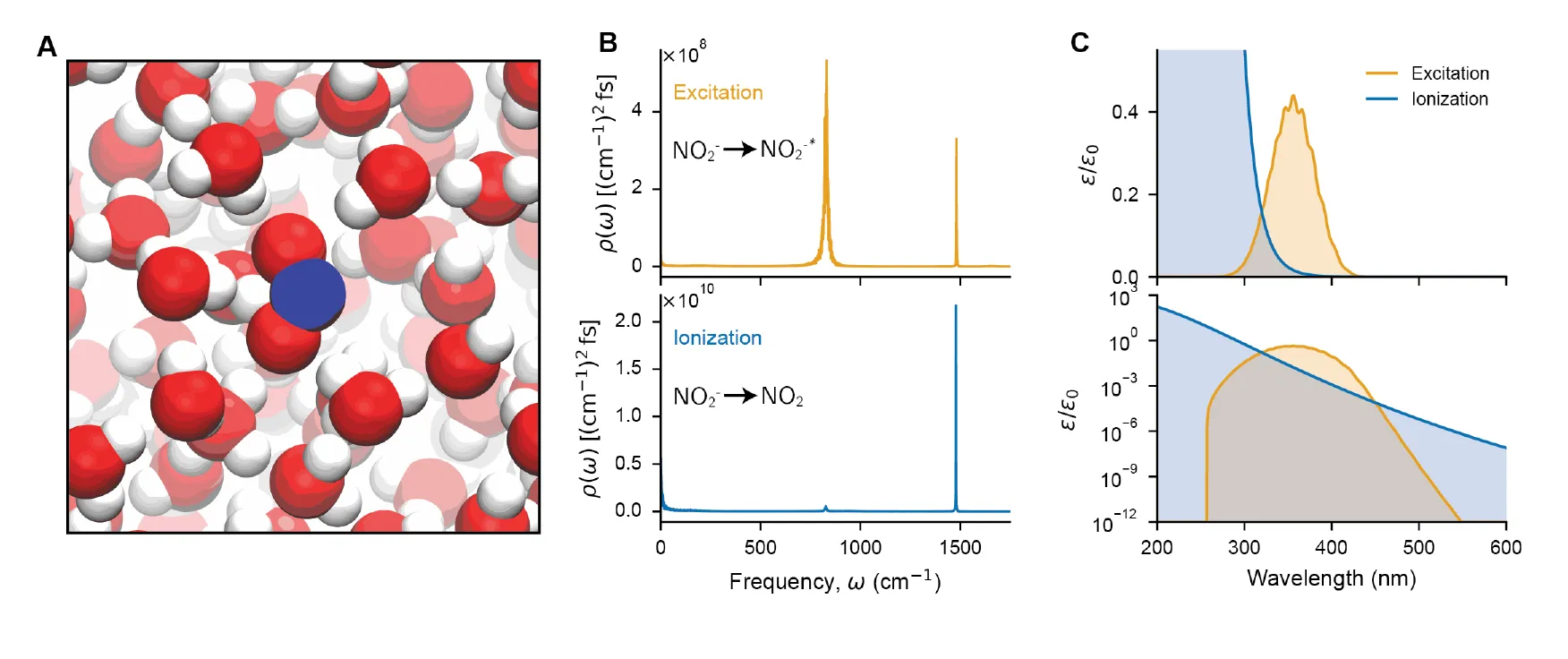
Simulated nitrite in water (A). On a log scale (C, bottom), the ionisation spectrum (blue) keeps a long tail toward long wavelengths, while excitation (orange) dies out. — Figure 2, Wallace, Heller et al. (2026), arXiv:2610.17021.
A kinetic model with known rate constants reproduces the reaction times and droplet-size dependence. Radical “traps” support it: fumarate, which reacts with solvated electrons, disappears as fast as predicted only if those electrons are present — a hallmark of ionisation. The same model also accounts for two earlier droplet experiments, whose authors had proposed other explanations, such as spontaneous oxidation at the air–water interface.
A hidden sink under the Sun
The ionisation tail overlaps the solar spectrum. Using a standard sunlight spectrum, the team estimates that at a typical environmental nitrite concentration, ionisation produces nitrogen dioxide and solvated electrons at about 22% of the rate of the classic route. But the classic route partly regenerates nitrite. In dilute water, where dissolved oxygen captures the electrons, the simulations show ionisation consuming nitrite about three times faster than excitation; at millimolar concentrations, the order reverses.
The authors call it a possibly overlooked source of nitrogen oxides, solvated electrons and oxidants in aerosols, snowpack and natural waters. Their kinetic model still has gaps — it ignores reactions with the surrounding oil and losses into it — and the experiments used very concentrated solutions. The environmental numbers come from simulations that, they write, still need refining.