THE FIRST LOOK AT A SINGLE ANT PHEROMONE DROP
When a Lasius niger ant finds food, it heads home and leaves a scent trail behind it. It lowers its abdomen to the ground and deposits tiny droplets of pheromone, a chemical message that leads its nestmates to the source. Such trails were described as early as 1779. They have become a textbook model of self-organisation and inspired a whole family of computer methods, ant colony optimisation algorithms.
The drop nobody had seen
Yet the basic unit of the trail had never been observed. Researchers infer how strong a trail is from ant traffic or from the laying behaviour, and assume that every drop is the same. The volume of a deposit, how fast it evaporates, the real concentration of a natural trail: all unknown. Even the solvent that makes up most of a drop had never been identified.
Laure-Anne Poissonnier, Pierre Bon and their colleagues at the XLIM institute (CNRS and University of Limoges) set out to see these drops directly.
Weighing a drop with light
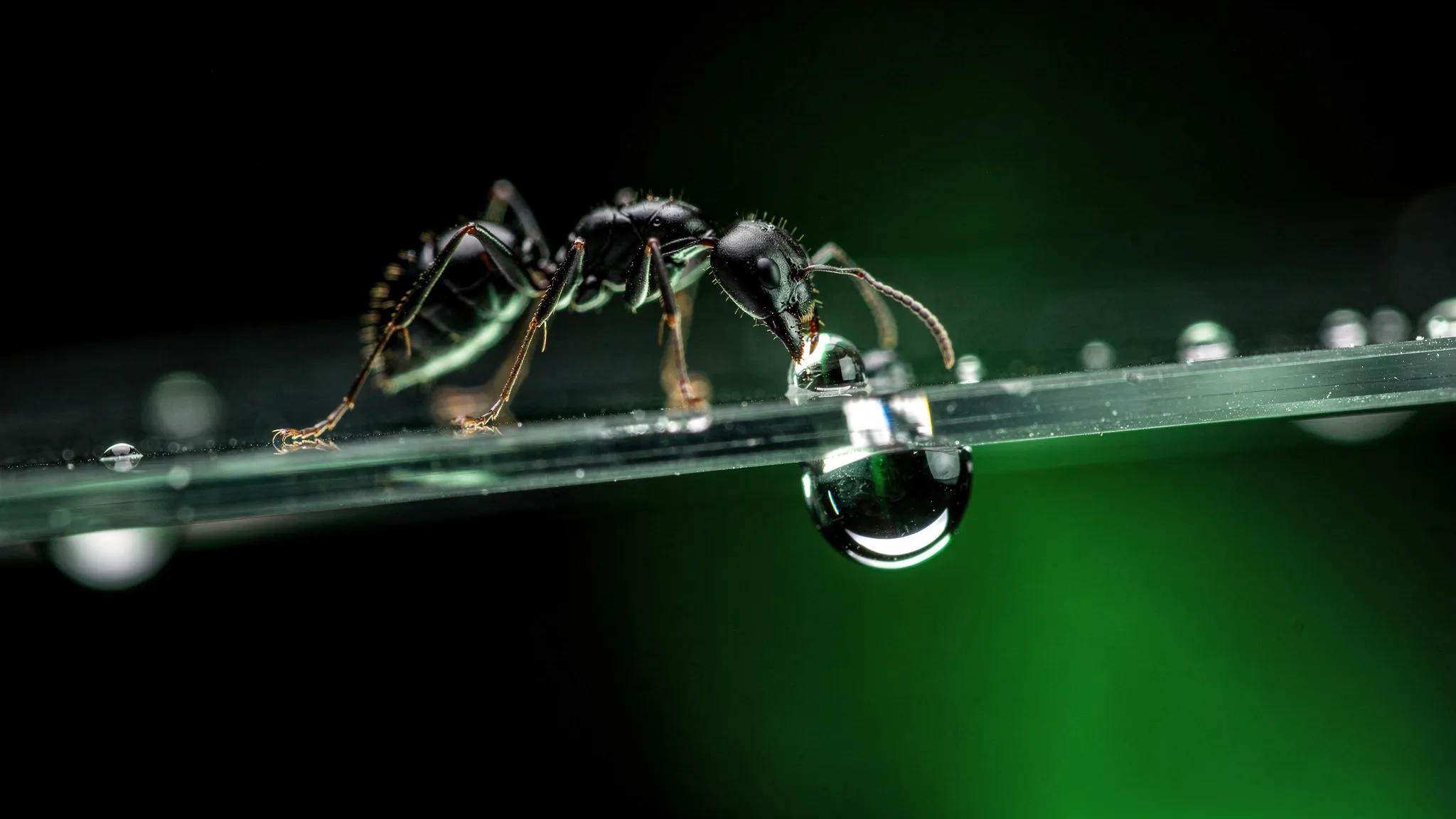
The ants, Lasius niger, came from a colony founded by a queen collected in Toulouse in 2020. After a few days without food, workers were let onto a suspended glass bridge 57 millimetres long, with sugar water at the far end.
The deposits are transparent, so the team used quantitative phase imaging: an interferometric technique that measures how much a transparent object delays the light passing through it. Assuming a refractive index, that delay gives the local thickness, to within about 20%. No dye, no contact. A first camera filmed a fixed patch of the bridge at up to 250 images per second; a microscope with a motorised stage then scanned the whole bridge.
A liquid that vanishes, a solid that lingers
The first drops were caught live, as they left the abdomen. They were liquid. One went from 0.4 to 0.15 picolitre in about 120 milliseconds. Another, four times larger, went from 1.7 to 0.4 picolitre with a time constant of 11 seconds. A picolitre is a trillionth of a litre.
What remains is a flat solid patch about 80 micrometres wide and only tens to hundreds of nanometres thick. Followed under the microscope for over an hour, one such patch slowly lost about 10% of its volume, with a time constant of 63 minutes — close to how long Lasius niger trails are known to stay active. A solid residue was still there 24 hours later.
The authors read this as three ingredients:
- a solvent that makes up most of the drop and evaporates in seconds — missed by the usual chemical analyses, which collect the trail afterwards;
- a solid that slowly sublimates, turning straight into gas. They suggest isocoumarin, a molecule known to make these ants follow a trail;
- a stable residue, which may act as a holding matrix and keep the scent in place.
If all the sublimated material in one deposit is isocoumarin, it amounts to about 26 picograms, or 110 billion molecules released into the air.
Watching the ant is not enough
Researchers usually count drops by watching for the characteristic abdomen bend. The team filmed ants from above and from the side, then scanned the bridge. In one representative ant, 7 laying postures were seen: 6 matched a real deposit, one matched nothing, even when searched with higher sensitivity. The behaviour is a useful but imperfect proxy.
No two drops alike
Then came the biggest surprise. Across five ants, the deposits differed in shape, area and volume:
- median area: 4,300 square micrometres, with tenfold variation;
- median volume: 0.68 picolitre, ranging from under 0.2 to over 4 — more than 20-fold;
- round or pear-shaped, depending on how the ant dragged its abdomen.
A statistical model attributed about 90% of the variation to differences between individual ants. The common assumption of identical deposits is wrong, at least in this species.
Trail specialists?
If these individual differences are stable over time, some workers may play an outsized role in building trails. The authors want to feed these measured values into models of collective behaviour and optimisation algorithms, and to find out the smallest amount an ant can detect. Beyond pure biology, they point to practical stakes: baits against invasive ants exploit the recruitment that trails drive, and pheromones are increasingly used in farming as targeted alternatives to pesticides.