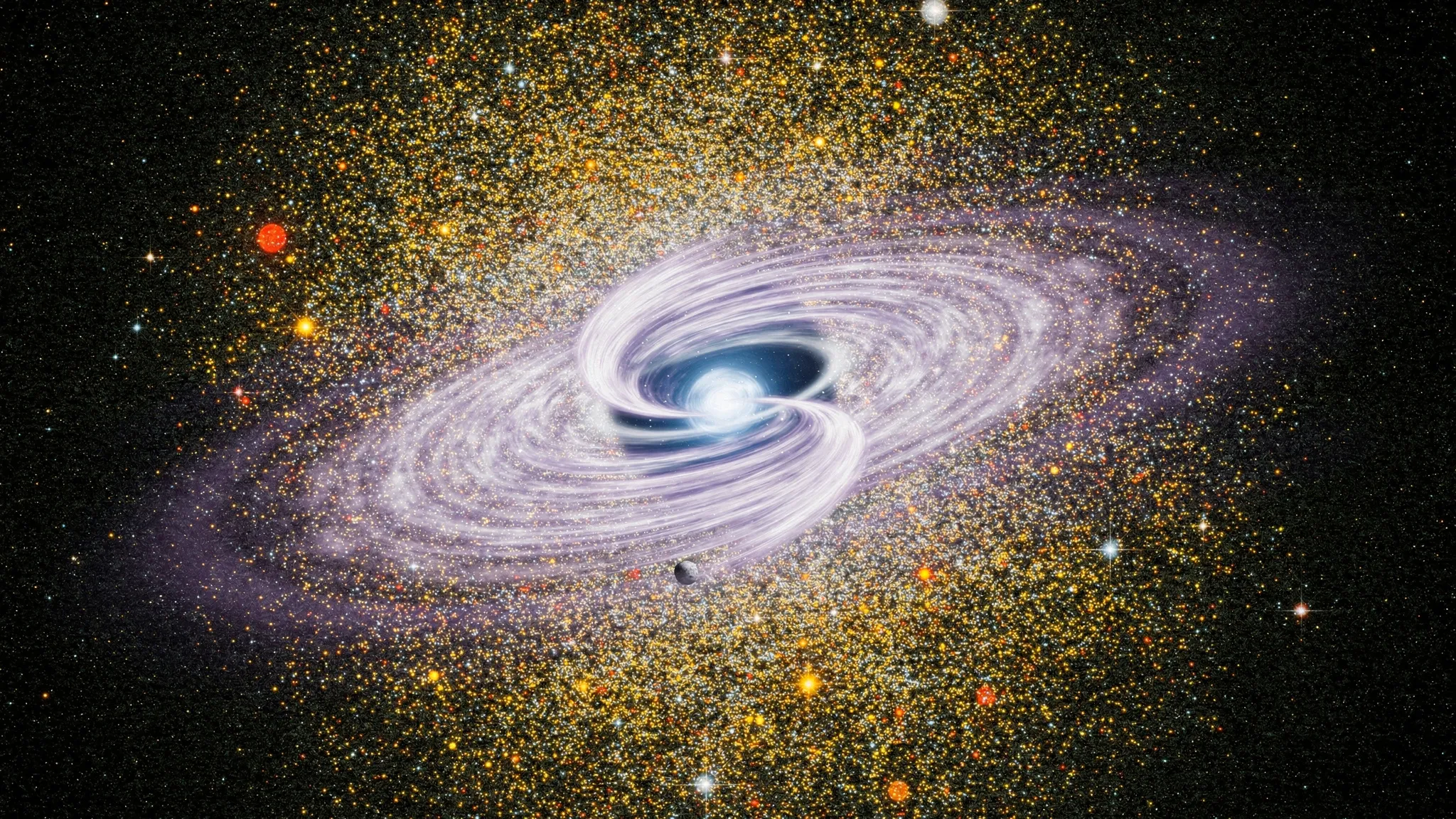
THE BLACK HOLE THAT SWALLOWS ITS OWN LIGHT
The event horizon is what makes a black hole a black hole: a boundary beyond which nothing, not even light, can return. By definition, it sends us no signal. The Event Horizon Telescope has imaged the shadows of the giant black holes in the galaxy M87 and Sagittarius A* — indirect evidence of a horizon. But the horizon of a black hole born from a star is only tens of kilometres across, far too small to image.
The faint-companion argument
Astronomers have another clue. In pairs where a dead star pulls gas from a companion, quiet black hole systems are usually about a hundred times fainter than neutron star systems with similar orbits. The explanation: falling gas hits the surface of a neutron star and glows, while a black hole swallows the energy.
The weak point is an assumption. The argument supposes that similar orbits mean similar feeding rates. For orbits longer than 80 minutes, the companion can be a brown dwarf, an ordinary star or a giant, and several effects can drive the flow of gas. The real feeding rate is unknown.
Pairs that orbit in minutes
Qian-Qi Ma and Wei-Min Gu and Mouyuan Sun of Xiamen University, with Shan-Shan Weng of Nanjing Normal University, turned to ultra-compact X-ray binaries. When the orbit takes less than 40 minutes, the two bodies are so close that the companion can only be a white dwarf. And the orbit shrinks mainly by emitting gravitational waves.
That makes these systems clean laboratories. The feeding rate then depends only on the theory of gravity and on how the size of a white dwarf relates to its mass. It can be computed from the orbital period alone, with a few assumed masses: 1.4 to 2 Suns for a neutron star, 3 to 20 for a black hole.
The team kept five such systems, all in globular clusters, dense balls of old stars whose distances are known to within 2%:
- four contain a neutron star, identified by its thermonuclear X-ray bursts;
- one, 47 Tuc X-9, contains a black hole, identified from how its radio and X-ray emission vary together. Its orbit lasts about 28 minutes.
They then compared each system’s average X-ray output, taken from Chandra, Swift and other observatories, with its computed feeding rate.
A thousand times dimmer
The result is the radiative efficiency: the share of the infalling mass’s energy that comes out as X-rays.
- For all four neutron stars, it is above 5%.
- For the black hole, it is below 0.03%.
The gap is two to three orders of magnitude. The most striking pair: the neutron star system M15 X-2 and the black hole 47 Tuc X-9 are fed at similar rates, about 10¹⁶ grams per second, yet 47 Tuc X-9 is a thousand times fainter. Even allowing for uncertainties of up to a factor of ten in the brightness of some sources, the two groups stay apart.
Where the energy goes
The authors explain it by what lies at the bottom. A neutron star has a hard surface: even if the hot inflowing gas radiates poorly on the way in, its energy is finally deposited on that surface and re-emitted. A black hole has no surface. At low feeding rates, much of the gas’s energy is carried inward as heat — and disappears behind the horizon.
For the authors, this is strong evidence for the horizon of a stellar black hole, though indirect, as their own summary puts it. It rests on a single black hole. They make a testable prediction: any new neutron star found in such a tight pair should land in the bright group, and any black hole with a similar orbit should be as dim as 47 Tuc X-9.
A lesson for giant black holes
The study carries a wider warning. For black holes, brightness is a poor gauge of how much they eat. A black hole can grow while staying faint. According to the authors, surveys that infer the growth of supermassive black holes from their light could miss part of that growth.