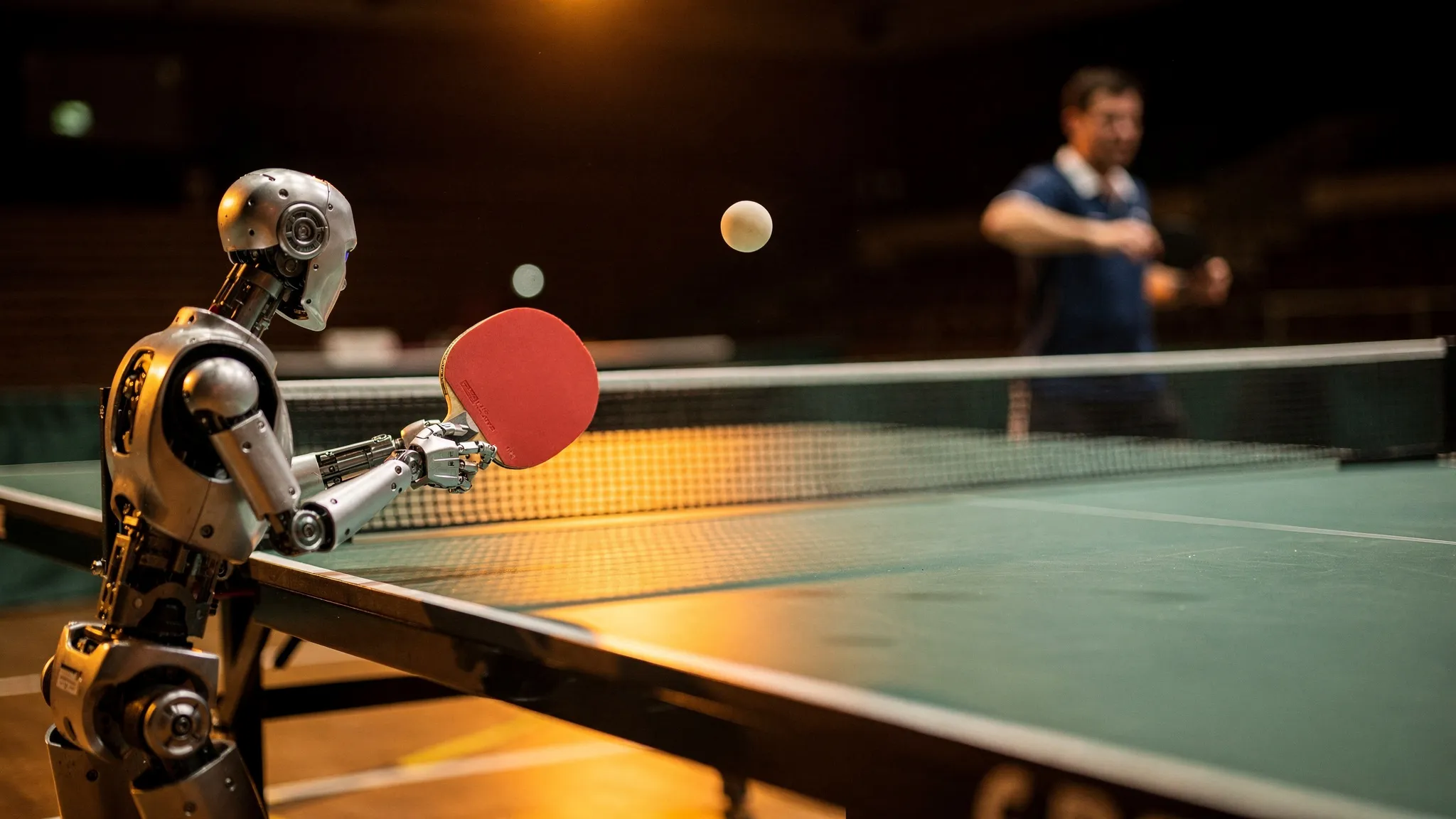
A HUMANOID ROBOT LEARNS WHERE TO AIM
A good table-tennis player does two things at once. They execute: they move their whole body to put the ball where they want. And they decide: they pick the spot that will trouble the opponent. A return can be precise but easy to reach, or clever but too hard to pull off. When a robot learns both at once, it is hard to tell which one makes it win.
A team from Zhejiang University, Tsinghua University, Tongji University, the Ocean University of China, the Shanghai Innovation Institute and RoboParty Lab chose to separate them. The link between the two is a single number pair: the point on the table where the ball should land.
A body that hits where it is told
The robot is a Unitree G1 humanoid, with 29 motorised joints. An external tracker follows the ball 100 times per second.
When a ball comes in, a physics-based planner works out what the racket must do — position, speed and angle at impact — to send the ball to the requested landing point, taking gravity, air drag, the bounce and the net into account. A neural network then turns that plan into commands for the whole body, 50 times per second.
Training happens in three stages, in simulation:
- Learning to hit. The robot practises on balls thrown in a set way, aiming at landing points chosen at random.
- Learning to rally. Two simulated robots play each other. Incoming balls now come from a real opponent’s strokes, but the targets are still random: no tactics yet.
- Learning to play. The whole body control is frozen. A second, separate network learns only to pick one of nine zones on the table, from the ball’s recent path, its own position, the opponent’s position and its previous target. It is rewarded for winning points, with no tactical rule written in by hand.
Precise, then smarter
In simulation, 99.2% of returns landed legally, and 94.3% of those within 30 centimetres of the requested spot, with an average error of 15 centimetres. Practising in rallies made the strokes more accurate and more often legal than the same amount of extra training on pre-set balls.
Then came the key test. Every player used the exact same frozen body, so only the choice of target differed. The learned strategy won:
- 89% of points against a player that always aims at the centre;
- 82% against one that aims at random;
- 73% against one that always aims as far from the opponent as possible.
It did not simply find a few good spots. It shifted its target away from where the opponent stood, and away from where it had sent the previous ball.
Three games against a human
On a real G1, with the same frozen body and the human’s position captured by motion tracking, the robot played three games to 11 against the same recreational player. It won 11–4, 11–6 and 11–9, with multi-stroke rallies and both forehand and backhand returns.
Not yet at the club
The authors list what is missing. The robot relies on an external ball tracker and motion capture rather than its own eyes. The ball model ignores spin. Nine zones limit its tactics, it sees the opponent only as a position on the floor, and it serves to a fixed spot. And all its real games were against a single amateur. Their broader point is a design rule: keep the meaning of the goal fixed while the body underneath keeps learning.