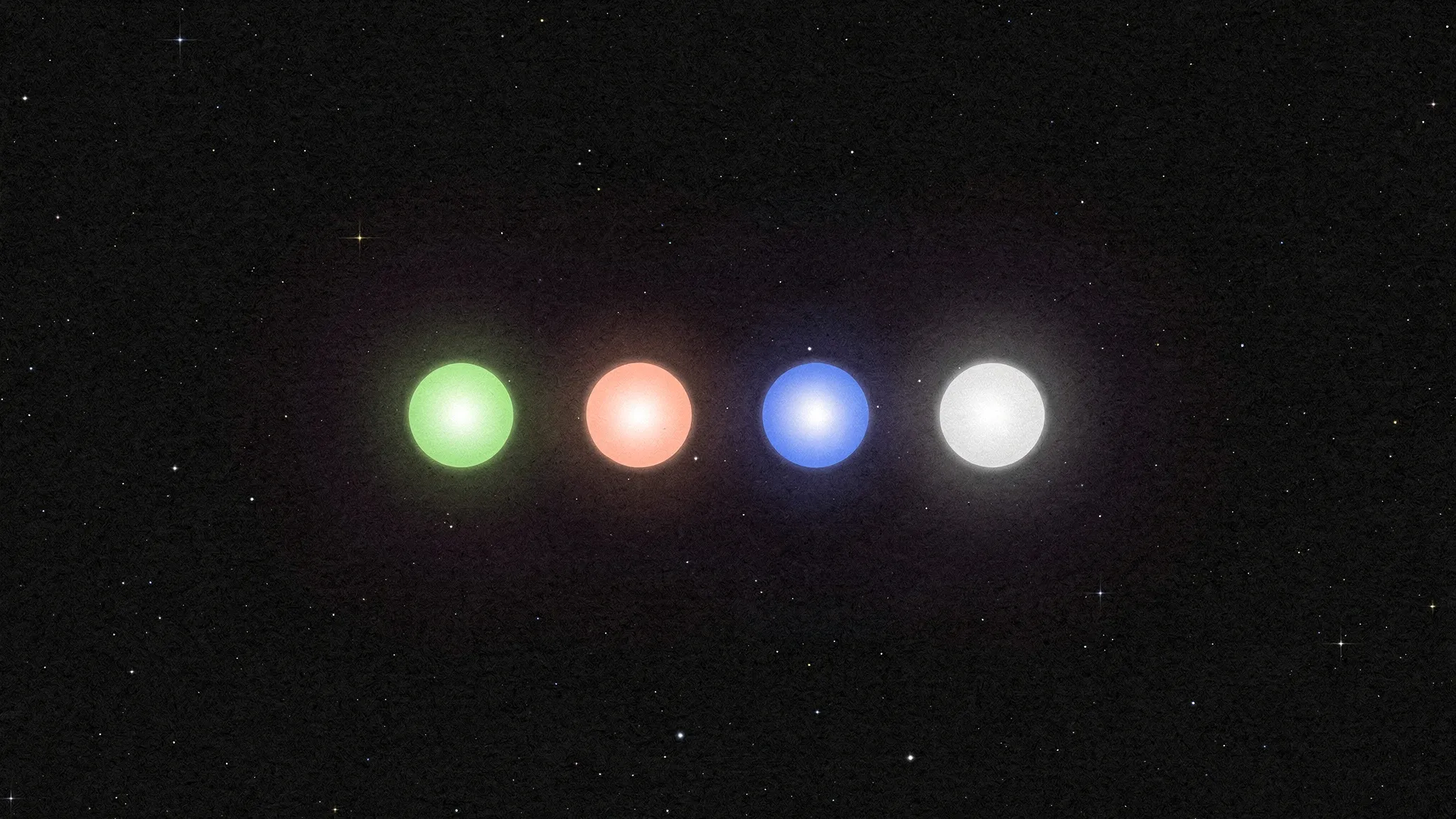
THE ONLY GREEN STARS KNOWN ARE WHITE DWARFS
Look at the night sky and the colours of stars are subtle but real: Betelgeuse and Antares look reddish, Sirius and Rigel slightly bluish. For ordinary stars, colour is a thermometer. Their light roughly follows that of an ideal hot body, a blackbody, which goes from orange to white to blue as it heats up.
Most stars, though, are far too faint to be seen with the naked eye, and even through a telescope the eye is poor at judging colour in the dark. The colourful pictures in astronomy are mostly false colour: the Sloan Digital Sky Survey, for instance, maps its i, r and g bands onto red, green and blue, although the human eye only covers the g and r bands. Useful for science, but misleading about what the stars actually look like.
Atmospheres as dense as a liquid
White dwarfs are the dense remains left behind by most stars once they die. Their atmospheres can be extraordinarily compressed — up to about 1 gram per cubic centimetre for the coolest, the density of a liquid. In such conditions, carbon, calcium or sodium atoms absorb light over enormously broadened bands, hundreds to thousands of ångströms wide. The light that escapes can be very far from a blackbody.
Mark Hollands, Boris Gänsicke and Pier-Emmanuel Tremblay of the University of Warwick, with Detlev Koester of the University of Kiel, asked a simple question no one had addressed for these stars: what colour would they appear to a human observer close enough to see their disc?
From spectrum to screen
The answer comes from colour science, the field that calibrates screens and lighting. The team integrated each spectrum over the standard curves describing the sensitivity of the human eye (the CIE 1931 colour-matching functions), then converted the result into the standard colour space of computer monitors, sRGB. As a check, a model of the Sun comes out as a very slightly warm white, hex code #FFF1EC; a 10,000-degree hydrogen white dwarf, pale blue.
They applied this to model atmospheres, to dozens of observed spectra chosen for their oddities, and to the complete census of the 152 white dwarfs within 20 parsecs of the Sun.
A palette of dead stars
White dwarfs with pure hydrogen or helium atmospheres behave almost like blackbodies. The others do not.
- Pink and purple. Carbon-rich white dwarfs, whose C₂ molecules absorb broad bands in the middle of the visible, fall below the blackbody colours. One of them, WD J1011+2845, 14.7 parsecs away, emits most of its visible light beyond 600 nanometres. Its colour is a deep salmon pink — according to the authors, probably the reddest star known in terms of perceived colour.
- Cyan. Some cool white dwarfs with mixed hydrogen and helium have their red and infrared light absorbed by colliding molecules. The most extreme turn cyan.
- Yellow. In WD J0744+4649, calcium swallows most of the light below 460 nanometres: the star is not orange, but yellow.
- Green. WD J1330+6435, at 4,240 degrees, has its orange light absorbed by sodium and its violet light by calcium. What remains peaks around 500 nanometres: chartreuse green. The authors know of no other star of any kind claimed to be green, making white dwarfs so far the only known way to produce a green star. Its spectrum is somewhat noisy, they note, but an older model gives a similar hue.
- Blue at 4,000 degrees. WD J2356−2054 is only about 4,000 degrees, yet sodium wipes out the middle of its visible light so thoroughly that it looks vivid blue — bluer than any blackbody, so it cannot even be given a colour temperature.
White after all
The census of the 20-parsec neighbourhood tells a calmer story. Only about 3.4% of these white dwarfs stray clearly from blackbody colours: two yellow and three pink. For the remaining 147, the colour temperatures span 3,000 to 25,000 degrees, and their median, 6,768 kelvins, gives the hex code #F9F5FF — remarkably close to the standard white of computer screens. The authors admit to some amusement: the common picture of bluish white dwarfs is unrepresentative, a bias of surveys that favour bright, hot stars. On average, white dwarfs really are white.
Painting the discs
The team also generated images of the discs themselves, taking into account how a star darkens towards its edge. For hydrogen white dwarfs, the discs look almost flat. For carbon and metal-rich ones, the edge darkens strongly and even shifts hue: the green WD J1330+6435 turns orange in the outermost pixels of its disc. The surfaces of these stars remain vastly brighter than any screen can show, but the authors expect these portraits to be useful for outreach. They also expect more surprises: between the green star and the blue one, other vivid green, cyan and blue white dwarfs probably wait in future surveys.