THE GALLIUM ANOMALY, CHECKED AGAINST THE SUN
Gallium-71 can swallow an electron neutrino and turn into germanium-71, spitting out an electron. Collect the few germanium atoms made in the gallium, count them, and you have measured a flux of neutrinos. That is how the SAGE and Gallex/GNO detectors watched the Sun.
To check those detectors, physicists also exposed them to artificial neutrino sources — very intense samples of radioactive chromium-51 and argon-37. The germanium count came out low. Early experiments hinted at it without settling the question. Then the BEST experiment, with a 3.5-megacurie chromium-51 source inside two nested zones of liquid gallium metal, confirmed it.
Twenty percent missing
BEST was designed as a short-distance oscillation experiment, to test whether sterile neutrinos mixed with ordinary electron neutrinos could explain the shortfall. The capture rates showed no dependence on distance. Together, the six source measurements — 0.97, 0.81, 0.97, 0.83, 0.81 and 0.78 of the expected rate — confirm the low rate at more than 4 sigma, for a combined ratio of 0.817. This is the gallium anomaly.
The expected rate rests on a cross-section, the probability that gallium captures a neutrino. It is derived from the reverse reaction, the radioactive decay of germanium-71 by electron capture, whose half-life (11.465 days) and energy are precisely known. One step of that derivation treats the electron and the nucleus separately — “factorization”. In 2026, Cadeddu and colleagues argued in Physical Review Letters that this step could fail and make the true cross-section 20% lower. Steven Elliott, of Los Alamos National Laboratory, and Hamish Robertson, of the University of Washington, are sceptical: factorization reproduces measurements in many nuclei to about 1%, with one known exception, sodium-22, at about 10%. “A breakdown of factorization at the 20% level would thus be very surprising.”
A source nobody built
So they used a neutrino source that is calibrated independently of gallium: the Sun. Its neutrino output is now measured on Earth through fundamental Standard Model reactions — neutrinos bouncing off electrons in the Borexino detector, and breaking apart deuterium nuclei in SNO. None of that depends on the gallium cross-section.
The authors combine five solar sources: the main proton-proton chain (pp), plus pep, beryllium-7, the CNO cycle and boron-8. Borexino supplies the beryllium-7, pep and CNO fluxes, SNO the boron-8 flux. The pp flux comes from the Sun’s brightness: every helium nucleus made releases two neutrinos and 26.731 MeV, and about 2% of that energy leaves as neutrinos. Along the way, neutrinos change flavour; the probability that one arrives still as an electron neutrino is computed with mixing parameters from Daya Bay and JUNO, and the density profile of a solar model — the only remaining dependence on solar models. The gallium cross-sections come from a new evaluation by Haxton and Rule.
Sixty-seven out of sixty-seven
The prediction for a gallium detector, in solar neutrino units (captures per 10³⁶ target atoms per second):
- pp neutrinos: 40.00
- beryllium-7: 18.75
- boron-8: 4.17
- CNO: 3.00
- pep: 1.55
- total: 67.5 (+1.4 / −1.1)
SAGE and Gallex/GNO, combined, measured 66.1 ± 3.1. The ratio is 0.980 (+0.050 / −0.049).
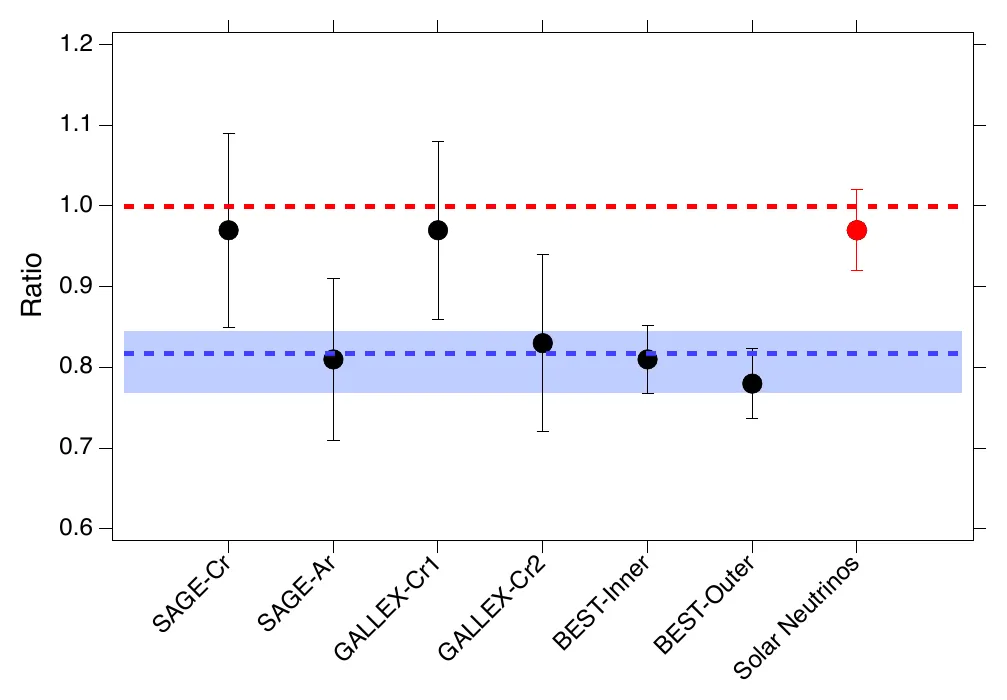
Measured over expected capture rates: the six source experiments (black) and the solar test of this work (red). The blue band is the combined source result. — Figure 3, Elliott and Robertson (2026), arXiv:2610.22219.
More than 90% of this predicted rate relies on cross-sections taken from germanium decay and the “detailed balance” between a reaction and its reverse — exactly the part Cadeddu and colleagues questioned. With the Sun as the source, there is no anomaly.
Somewhere else
Two suspects are cleared at once. The gallium cross-section shows no sign of error, factorization included. And the efficiencies of extracting and counting the germanium atoms in SAGE, Gallex and BEST’s solar runs check out; since the procedures for the source experiments are similar, those are likely accurate too.
The anomaly itself stands. The paper offers no replacement explanation and ends on one line: “The source of the gallium anomaly evidently lies elsewhere.” One detail for context: both authors also sign the BEST papers that confirmed the anomaly in the first place.