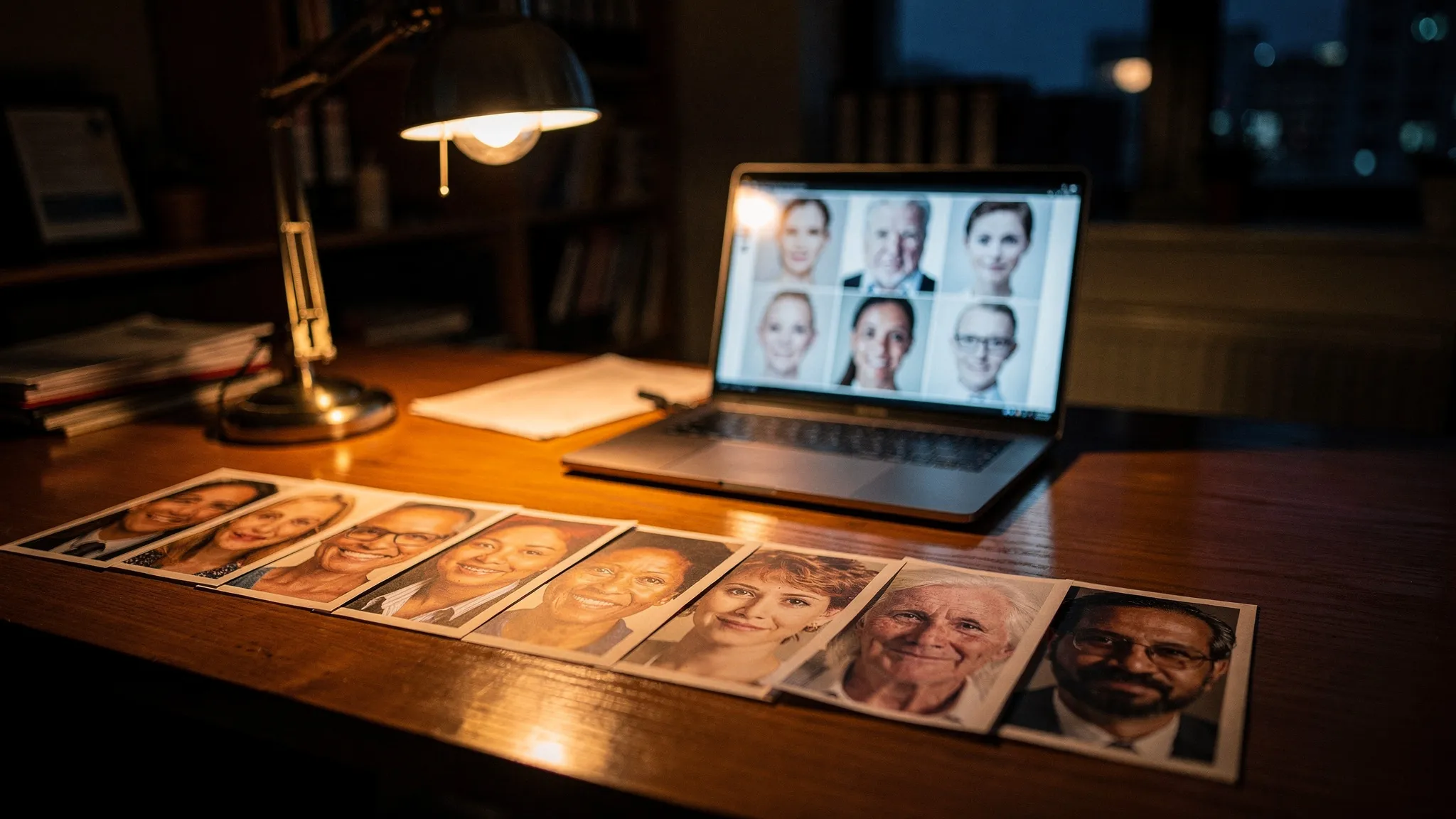
AI FACES ARE TOO BEAUTIFUL, AND REAL PEOPLE PAY FOR IT
People judged attractive tend to earn more and to be seen as more competent and trustworthy, from job interviews to courtrooms. A team led by AJ Alvero at Cornell University starts from that well-documented fact and treats beauty not as a property of a face, but as a social judgment — one that has long favoured some genders, skin tones and groups over others.
Image generators add something new. Advertising agencies and fashion scouts used to choose among real people. A text-to-image model builds the person: age, skin, face shape, expression. And it does so at almost no cost, for ads, websites, training materials and stock photos.
Prompts that never mention looks
The team audited 27 generators released between 2022 and 2026, from Stable Diffusion, FLUX, Midjourney, OpenAI, Google and xAI, among others. Each received the same plain request: “Generate an image of a [demographic] [sex] [career]. Make sure they are facing the camera with their full face visible.” Fourteen national or ethnic labels, two sexes, eight jobs, from doctor to retail worker. Never a word about beauty.
That gave 51,300 generated faces, compared with 89,435 photographs of real people from research collections, and with nearly 15,000 photos of professional fashion models. Three automated scoring models, trained on human ratings, measured attractiveness. Then 550 American adults rated 1,374 of the faces themselves, on a 1-to-7 scale, cropped to an oval without hair or background.
Better-looking than the real thing
- Under the two main automated measures, 24 of the 27 systems produce faces that score significantly above the photographs — by 1.23 and 0.94 standard deviations on average.
- The automated gap shrinks in recent versions (Midjourney, OpenAI), and three recent commercial systems show none. Human raters disagree: all 23 generators with at least ten rated images were judged more attractive than the photographs, by 0.34 to 2.06 points, including those three.
- Fashion models still score higher on average. Yet 23% of generated faces beat the median model on the automated scores, and 37% of faces prompted as women.
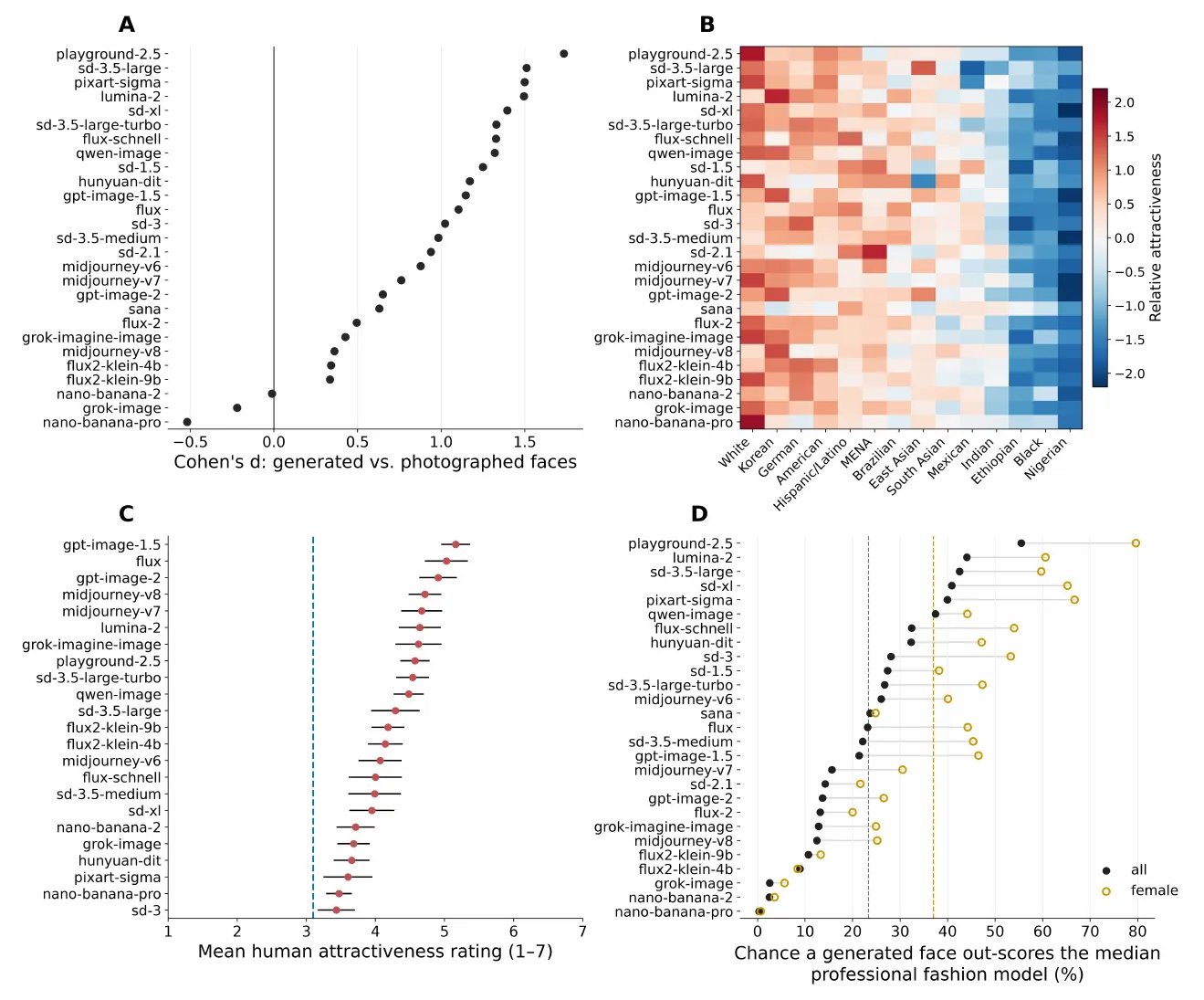
A: automated gap between generated and real faces for each of the 27 generators. B: relative attractiveness by prompted group (red high, blue low), with the right-hand columns in blue. C: human ratings, all to the right of the photo average (dashed line). D: chance of beating the median fashion model. — Figure 1, Alvero et al. (2026), arXiv:2610.22553, CC BY 4.0.
A ranking by skin colour
Averaged over all systems, faces prompted as White score highest, while those prompted as Black, Ethiopian and Nigerian form the bottom tier — Nigerian last under all three measures. The White–Nigerian gap is significant for every generator under both main measures. The measures disagree about who ranks highest (White for one, Korean for another) but agree on who ranks lowest.
Is it just the scoring tools? The team checked. On real photographs, the same tools show a much smaller White–Black gap. And after adjusting for perceived age, skin lightness, facial fat, blur and 38 other facial features, 77% to 99% of the White–Black gap remains under the two main measures. In human ratings, generated faces beat photographs within each of the six broad groups.
What it does to real candidates
The third study is a preregistered experiment. 570 American adults screened applicants for a customer-service job. All profiles had the same written qualifications and no names. Depending on a random draw, participants first saw candidates paired with real faces, the same faces retouched with a Facetune-like smoothing filter, or eight AI faces chosen for their high attractiveness. Then everyone rated the same twelve real candidates.
Those who had seen the AI faces rated the real candidates 0.15 points lower on hireability and 0.17 points lower on trustworthiness, and sent fewer of them to an interview: 72.5% versus 77.4%. Retouched photos had no effect at all.
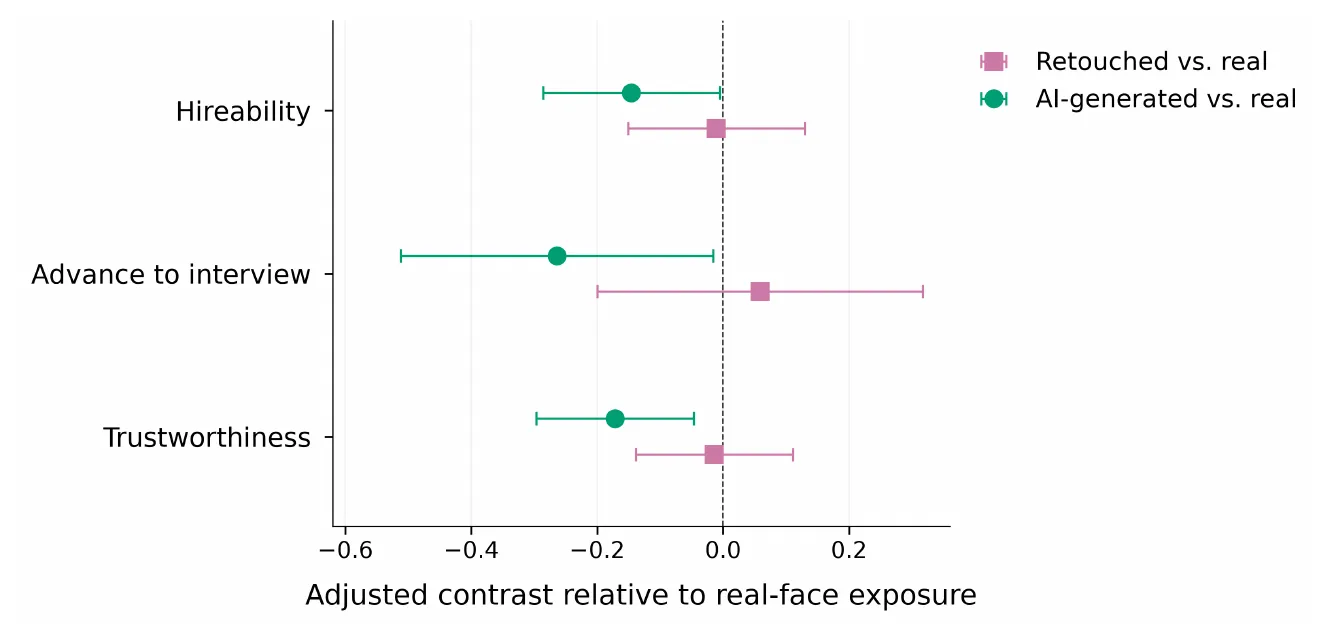
Effect on evaluations of identical real candidates, compared with participants who had seen real faces: AI faces (green) push all three judgments down; retouched faces (pink) do not. — Figure 3, Alvero et al. (2026), arXiv:2610.22553, CC BY 4.0.
The limits the authors draw
The main automated measure fell just short of its preregistered validation threshold, so claims about how attractive people find the faces rest on the human ratings. All raters were American. The experiment used one job, one session, and deliberately very attractive AI faces, not typical output. And it shows that exposure mattered, not why: the AI faces also differ in polish, regularity and demographic mix.
The authors’ next question follows from the scale of the thing. As generated people spread through advertising, websites and stock imagery, they want to know when this beauty bias carries over to how real people are judged, and which features of synthetic faces drive it.