NO SIGN OF A HIDDEN FORCE BENDING GALAXIES
Recent measurements of the expansion of the Universe leave room for dark energy that evolves over time, rather than a fixed cosmological constant. One proposed explanation is that dark energy interacts with dark matter. That would break a pillar of physics, the equivalence principle, which says that everything falls the same way, but only in the dark sector.
Such models produce a fifth force acting on dark matter alone. Laboratory tests of the equivalence principle reach parts in 10¹³ to 10¹⁵, but by construction they cannot see a force that ignores ordinary matter. The best limits so far came from cosmology, at a few thousandths of gravity, and some readings of the latest data even favour a force of that size.
A disk left behind
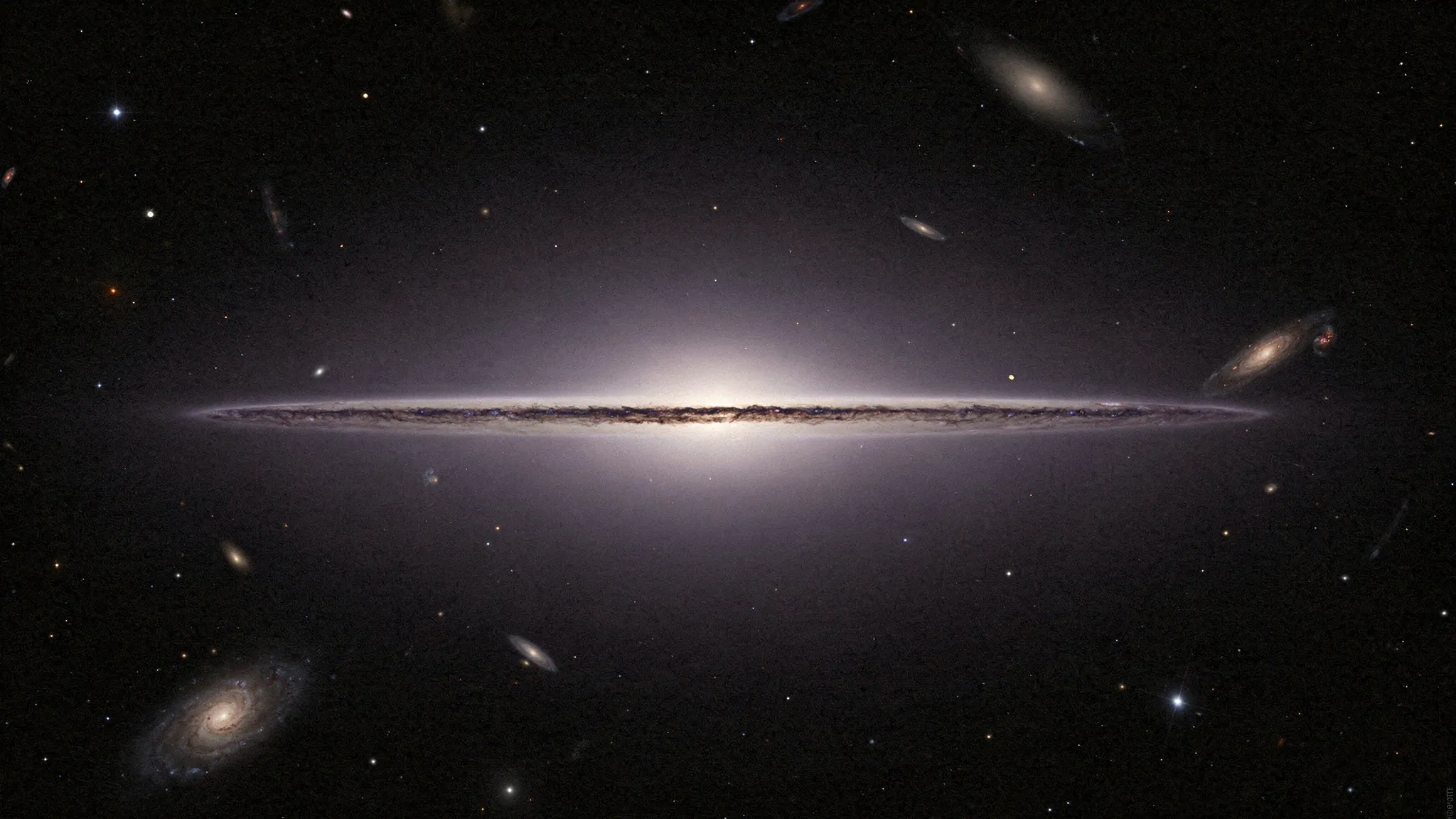
Harry Desmond (University of Portsmouth) and Pedro G. Ferreira (University of Oxford) look for it inside galaxies. A spiral galaxy is a disk of stars and gas sitting inside a much larger halo of dark matter. If a fifth force pulls the halo towards neighbouring structures but not the stars, the halo moves ahead and the disk lags behind, by a few tens of parsecs.
The disk stays bound to the halo, but the halo’s restoring pull weakens towards the outskirts. So the outer stars must be displaced further than the inner ones, and the disk bends into a U shape, a cup opening away from the force. The depth of the cup is exactly proportional to the strength of the force.
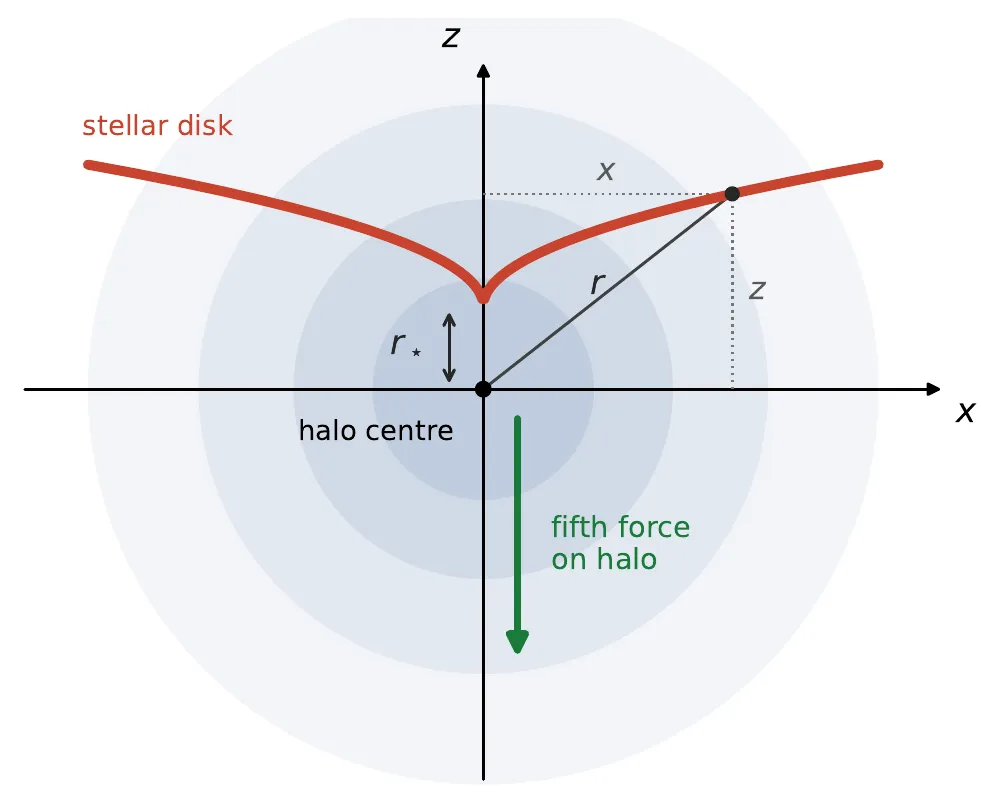
How a force on dark matter alone bends a disk: the halo is pulled away (green arrow), the disk settles off-centre and curls into a U. — Figure 1, Desmond & Ferreira (2026), arXiv:2610.24618, CC BY 4.0.
Thousands of edge-on disks
The predicted warp is far too small to see in any single galaxy, and real galaxies are warped by many ordinary causes. The test is therefore statistical. The authors measured the midline of 3,968 disks seen edge-on in Sloan Digital Sky Survey images, with a measure that responds only to U-shaped bends and ignores the S-shaped warps common in spirals.
From a map of the matter in the local Universe, out to 290 megaparsecs, they computed for each galaxy the direction and strength of the fifth force it would feel. If the force existed, the warps would line up with these predictions.
They do not. The measured warps show no sign of the predicted correlation, and even lean very slightly the other way, an effect the authors trace almost entirely to one galaxy with a foreground star left in its image.
A limit three times tighter
The result is an upper limit: the fifth force must be weaker than 7.7 × 10⁻⁴ of gravity (95% credibility) for ranges of 8 megaparsecs and beyond. After testing fifteen variations of their assumptions, the authors quote a conservative limit of 1.7 × 10⁻³.
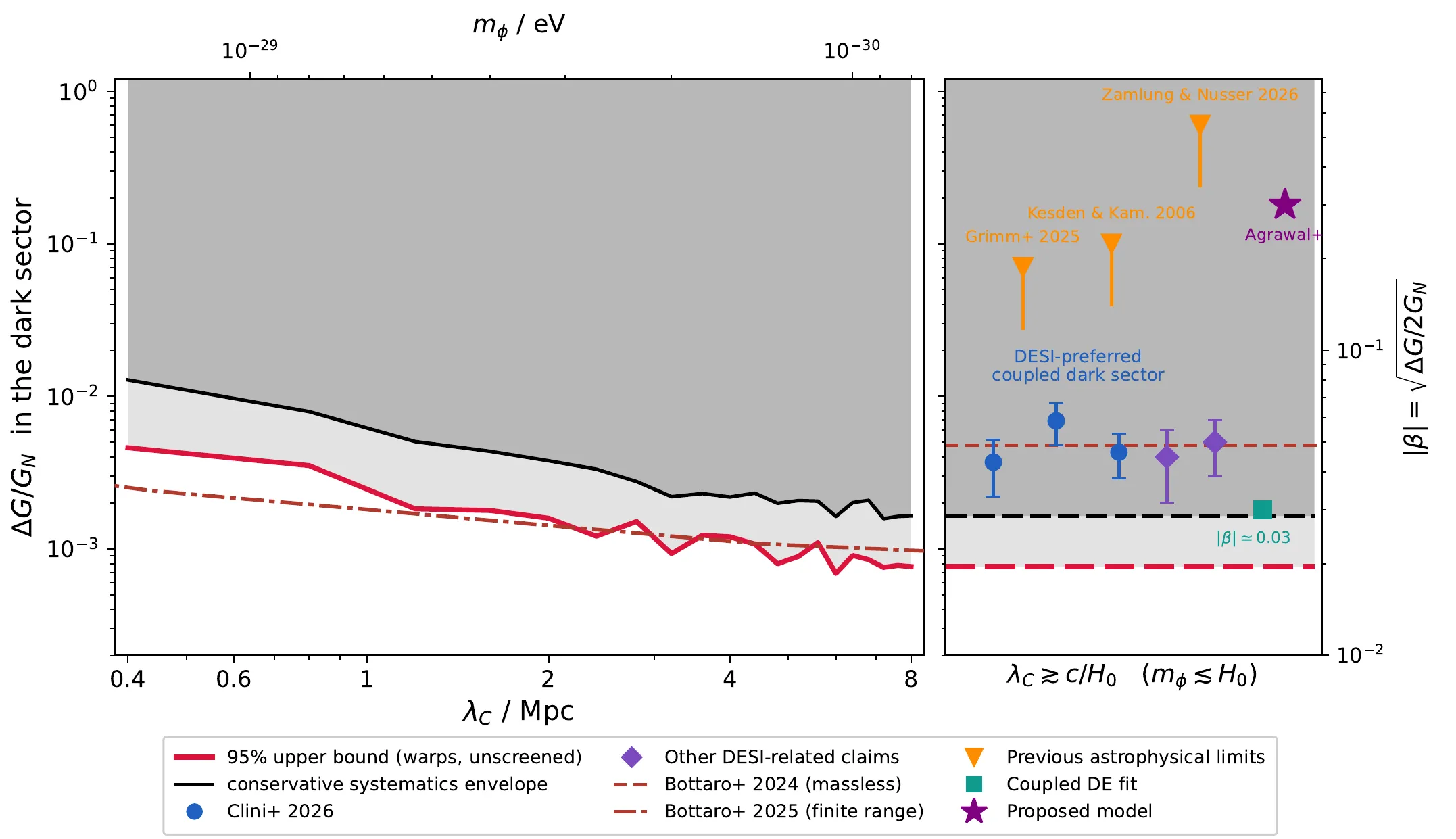
Excluded region (grey) for the strength of a dark-sector force against its range; on the right, the infinite-range case, where several values preferred by fits of DESI data (blue, purple) lie above the new limit. — Figure 3, Desmond & Ferreira (2026), arXiv:2610.24618, CC BY 4.0.
For an effectively infinite range, even the conservative limit is three times stronger than the tightest cosmological bound, and 43 to 360 times stronger than earlier astrophysical tests. It disfavours, at about 2 to 3 sigma, the couplings preferred by several recent fits of interacting dark energy to data from the DESI survey.
The two approaches are complementary. Cosmological limits depend on how the field behaved over cosmic history; the warp test measures the force acting on dark matter today. At intermediate ranges, a cosmological analysis of the simplest model still gives a tighter bound than the conservative one here.
Ways out
A theory could still hide the force inside galaxies with a “screening” mechanism. The authors show that the common kinds of screening cannot do so while keeping the force relevant for cosmology. Two more exotic options, Vainshtein screening and a so-called disformal coupling, remain open and are left for future work. Until then, they suggest that fits of interacting dark energy should treat 1.7 × 10⁻³ of gravity as the ceiling.