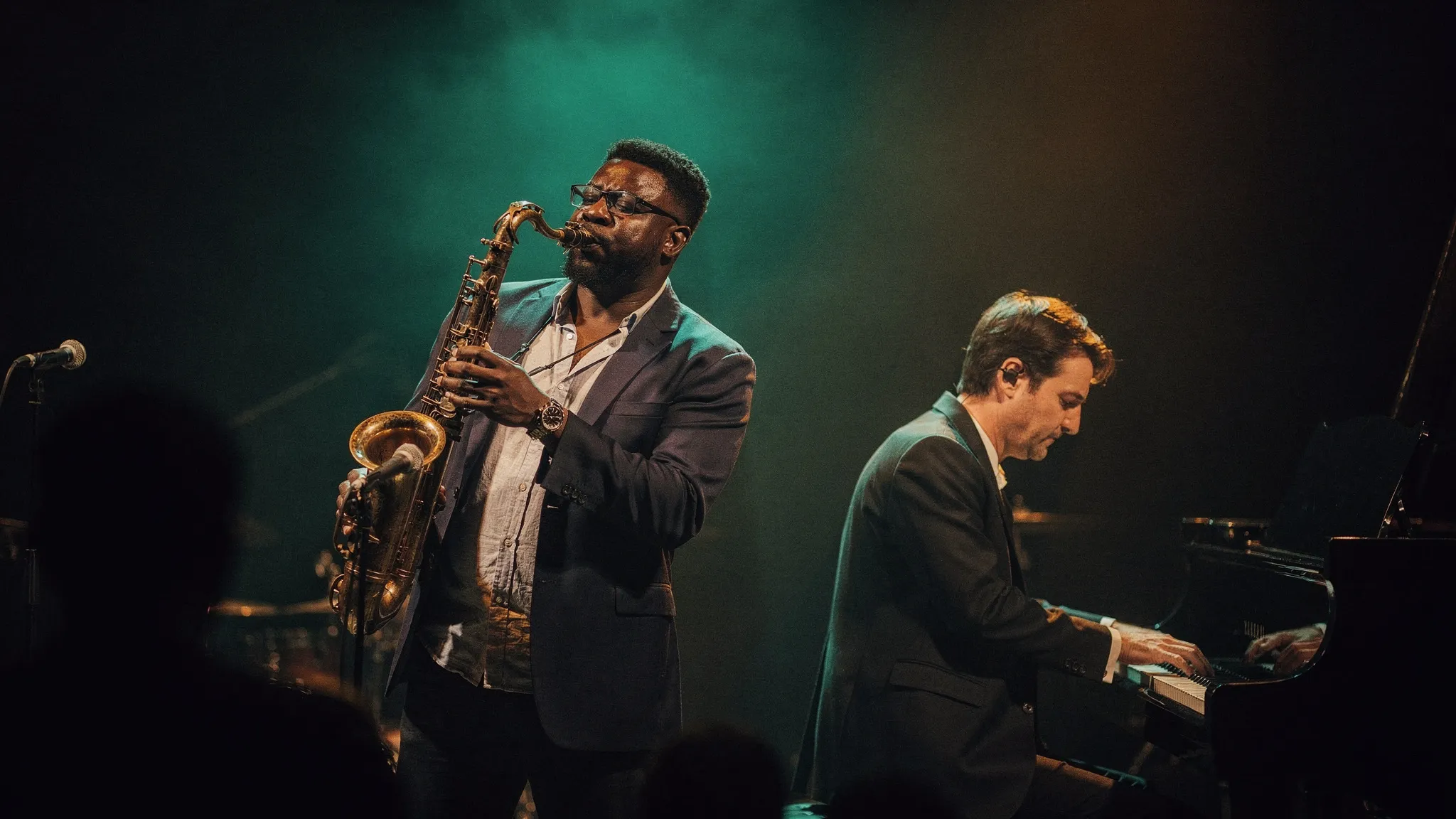
TWO JAZZ PLAYERS, TWO VOICES, ONE GROOVE
Much of what people value most in creativity happens between them: a conversation, a collaboration, a jam. Yet how two minds jointly manage the flow of novelty, moment by moment, is unknown. And there is a puzzle. Partners who fully converge produce nothing new; partners who ignore each other do not interact at all. Creative duos must sit somewhere in between — but where, and how?
Tatsuya Daikoku and colleagues at the University of Tokyo, with the University of Cambridge and Seitoku University, looked for the answer in jazz, where two musicians often trade solos, taking turns to improvise over the same tune.
Measuring surprise, note by note
The brain constantly predicts what comes next, and music plays with those predictions. The team first built a model of what jazz “expects”: a statistical-learning model trained on 456 professionally transcribed solos by 78 musicians, from the Weimar Jazz Database. For every new note, it gives two numbers, in bits — the unit of surprise: a note given a one-in-two chance is worth 1 bit, a one-in-four chance 2 bits: how surprising the note was given what came before, and how uncertain the context was — how many continuations seemed plausible.
They then let the model listen to real duos from an existing corpus: solo-trading sections of the jazz standard Autumn Leaves, played by 6 professional duos — bass and guitar, piano and bass, piano and saxophone, piano and violin, saxophone and electric bass, trumpet and guitar. In all, 54 takes, 530 solos and 11,433 notes, separated by instrument and transcribed with the help of AI tools, then checked by hand. Melody (pitch) and rhythm were analysed separately.
The melody says who is playing
In pitch, each musician keeps a personal signature:
- within a take, the two partners differ significantly in 90% of takes; the same player compared with themselves in the next take, in only 35%;
- the gap between partners never closes, whether one turn or five turns apart;
- a classifier tells which partner played from a single solo (a score of 0.87, where 0.5 is chance), in all six duos;
- about 74% of the variation in melodic uncertainty is explained by who is playing, under 1% by which take.
The authors note a caveat: in every duo, the two musicians played different instruments, so part of this signature may come from the instrument rather than the person.
The rhythm says which performance it is
Rhythm shows the opposite pattern. Within a take, the partners are almost indistinguishable, and a classifier cannot tell them apart. Instead, the rhythm changes from one take to the next: each performance sets its own shared rhythmic state.
And only real partners share it. Pair a solo with the partner’s next solo in the same take, and the rhythmic distance — a score of how different the two solos’ rhythmic profiles are, from 0 when they are identical to 1 at most — is small. Pair it with the same partner’s solo from another take — a fake duet — and the distance doubles (0.116 against 0.238). Even when the fake duet is drawn from a neighbouring take, just before or just after, the distance stays larger (0.161).
That shared state is not frozen. Over a take, each player drifts away from their own earlier solos at the same rate as from their partner’s. The two are not diverging; they seem to be travelling together.
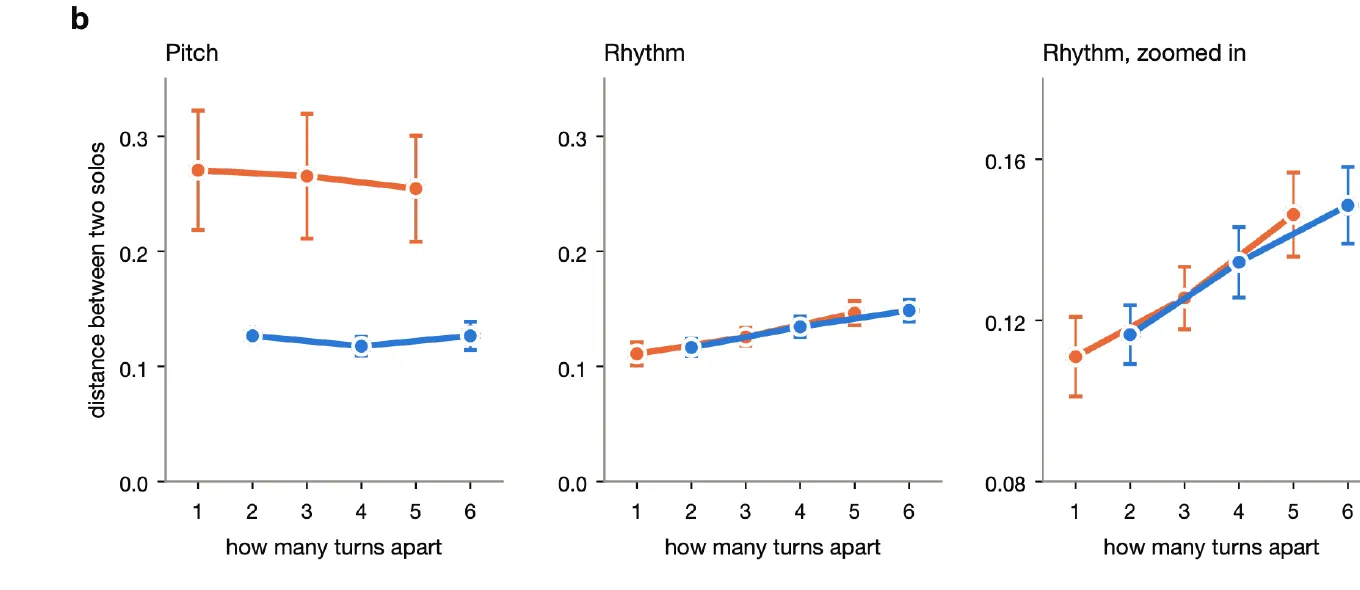
Distance between two solos by how many turns separate them, comparing a player with the partner (orange, odd turns) or with their own earlier solos (blue, even turns). In pitch, a wide gap never closes; in rhythm, the lines overlap and climb together. — Figure 1b, Daikoku et al. (2026), arXiv:2610.31131.
Push and pull at every hand-off
On top of this, the turns themselves are coupled. When a player’s solo is more surprising than their own average, the partner’s next solo tends to be less surprising than theirs — in both rhythm and pitch, in all six duos, and far beyond what two shuffled controls produce. Across the 415 hand-offs of the corpus, the correlation is −0.19 for rhythm and −0.10 for pitch: a modest tendency, but a consistent one.
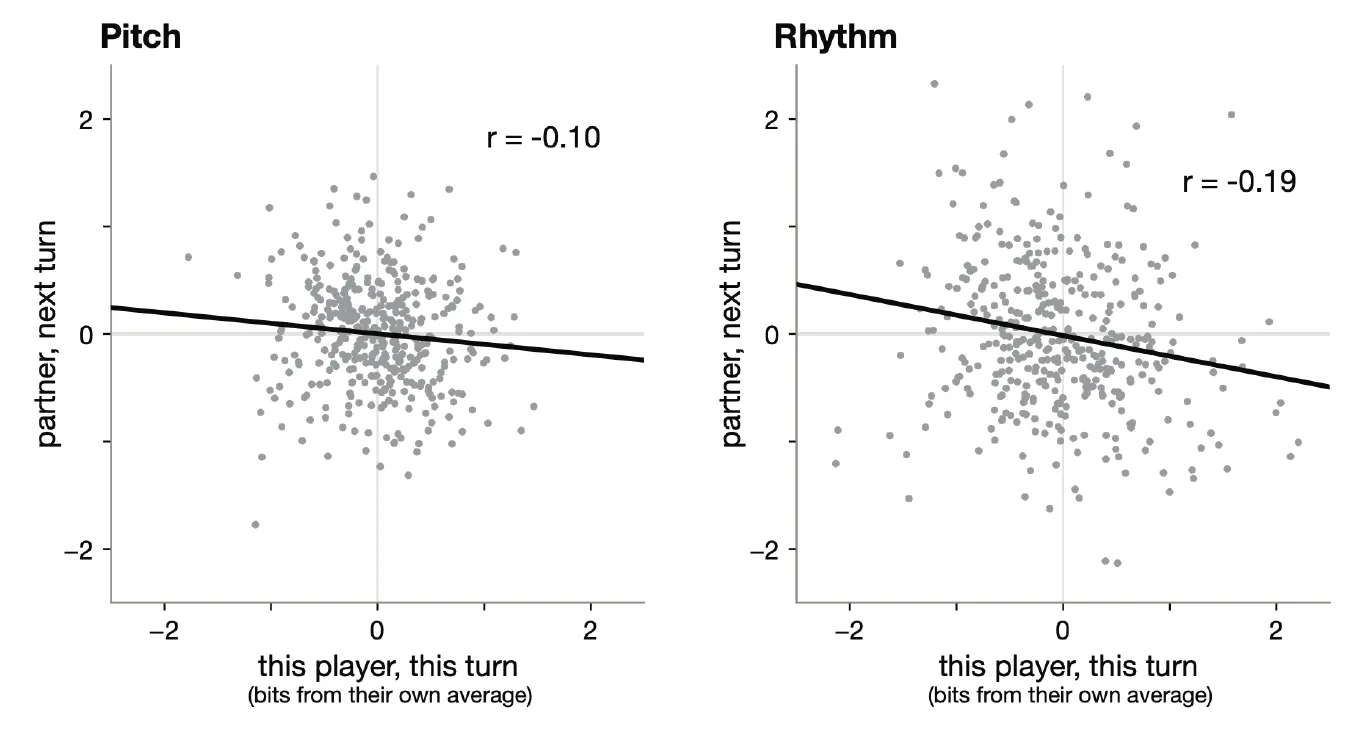
Each dot is one hand-off between solos. Excess surprise by one player is answered by restraint from the other. — Figure 2, Daikoku et al. (2026), arXiv:2610.31131.
This is complementarity, not imitation. The authors’ reading: when one spends, the other saves, keeping the duo’s total surprise within a workable band while the shared groove explores.
Close and distinct at once
Two improvisers, then, neither merge into one system nor stay two separate ones. They keep their own melodic voice to the end, share the rhythmic feel of the moment, and rebalance at every exchange. The authors predict the same split should show up in conversation, between what marks the speaker and what belongs to the conversation.
Limits remain: one tune, one style, six duos, and observational data that cannot show cause. Nor does the study show yet that this push and pull is what makes a performance sound creative to listeners — the next step, the authors say.