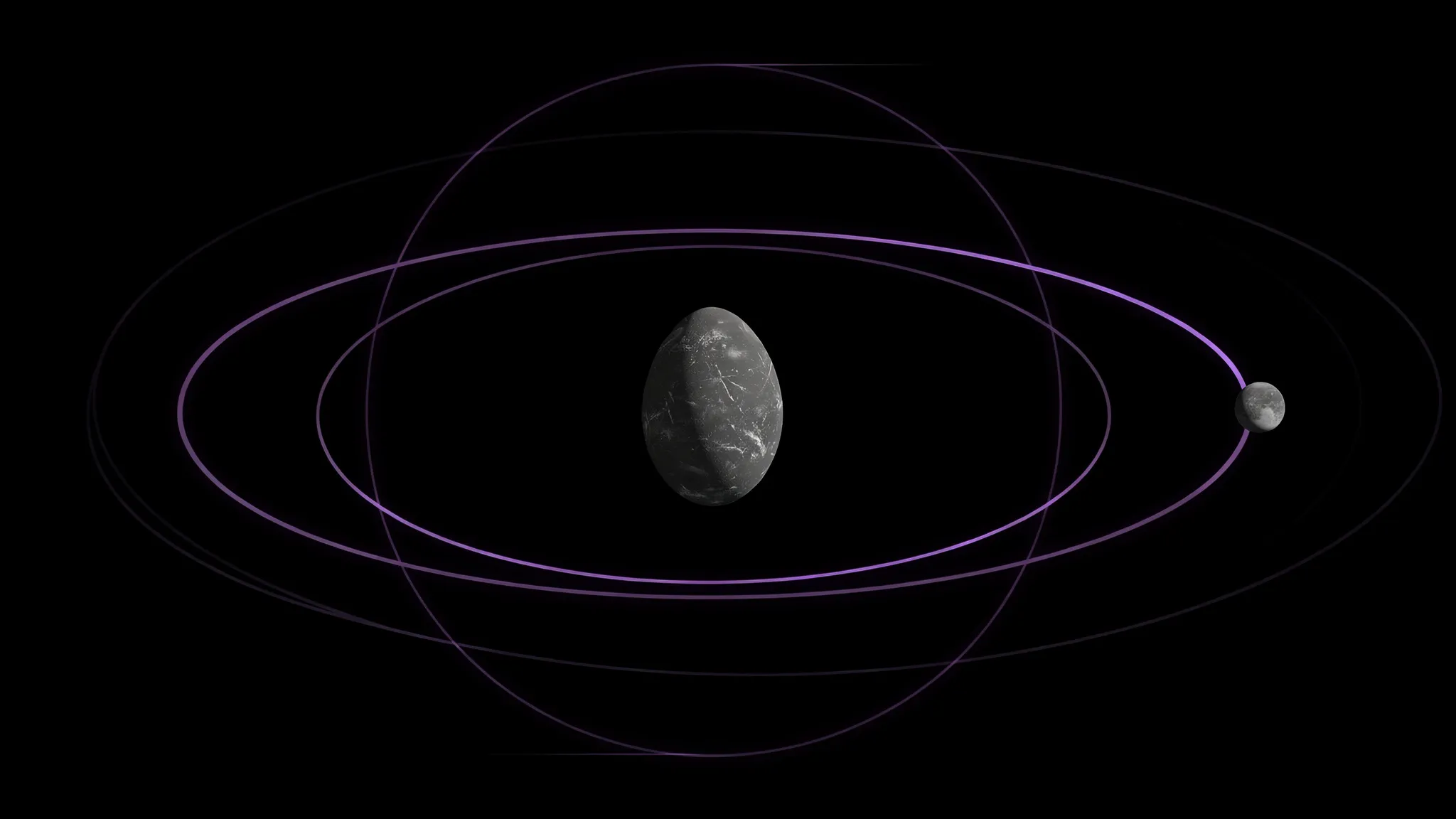
QUAOAR IS NOT A BALL, AND ITS MOON HAS BEEN WEIGHED
Far beyond Neptune, the trans-Neptunian objects take more than two centuries to circle the Sun. Most of the large ones were discovered in the early 2000s, so we have watched only a small slice of their orbits — and we keep seeing them from almost the same angle. For (50000) Quaoar, that angle has changed by just 1.7 degrees across the observations used here. Working out a three-dimensional shape from a single point of view is like guessing the shape of a potato from its shadow on one wall.
Two ways to see a far-away shape
Astronomers have two tools.
- Light curves. As an object spins, its brightness changes. A sphere or a flattened ball looks the same from every side, so its light stays flat — unless dark or bright patches on its surface create one peak per turn. An object stretched in three directions, a triaxial ellipsoid, shows its largest face twice per rotation: two peaks per turn.
- Stellar occultations. When the object passes in front of a star, observers along its path see the star vanish for a moment. Each observer records a line across the object’s silhouette, a “chord”. Several chords give a snapshot of the outline; many occultations at different moments act like a form of tomography.
Quaoar sits in a region of the sky crowded with stars. That is good for occultations — there are plenty — but bad for light curves, which neighbouring stars contaminate. The best model so far described Quaoar as a flattened ball carrying an enormous surface spot to explain its flicker.
Thirty-seven shadows
Giuliano Margoti and colleagues at Brazil’s Observatório Nacional and the LIneA laboratory, the Federal University of Technology – Paraná, the Instituto de Astrofísica de Andalucía in Spain and the Paris Observatory built a method that fits occultations and light curves at the same time, along with their uncertainties.
They fed it 37 stellar occultations observed between 2011 and 2025 — 108 chords, 214 points on Quaoar’s edge — plus a light curve from 2003, reprocessed with modern tools, and new photometry from the Hubble Space Telescope in 2024 and 2025. One assumption anchors the model: Quaoar spins around the same axis as its rings.
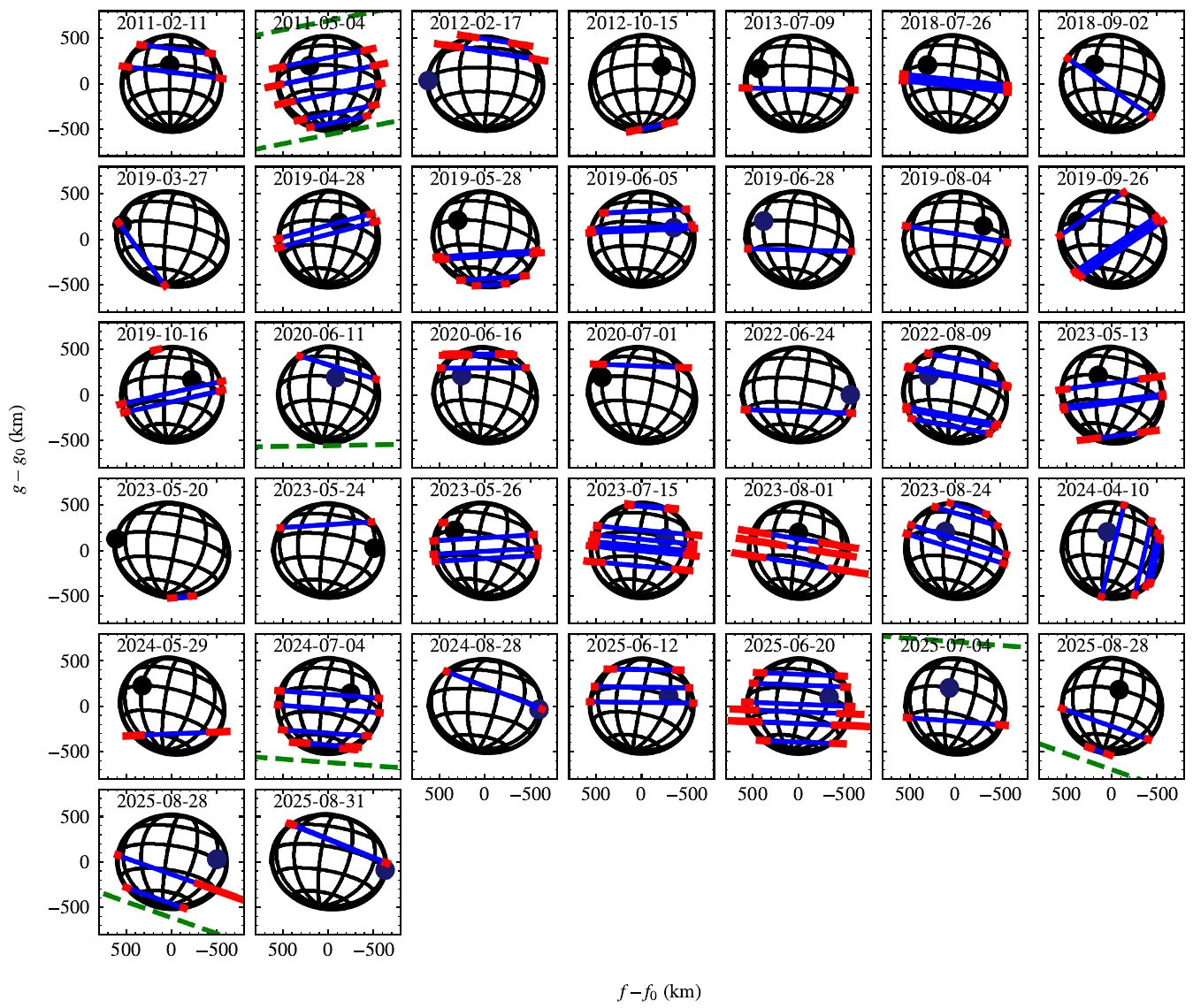
The fitted shape of Quaoar against each of the 37 occultations from 2011 to 2025: blue lines are the chords where the star disappeared, red marks their uncertainties, dashed green lines the nearest observers who saw nothing. — Figure 4, Margoti et al. (2026), arXiv:2610.30494.
A stretched world
The answer: Quaoar is triaxial. Its three semi-axes measure about 621, 547 and 512 kilometres — so roughly 1,241 by 1,093 by 1,023 km end to end. Its volume equals that of a sphere 1,116 km across, and its density is 1.66 grams per cubic centimetre. It turns once every 17.68 hours or so, and the stretched shape alone reproduces both the 2003 and the Hubble light curves with the same period. The fit to the occultation edges is tight: a weighted scatter of 2.1 km.
The authors explain why they now prefer this shape to the flattened one. The old model needed a spot covering nearly half a hemisphere, hard to produce naturally, and two slightly different rotation periods for the two light curves. The triaxial shape needs neither.
Weighing Weywot by a wobble
Quaoar has a small moon, Weywot. Predictions of Quaoar’s position track the centre of mass of the pair, but an occultation pinpoints Quaoar’s own centre. Because Weywot has some mass, Quaoar swings slightly around that shared centre, opposite to its moon. Comparing Quaoar’s measured offsets with Weywot’s position at each event — directly observed in two occultations where both bodies were caught — gives the ratio of their masses.
Result: Weywot weighs about 1.5 × 10¹⁸ kilograms, roughly a thousandth of Quaoar’s mass. Its density comes out at 0.95 ± 0.60 grams per cubic centimetre, a loose figure because Weywot’s size is uncertain. The wobble is only a few thousandths of an arcsecond, too small for the Gaia satellite’s single measurements of such a faint object, but within reach of occultations, often precise to better than two thousandths.
Rings tuned to the spin
The new shape also matters for what orbits Quaoar. Its gravity is more lopsided than previously thought — the relevant coefficient is about three times the earlier estimate. In the team’s simulations, any material within about 2.4 Quaoar radii is cleared out in less than three years, so smaller moons can only survive further out. The inner, fainter ring lines up within 20 km of a 5:7 resonance with Quaoar’s spin — at that distance a ring particle completes five orbits while Quaoar turns seven times — and the main, outer ring can be linked to a 2:6 resonance if its particles follow stretched orbits — which might also explain why that ring’s width changes around Quaoar. The authors note one caveat: they treated Quaoar as uniform inside, whereas it has probably partly separated into layers, though they do not expect this to change their conclusions qualitatively.