THE SEA'S SALT CATCHES GHOST PARTICLES
Giant neutrino telescopes such as IceCube and KM3NeT turn natural ice or seawater into detectors: cubic kilometres of transparent medium, watched by thousands of light sensors. They have caught neutrinos from deep space at enormous energies. But at lower energies, in the range of a few million electronvolts (MeV), their sensors are too far apart to spot a single neutrino interaction. They can only notice a collective rise in their counting rates.
That is a pity, because MeV neutrinos carry precious information. A nearby collapsing star — a core-collapse supernova — releases around 10⁵⁸ of them, straight from its heart. Others, called geoneutrinos, probe the Earth’s interior; those from nuclear reactors allow precise measurements and remote monitoring.
A signal in two beats
Electron antineutrinos are caught through a reaction called inverse beta decay: the antineutrino hits a proton and produces a positron — the electron’s antimatter twin — and a neutron. The positron gives an immediate flash of light. The neutron wanders for a while, then is captured by a nucleus, which gives off a second flash. Two flashes, close in time and place: a signature that background noise rarely imitates.
In pure water, the neutron is captured by hydrogen after about 200 microseconds, emitting a gamma ray of only 2.2 MeV. Dense detectors such as Super-Kamiokande or SNO+ can see it. In a sparse ocean telescope, buried in the noise of cosmic muons, sensor noise and natural radioactivity — especially potassium-40 dissolved in seawater — it is almost invisible.
Chlorine to the rescue
Ruike Cao, Iwan Morton-Blake, Donglian Xu and their colleagues at Shanghai Jiao Tong University point out that seawater already contains the solution. Chlorine-35 makes up only about 0.25% of the nuclei in seawater, but it captures slow neutrons about 130 times more readily than hydrogen (43.6 barns against 0.333 — the barn is the unit physicists use for a nucleus’s chance of catching a particle). And its capture releases a cascade of gamma rays worth about 8.6 MeV — four times more energy, so many more photons to detect.
The capture is also quicker: about 130 microseconds in seawater instead of about 200 in pure water. A shorter wait means a narrower time window, and fewer chance coincidences.
Twice as far
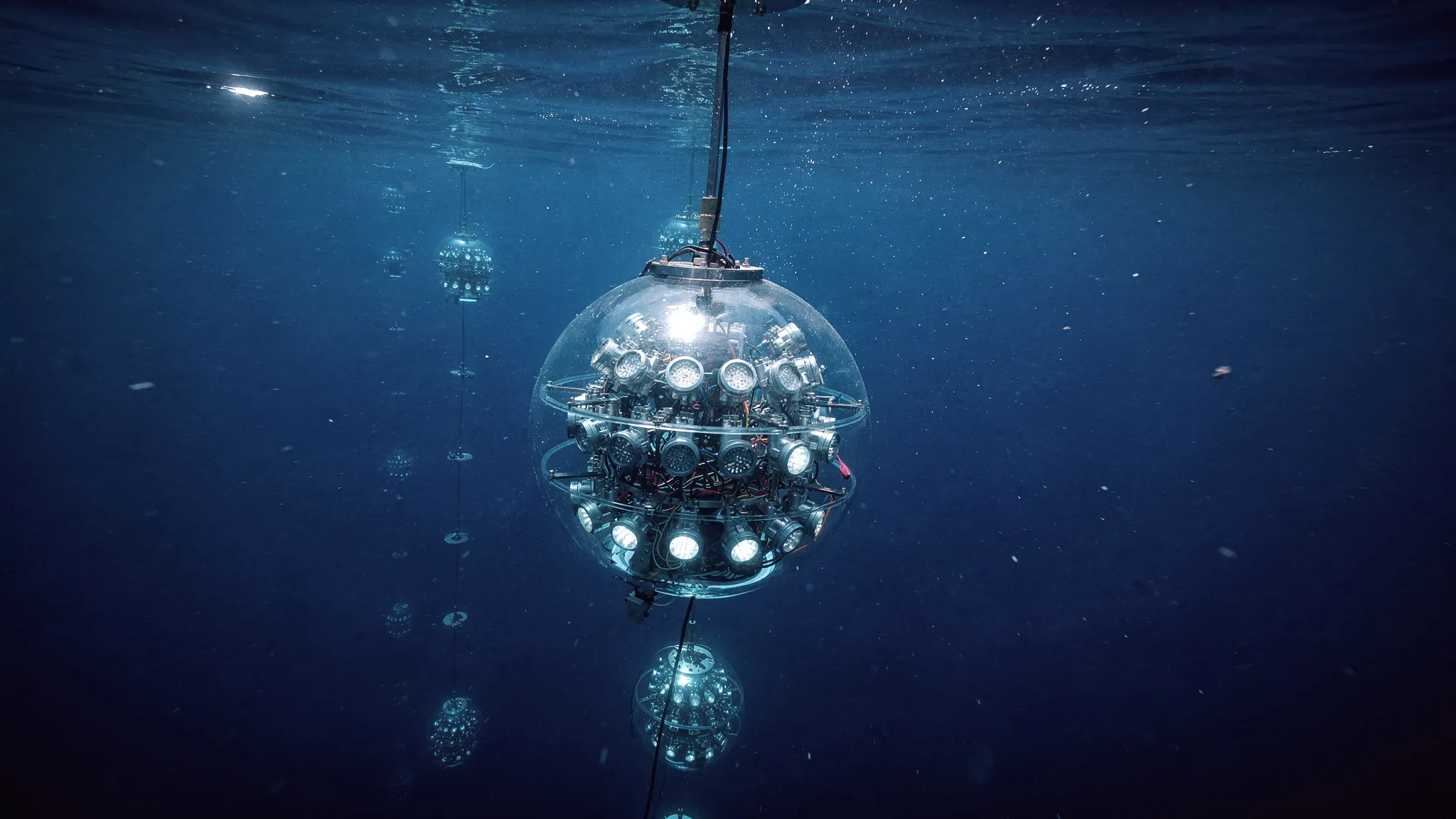
The team simulated the idea in TRIDENT, a next-generation neutrino telescope planned in the South China Sea, which should instrument about 10 cubic kilometres of water with some 1,000 strings of sensor modules. Each module holds 31 small light sensors, so it can require several of them to fire at once. Their simulation included the potassium-40 activity measured at the site and the muons that still reach a depth of about 3 kilometres.
Four filters pick out the antineutrinos: how many sensors light up, the delay between the two flashes (under 0.3 milliseconds), the direction of the light, and a veto when neighbouring modules see a passing muon.
The gain is large. For a benchmark star of 27 solar masses, TRIDENT would detect the collapse with 5-sigma significance — the physicists’ bar for a discovery, under one chance in a million of a fluke — out to about 50 kiloparsecs (one kiloparsec is about 3,260 light-years) using the first flash alone. Adding the chlorine-tagged neutron extends that to over 100 kiloparsecs — double the distance. With another supernova model (30 solar masses), the horizon grows from about 60 to 125 kiloparsecs.
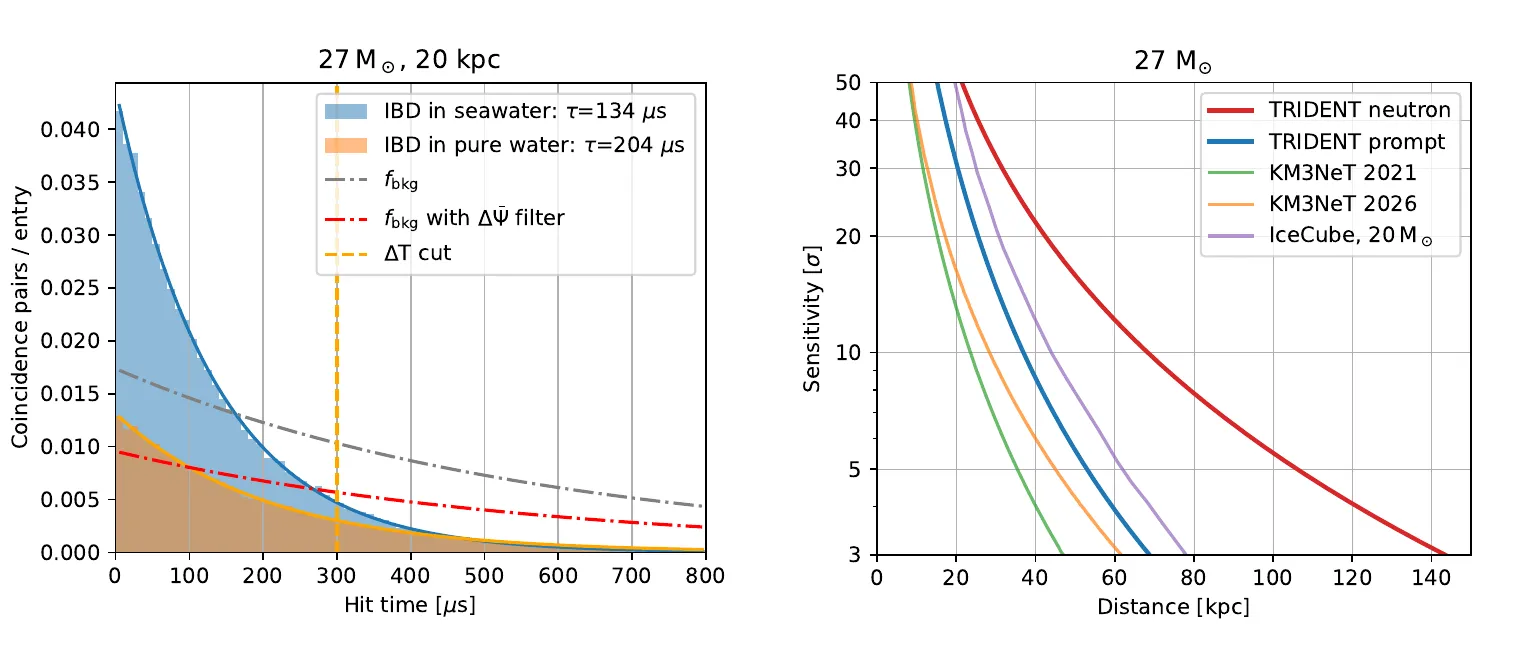
Left: in seawater (blue), neutron captures come faster and more visibly than in pure water (orange). Right: tagging the neutron (red) pushes TRIDENT’s supernova horizon far beyond the first-flash signal alone (dark blue). — Figure 2, Cao et al. (2026), arXiv:2610.30754.
Tested under a mountain
To check the principle, the team lowered one TRIDENT module into a 0.5-tonne water tank at the China Jinping Underground Laboratory, under 2.4 kilometres of rock that blocks most cosmic muons. An americium–beryllium source 30 centimetres away produced the same two-beat pattern as an antineutrino: a gamma ray, then a neutron.
They tried pure water, water salted to seawater concentration, and salted water with extra potassium chloride to mimic the ocean’s radioactivity. In the salted water, an excess of quick second flashes appeared, with a significance above 3.4 sigma (below the 5-sigma discovery bar, but well beyond chance) and a capture time of 0.14 ± 0.04 milliseconds — in line with seawater. With the source removed, nothing. With the added potassium, the excess was weaker, around 2 sigma.
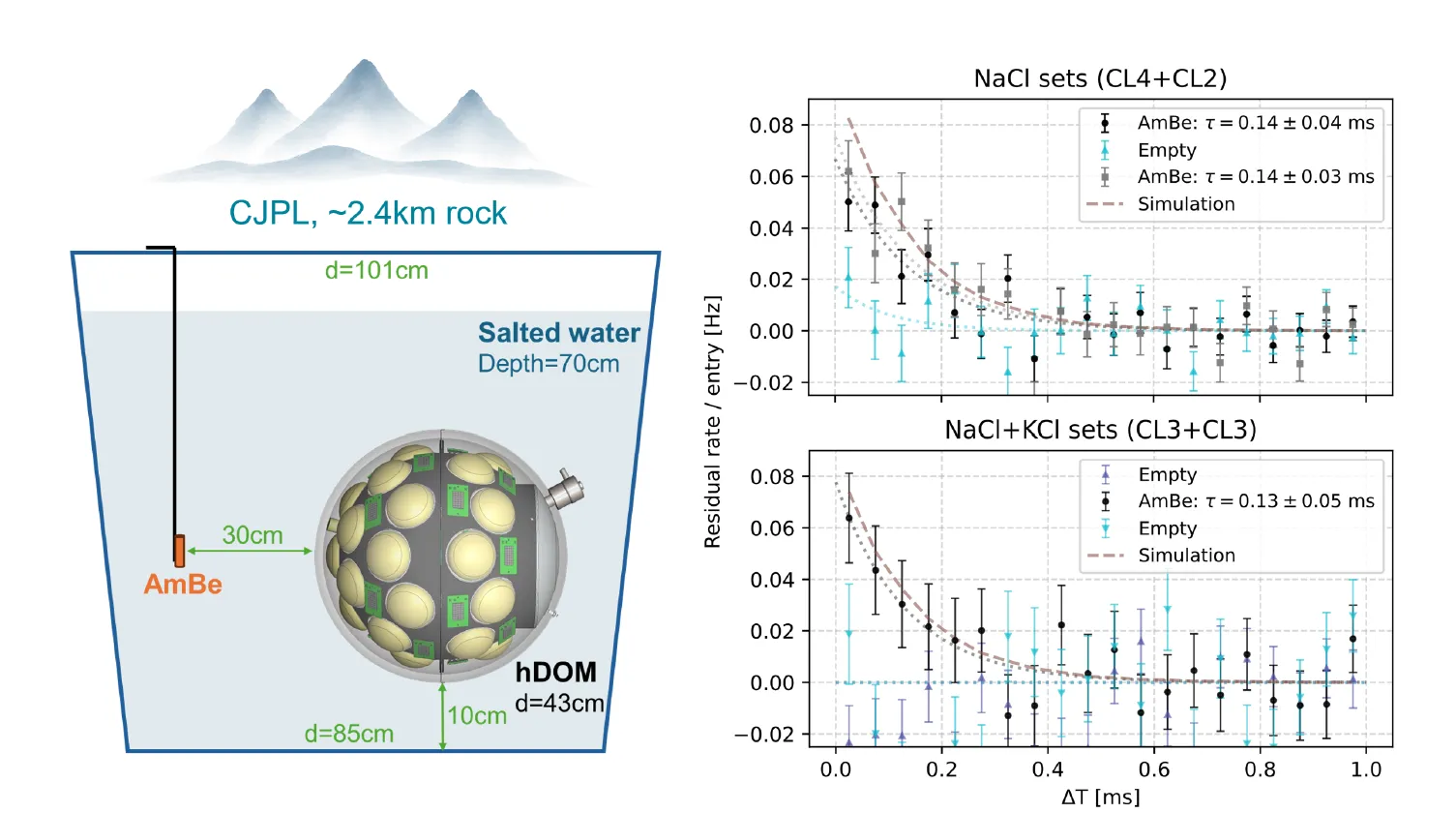
Left: the test set-up at Jinping. Right: with the source in salted water (black), an excess of short delays matches the simulated neutron capture (dashed). — Figure 3, Cao et al. (2026), arXiv:2610.30754.
An ocean full of detectors
The authors see the same trick working in other seawater telescopes with multi-sensor modules, such as KM3NeT and P-ONE. Because the salt is already there, they also imagine antineutrino detectors scattered through the sea, each placed for its own target: exploding stars, nuclear reactors or the Earth’s interior. The ocean’s natural salinity, they write, becomes an asset rather than a background. The results rest on simulations of a telescope still being planned, plus one tank test.