THE OVERSIZED PLANET OF BOYAJIAN'S STAR MAY WEAR A RING
On 3–4 September 2019, the TESS satellite watched a star called KIC 8462852 lose about 1.1% of its light for roughly 21 hours, then recover. The dip was smooth and symmetric: exactly what a solid, roughly round body produces when it passes in front of its star. For this star, that was a striking change.
A clean dip on a restless star
Better known as Boyajian’s star or Tabby’s star, KIC 8462852 is otherwise ordinary. Yet during the four years the Kepler mission monitored it, its light dropped abruptly and irregularly, by as much as 15% and 22% — far deeper than any planet could cause. The dips are stronger in bluer light, a sign of dust grains rather than a solid body. Proposed culprits range from disintegrating comets to a swallowed planet, and even non-natural “megastructures”; none has won general acceptance. The leading models need an unseen massive companion whose gravity sends dust-making bodies onto orbits that graze the star.
A recent study by Madurga-Favieres and colleagues paired the clean transit with archival radial-velocity data: the tiny back-and-forth motion a companion imposes on its star. They found a companion of 9.4 Jupiter masses (somewhere between about 5 and 14), a radius of 1.7 ± 0.1 Jupiter radii, and an orbit of at least about 1,030 days. If confirmed, it could be the long-sought body that drives the star’s comets.
Too wide for its weight
Wei Zhu and Quanyi Liu, astronomers at Tsinghua University in Beijing, point to a problem in those numbers. A gas giant heavier than Jupiter is held up mostly by tightly packed electrons that resist compression; when it is cool, adding mass barely changes its radius. Models and the measured mass–radius relation of cool giants agree: 1.0 to 1.1 Jupiter radii from about 2 to 12 Jupiter masses.
The usual ways to puff up a planet fail here. Intense starlight inflates “hot Jupiters” on tight orbits, but this companion’s estimated temperature is only about 270 kelvin, around −3 °C. At about 1.2 billion years, the star is also too old for leftover heat from the planet’s formation to help. A radius of 1.7 is therefore 60–70% too large.
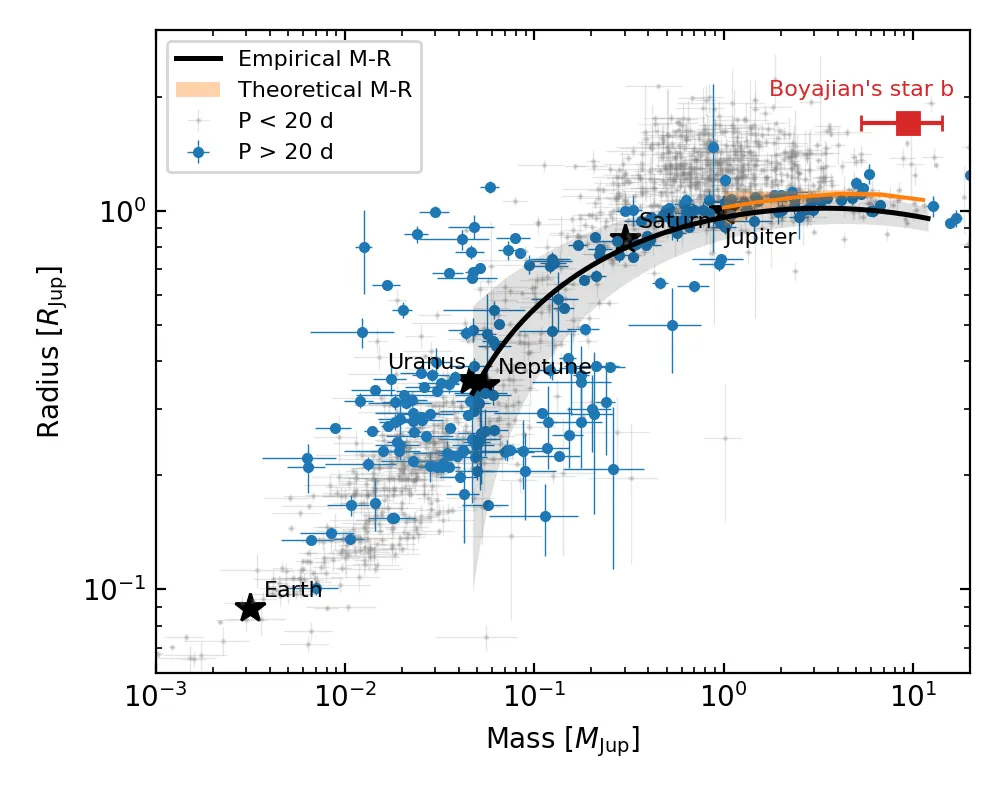 Known transiting planets by mass and radius: the companion of Boyajian’s star (red square) sits far above the size expected for a cool giant (black curve and orange band). — Figure 1, Zhu & Liu (2026), arXiv:2610.34806.
Hiding part of the shadow in a ring
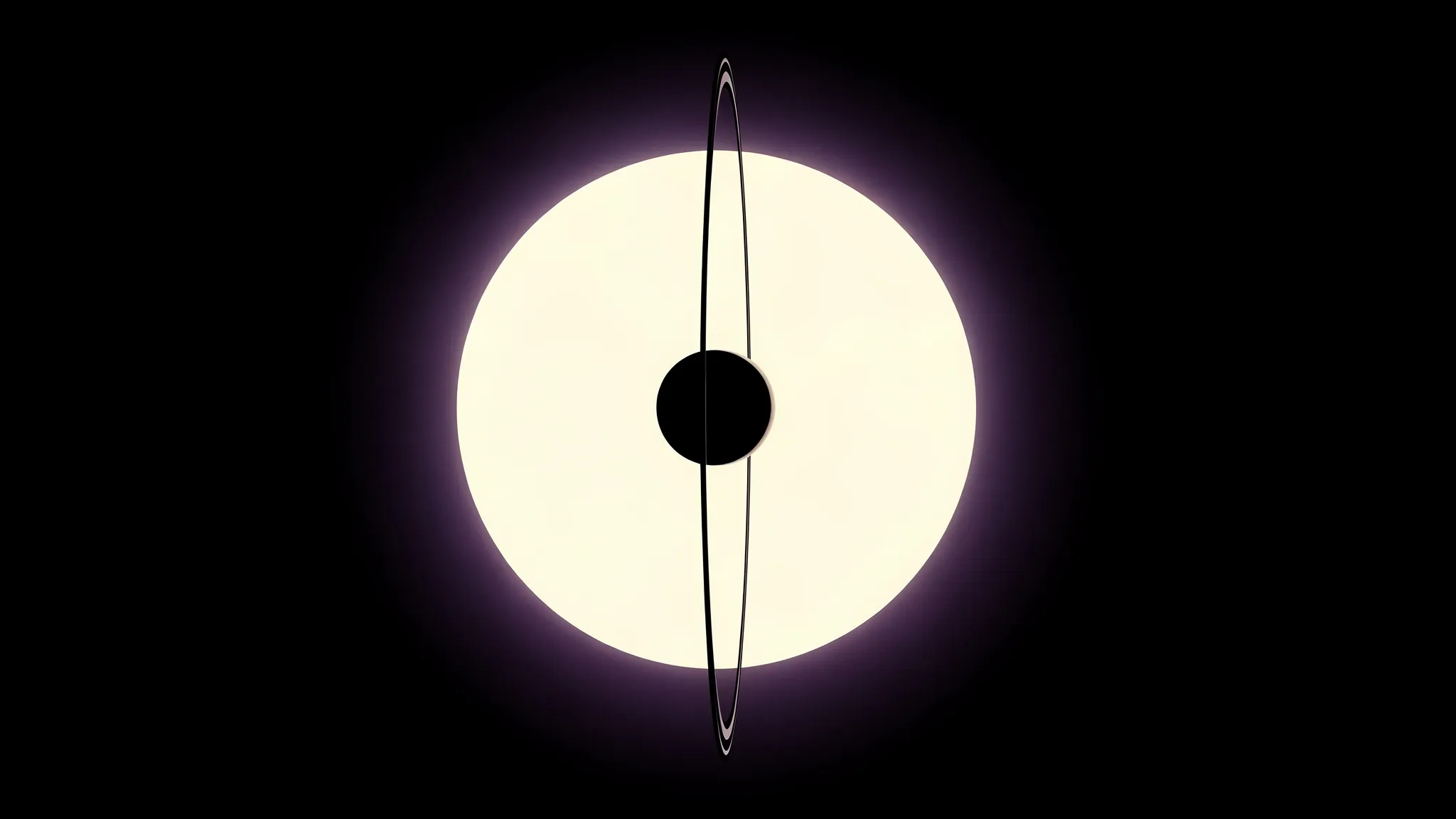
The proposal is geometric: an opaque ring around a smaller planet blocks extra starlight, and from afar the pair passes for one oversized planet. A ringed giant had been suggested for this star in 2018, but only as a sketch, with no ring parameters fitted.
The two astronomers reanalysed the TESS data, sampled every 2 minutes. A bare sphere fits, but it needs about 1.74 Jupiter radii and leaves a faint, structured mismatch near the bottom of the dip. They then extended their transit code, JoJo, to a planet with a flat ring seen from any angle. They fixed the planet at the size expected for its mass, 1.1 Jupiter radii, and made the ring fully opaque. Its outer edge had to stay within the Roche limit, the distance inside which the planet’s tides keep loose material from clumping into a moon; farther out, a ring would not last. A ring reaching beyond about 5 planet radii is judged highly unlikely.
An upright ring and a planet on its side
The best ringed solutions trade most of the planet’s apparent size for a wide, flattened ring:
- an outer edge at 3.1 to 4.4 planet radii, almost at the Roche limit;
- seen nearly edge-on, tilted 78–84° away from face-on;
- standing almost at right angles to the planet’s path across the star.
Since we see the orbit almost edge-on (the planet passes in front of its star), such a ring is tilted about 80° to the orbit. If it circles the planet’s equator, as Saturn’s does, this super-Jupiter rotates on its side, like Uranus. If real, a debris ring this close would likely be fed by shattered comets or small moons — perhaps the same population blamed for the star’s old dimmings.
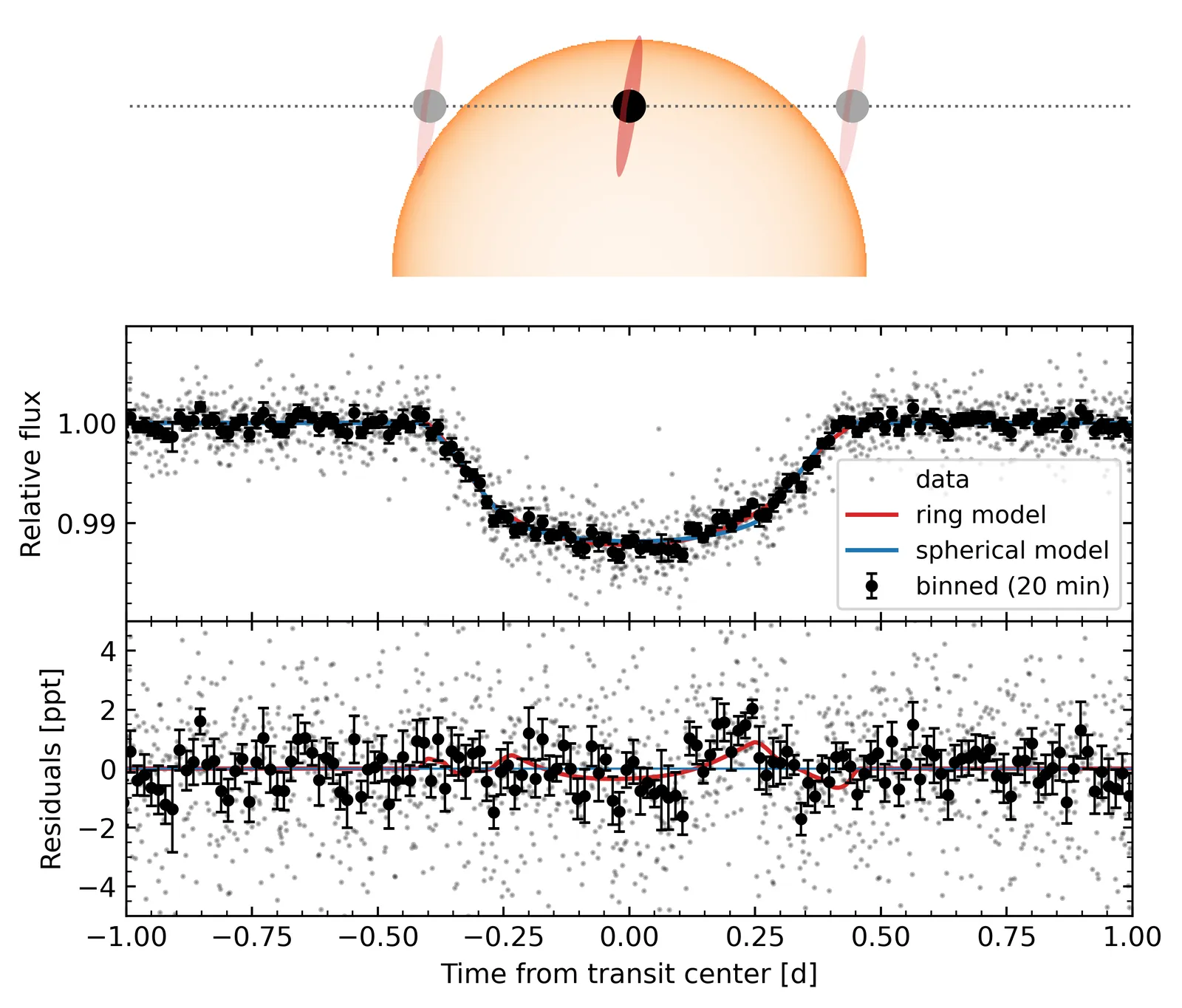 The best ringed planet entering, crossing and leaving the star (top), the TESS dip with the ring model in red and the bare-sphere model in blue (middle), and what the sphere leaves unexplained (bottom). — Figure 2, Zhu & Liu (2026), arXiv:2610.34806.
A near tie, decided by physics
Statistically, the contest is close. The ring improves a standard misfit score (χ²) by about 14, but it uses two more adjustable settings. Once a criterion that penalises extra settings (the BIC) is applied, its edge shrinks to 0.4 to 1.3 points: almost a tie.
The ring’s orientation rests largely on a slight rebrightening about 0.25 days after mid-transit, which a steeply tilted ring produces by starting to leave the star early. But the planet passing over a dark spot on the star could cause the same bump: while it covers a dark patch, it hides less light. Leave that bump out, the authors acknowledge, and the preference flips.
What survives is a simple argument. To block as much light as observed, the ring must reach at least 1.6 planet radii — a minimum that assumes a ring seen exactly face-on and touching the planet. Tilted like Saturn’s, it needs at least about 2.4 — already close to the Roche limit, which lies between about 2.5 and 5 planet radii depending on how dense the ring’s grains are compared with the planet. Either way, if a ring explains the radius, it must be a wide one.
The two pictures differ most as the planet enters and leaves the star’s disc, by a few parts in 10,000 of its light, within reach of existing space telescopes. For now, everything rests on a single transit, in data the authors themselves describe as of relatively poor quality.