HOW FAST MUST YOU WALL IN A FIRE?
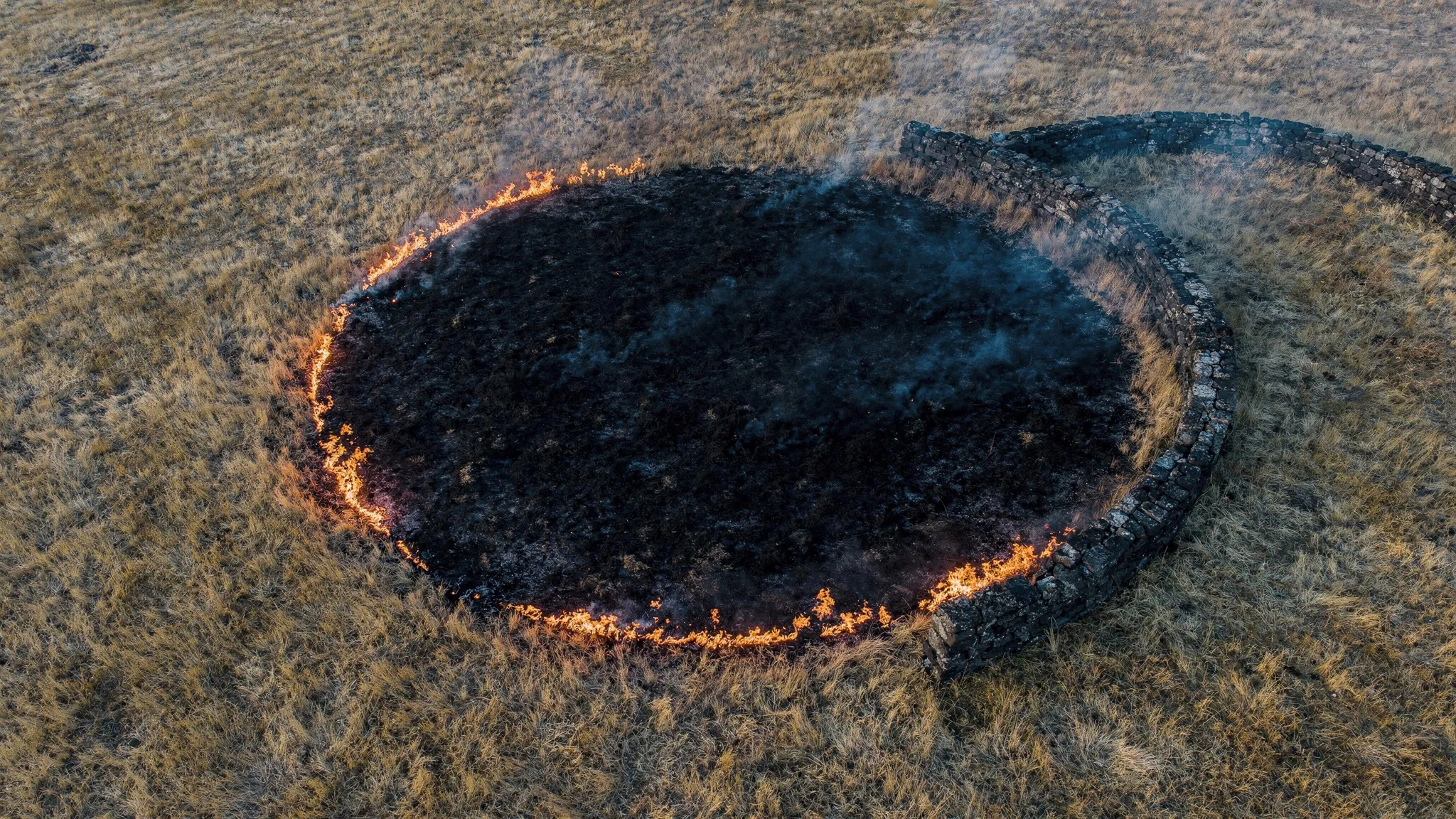
Picture a fire on an open plain, spreading at the same speed in every direction. To stop it, you can build a wall — but only in real time: after a time t, the total length of wall you have built is at most λ × t. A piece of wall, once laid, stays where it is. The fire cannot cross it, but it can go around it.
This “dynamic blocking problem” was introduced by Alberto Bressan, of Penn State University, as a model for fighting wildfires or the spread of a contaminant. The question is simple: how fast must the wall go up for the fire to stay trapped in a limited region? Changing the scale changes nothing: the answer does not depend on the region burning at the start. Bressan’s long-standing conjecture, for which he has posted a prize: the fire can be enclosed if and only if λ is greater than 2 — the wall must grow more than twice as fast as the fire spreads.
What was known
- Above 2, it can be done: a wall made of two arcs of logarithmic spiral (a spiral whose turns widen at a steady rate, like a nautilus shell) closes around the fire.
- At 1 or below, it cannot.
- If the fire could only spread into half of the plane, the threshold would be exactly 1.
- A spiral-shaped wall only works above about 2.614.
- A recent preprint showed that 1.5 is not enough.
Between 1.5 and 2, nobody knew.
Counting the free edge
With Luca Talamini, of the SISSA institute in Trieste, Bressan starts with a short argument. By the isoperimetric inequality, a region of area A has a border at least 2√(πA) long — the border of a disc of that area. The wall covers at most λt of that border. Along the rest, the fire advances freely, so at each instant the burned area gains, per unit of time, at least the length of the free edge: 2√(πA) − λt.
Follow that inequality through time: when λ is at most π/2, about 1.571, the burned area keeps growing at least like the square of time. The fire is never contained.
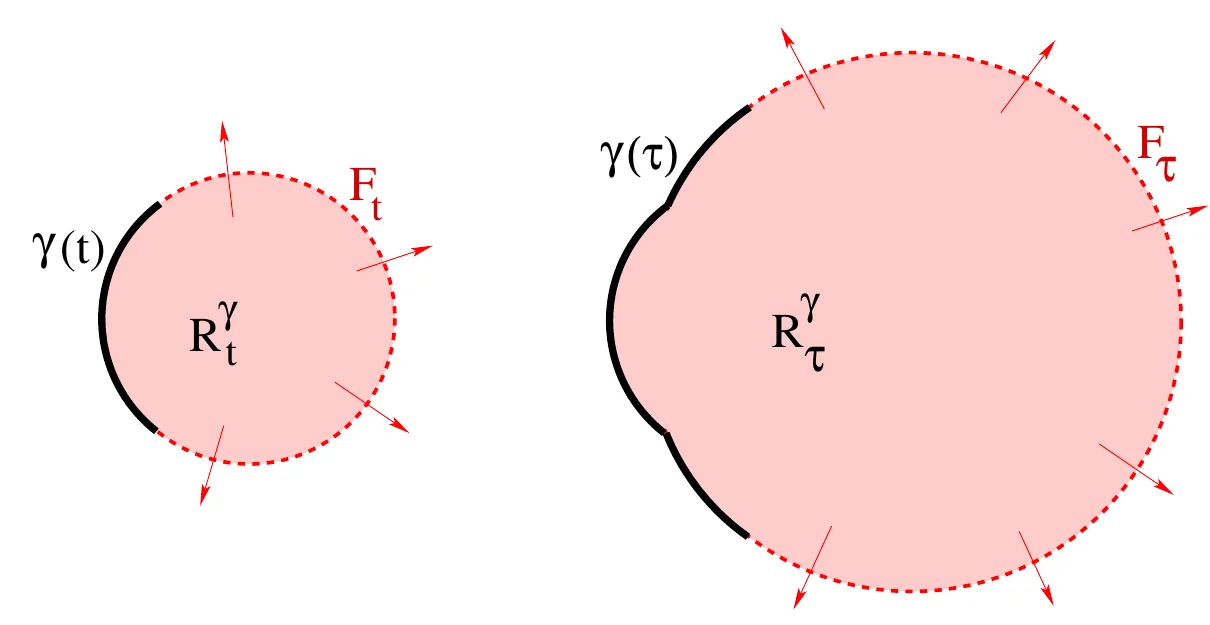
The burned region at two moments: the wall (black) holds part of the border, the fire spreads freely along the rest (red). The later wall must contain the earlier one. — Figure 1, Bressan and Talamini (2026), arXiv:2610.36919.
Two moments, one wall
That first argument ignores one fact: the wall built by one moment is still there at every later moment. So the wall cannot be placed as well as possible at both moments: at one of them at least, the fire’s free edge is longer than the first argument’s minimum. The authors compare the burned region at two moments t and t + T/2 — separated by half of the total time T they consider — to a double bubble — two adjoining regions whose combined border, with some parts counting more than others, is as short as possible. Known results on such bubbles give a sharper bound.
The threshold rises to Λ = 1.62621170228… At that speed or below, the burned area still grows at least like the square of time, whatever the strategy.
The authors write that the idea of this weighted double-bubble comparison, together with the simpler first bound, was suggested by the model GPT-6 Astra, used through ChatGPT as a research aid. They state that they wrote the manuscript themselves and take full responsibility for its mathematics.
Why one closed loop needs more than 2
Then comes the case where the finished wall is a single closed loop. Look at the spot where the last brick is laid, at a time T. The whole wall must be complete before the fire gets there, so λT is at least the length of the wall.
But inside the loop, the fire reaches that spot along a path shorter than each of the two arcs of wall that lead to it. The wall is therefore more than twice as long as the fire’s journey, which lasts at least T. Hence λ must exceed 2. For walls of this shape, the conjecture is proved.
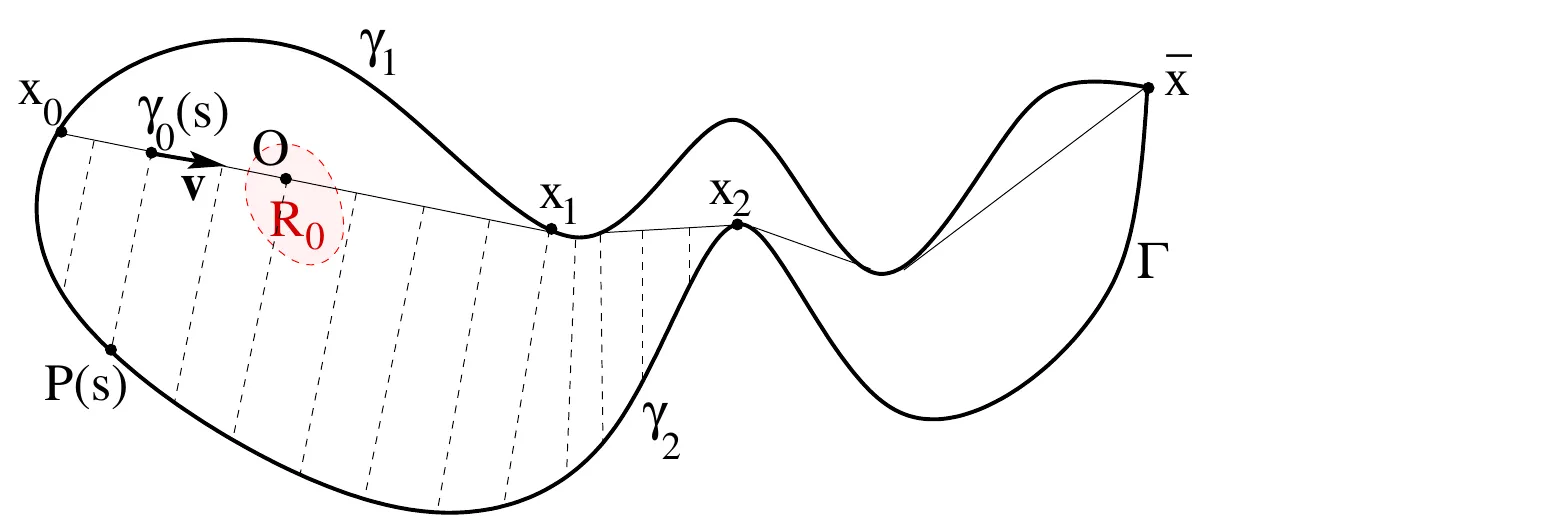
If the wall is one closed loop, each of its two arcs leading to the last brick (top right) is longer than the fire’s path inside. — Figure 4, Bressan and Talamini (2026), arXiv:2610.36919.
Walls built only to be overrun
The last result says what a cheaper strategy would need. Below speed 2, if no stretch of wall ever ends up with fire on both sides, the burned area is at least (2 − λ)t²/4: it grows without limit. Any strategy that beats the conjecture would therefore have to include purely delaying walls — barriers whose only job is to hold the fire back for a while, and which end up deep inside the burned zone. The last-brick argument, the authors note, does not work for walls that are not a single closed loop. Between 1.626 and 2, the race is still open.