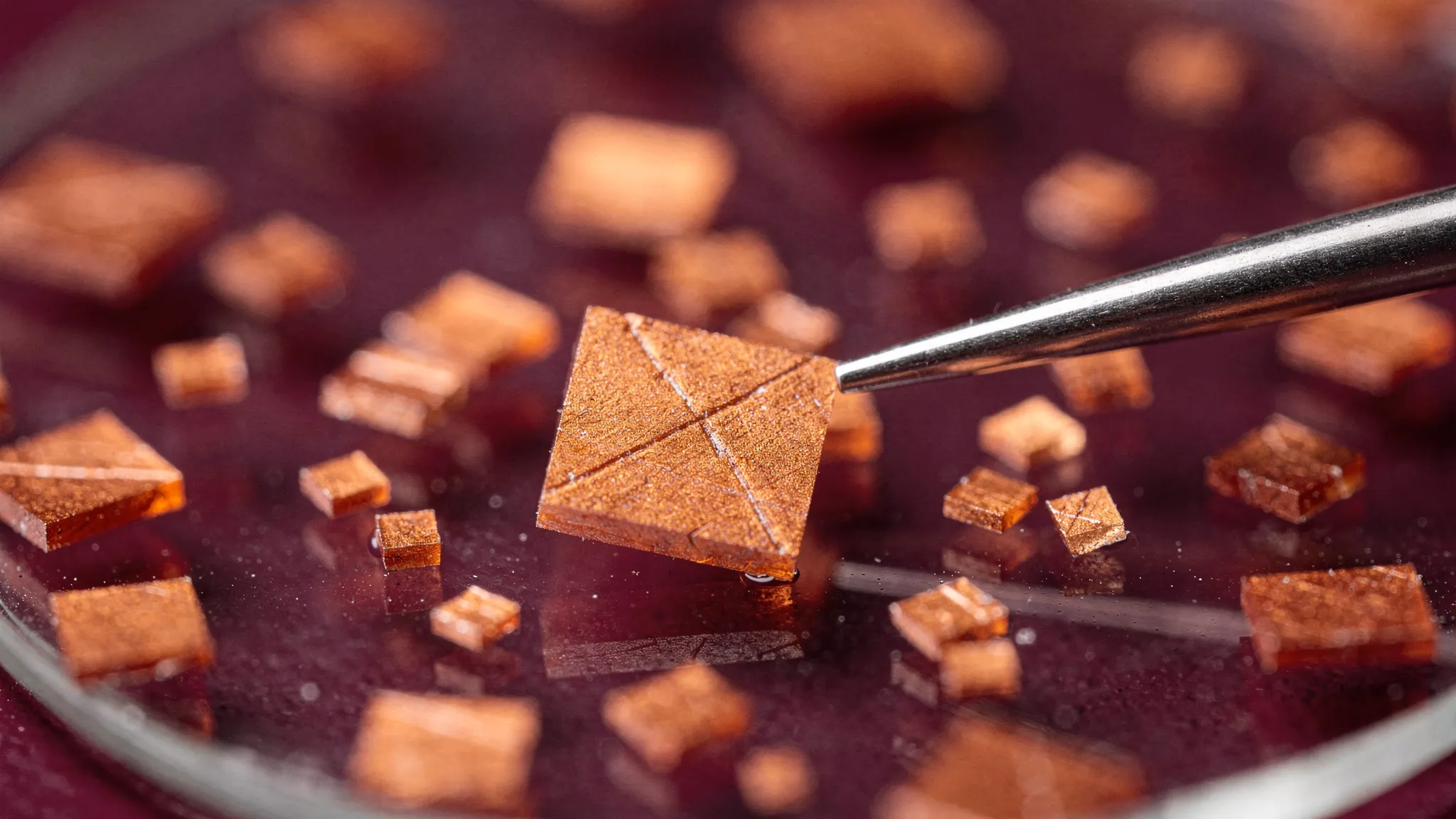
CRACKED MICROCRYSTALS THAT HEAL AND TRAP LIGHT AGAIN
Photonic devices are shrinking: guides that carry light, resonators that trap it, lasers. At that scale, a microscopic crack is enough to spoil them. How cracks form and heal in organic optical crystals, the authors write, remains “largely unexplored”.
Crystals that repair their own cracks are, in their words, “a rare and remarkable phenomenon”. Earlier examples cited in the paper include rock salt, potassium chloride and alumina, and several molecular crystals. But most were millimetres to centimetres long, handled with forceps and needles. Some healed slowly: crystals about 3 millimetres long recovered only 6.7% after being squeezed for 24 hours. Others, needle-shaped, rejoined in milliseconds.
A microscope tip as a hammer
Melchi Chosenyah, Rajadurai Chandrasekar and colleagues at the University of Hyderabad and the Central University of Karnataka, in India, went down to the scale where crystals work as optical components. They used an organic compound called HDMAC, which glows orange-red under ultraviolet light, with its emission centred at 660 nanometres. Dropped as a solution onto a glass slide, it forms thin square and rectangular crystals a few tens of micrometres across.
Their tool was the tip of an atomic force microscope — an instrument that feels surfaces with an extremely fine point at the end of a tiny flexible arm — used both to crack the crystals in controlled ways and to push the pieces back together. The authors borrowed their vocabulary from bone fractures: transverse cracks run across the crystal, longitudinal ones along it, oblique ones diagonally; an avulsion tears off a small fragment.
Pieces that fuse
- In a crystal about 13.7 by 12.5 micrometres, a diagonal crack disappeared when the side of the crystal was pushed inward. Under an electron microscope, the repair was nearly seamless, with a faint line at high magnification. Only the spot where a fragment had been torn away stayed unhealed.
- A crystal about 20 micrometres long was split into two separate pieces. Realigned and pressed together, they healed immediately. Pushed afterwards with the tip, the crystal moved as a single body.
- Cracks along two different crystal planes both healed. Nearly all the microcrystals healed when the broken surfaces stayed clean; a litter of tiny debris at the break hindered healing.
- A large, flake-like crystal, with the same molecular packing, shattered instead of cracking cleanly, and did not heal.
How much light comes back
Long crystals act as waveguides: light emitted at one end travels to the other. In a crystal 271 micrometres long, the team shone a 405-nanometre laser at one end and collected the guided glow at the other, before cracking and after healing. Comparing the two gave a “healing efficiency” of about 80%. Over six such crystals, it ranged from 32% to 99%. The losses came from light scattered at the repaired crack, especially where fragments were missing.
A resonator restored
Thin crystals also work as resonators: their top and bottom faces act as mirrors, so only certain colours of light build up between them. The thinner the crystal, the wider the spacing between these resonances. A crystal 31 by 28 micrometres and 1.8 micrometres thick showed resonances spaced 17.8 nanometres apart in wavelength — that is, in colour.
The team cracked it lengthwise down the middle, without splitting it. At the crack, the resonances were strongly suppressed. After healing, they returned, with a spectrum matching that of the intact crystal. Fluorescence images taken slice by slice, every 257 nanometres, showed a faint trace of the crack only in the top layers; below about 770 nanometres, the interior looked healed.
Softer at the seam
A diamond tip pressed into the crystal with the same force sank 95 nanometres into intact regions and 115 nanometres into the healed one. The healed zone’s stiffness, its Young’s modulus, fell from 2.15 to 1.49 gigapascals, about two-thirds of the original, and its hardness roughly halved. It still sprang back partly when the load was removed.
What holds the pieces together? Calculations of the forces between molecules point to continuous chains of attraction along the two healing planes: hydrogen bonds between molecules and dipole attractions between neighbouring layers, which the authors see as one of the driving forces.
The authors insist that no single number captures a healing efficiency: crystal size, crack type and how well the pieces are realigned all change the result. Their aim is optical components that survive damage — glowing crystals that, once broken, can be put back to work.