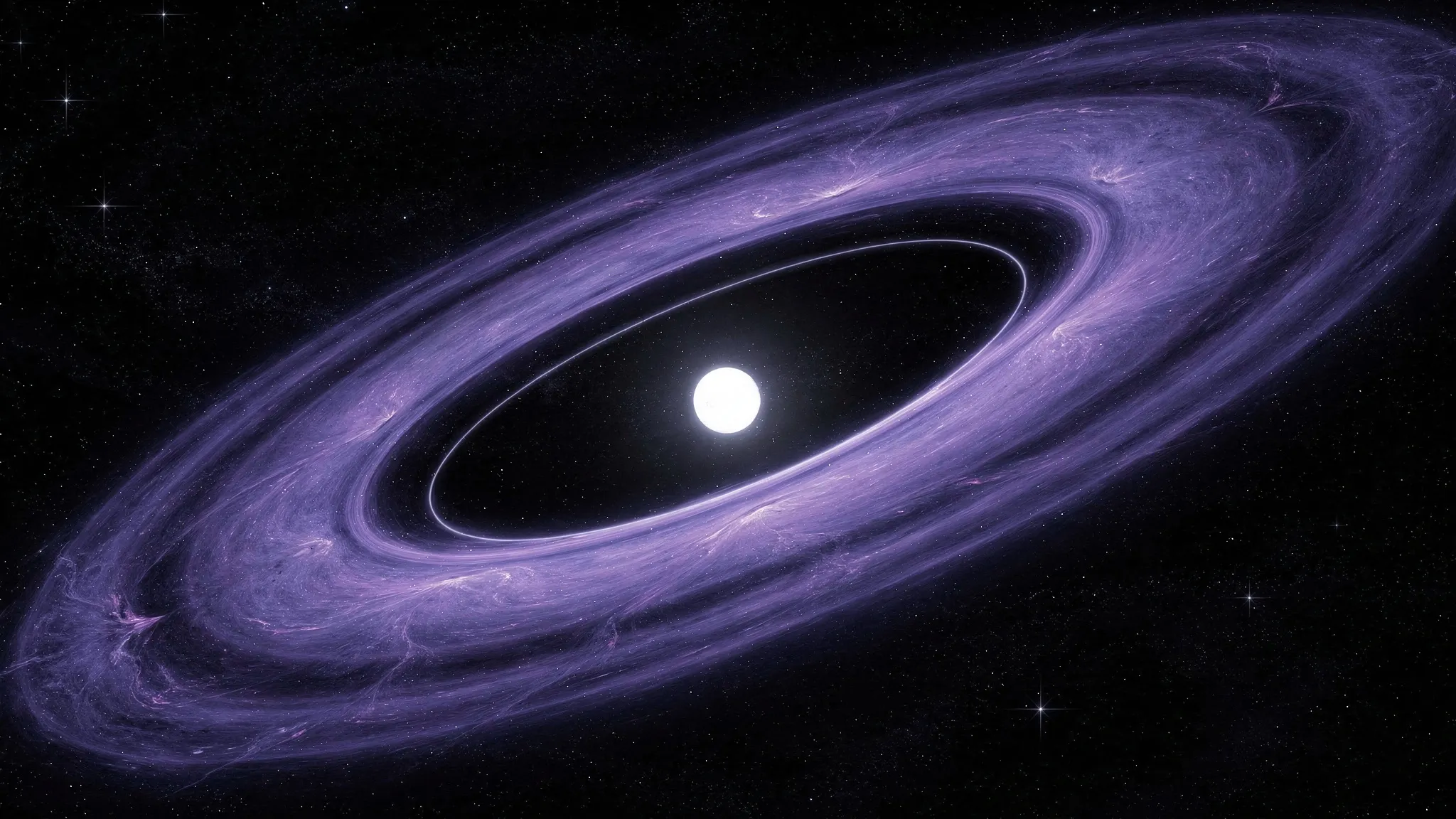
A WHITE DWARF WITH TWO RINGS OF GAS
Many planetary systems outlive their star. When it becomes a white dwarf — the dense remnant left behind — discs of dust can form around it, and planetary debris falling onto it leaves chemical traces in its atmosphere. A few of these discs also hold gas. That gas glows at precise wavelengths, most often in a trio of infrared lines from calcium. In all 21 gas discs known until now, each line has the same shape: two peaks.
Why a spinning ring draws two peaks
A disc of gas seen at an angle has one side coming towards us and the other moving away. The Doppler effect shifts light from the approaching side to slightly shorter wavelengths, and light from the receding side to longer ones. Each line splits into two peaks, further apart when the gas orbits faster — and closer to the star, gas orbits faster, as Kepler’s laws require.
The twenty-second disc
Nicola Pietro Gentile Fusillo, of the University of Trieste and INAF’s Trieste Astronomical Observatory, and colleagues from Warwick, Valparaíso, London and Kiel noticed that the white dwarf WD J1328−1450 gives off more infrared light than a bare star should: a sign of warm dust. They observed it with the X-shooter spectrograph on the European Southern Observatory’s Very Large Telescope, in 2021 and again in 2023.
The star has 0.47 times the mass of the Sun, packed into a ball 1.5% of the Sun’s radius. Calcium, magnesium and silicon in its atmosphere show that it is swallowing planetary material. But its calcium and oxygen lines have four peaks instead of two.
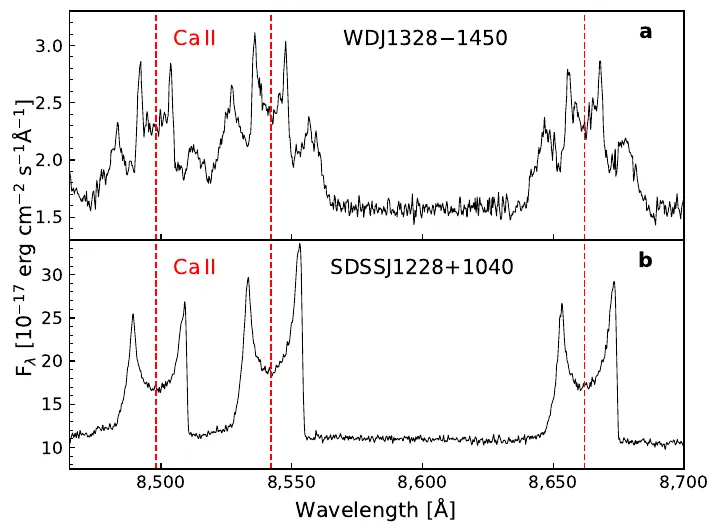
The three calcium lines of WD J1328−1450 (a), each with four peaks, against the usual two-peaked lines of SDSS J1228+1040, the prototype gas disc (b). — Figure 1, Gentile Fusillo et al. (2026), arXiv:2610.37773.
Two rings and a gap
The team reproduced the lines with two flat rings of gas, one inside the other. Measured in solar radii — the radius of the Sun — the inner ring runs from 0.14 to 0.34, the outer one from 0.54 to 1.93, with an empty gap in between. Even the inner edge lies about nine times the star’s own radius away.
We see the disc nearly edge-on, tilted at about 77°. Converted into speed, the inner ring’s two peaks sit about 1,024 kilometres per second apart — gas moving at roughly 500 km/s towards us on one side and away on the other. The outer ring’s peaks are only about 420 km/s apart: the inner gas orbits faster. Over about two years, the line shapes barely changed: the rings are stable.
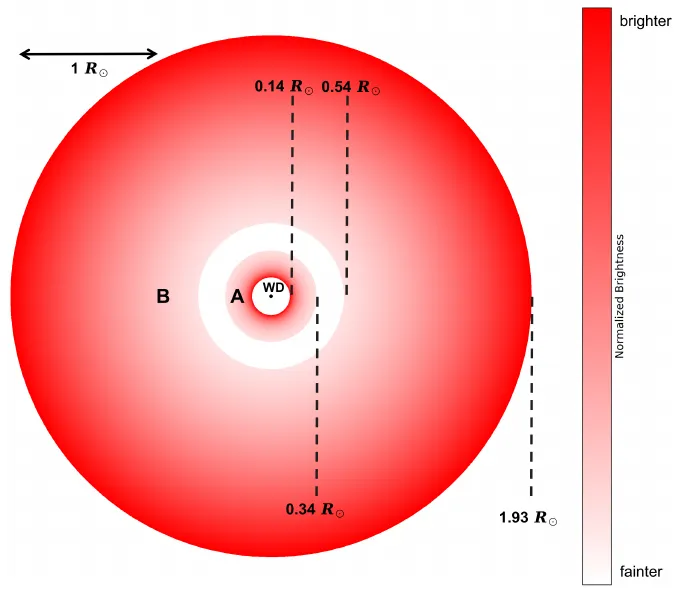
The glowing calcium gas seen from above, to scale: inner ring A, outer ring B and the gap. The bar at top left is one solar radius; deeper red means brighter gas. — Figure 3, Gentile Fusillo et al. (2026), arXiv:2610.37773.
Magnesium only on the inside
One magnesium line has just two peaks: it comes from the inner ring alone. Had the outer ring held as much magnesium, relative to calcium, as the inner one, its peaks would stand out at more than six times the noise level. They are missing. The ratio of magnesium to calcium fingerprints a material: about 5 to 15 in chondrites, a family of stony meteorites, about 8 in Earth’s mantle, about 1.6 in its crust. The two rings probably come from different parent bodies — or from different layers of one body that had separated into a magnesium-rich mantle and a magnesium-poor crust.
Something must feed each ring
Gas in such a disc spreads, but as it drifts outward and cools below about 1,200–1,500 kelvins, it condenses back into grains: each ring stays near wherever its gas is made. So what makes gas in two separate places? Dust evaporating at the inner edge of the dust disc would make gas in one place only, so a single ring; collisions grinding the dust would make it everywhere, unless an unknown brake acted only inside the gap.
Two white dwarfs too close to tell apart? The Gaia satellite, which maps the stars, sees only one, and only 0.067% of white dwarfs have a gas disc at all: two at once would be a long shot. One planet clearing the gap? Even the largest iron body that could survive near the gap, 440 kilometres across, would have far too little gravity to hold on to hot gas, the authors calculate — and it would not explain how gas is made in the two rings on either side.
The authors turn instead to SDSS J1228+1040, the prototype gas disc, where a signal repeating roughly every two hours can only be explained by a dense solid body inside the disc, making gas as it interacts with the dust. Their proposal: one such planetesimal — a small solid body of the kind planets are built from — in each ring.
How big can a survivor be?
So close to the star, gravity pulls harder on a body’s near side than on its far side and can tear it apart. A body with no internal strength would need a density higher than any known material: at least 3,600 grams per cubic centimetre at the inner ring’s inner edge. The two survivors must have internal strength. With the density of iron and the strength of rocky Solar System bodies, the inner one could be at most 45 kilometres across at its ring’s inner edge and 172 at its outer edge — a typical asteroid. The outer one could reach 346 kilometres at its ring’s inner edge and 2,340 at its outer edge, and a rocky body about 3,500 kilometres at the outer edge: from the size of Ceres to that of Pluto, or even the Moon.
A shadow could mimic the gap
One alternative remains open: a single disc whose puffed-up inner rim shades the region between 0.34 and 0.54 solar radii. It would also explain why the inner ring dims outward while the outer one brightens. But no other white dwarf, nor any young star with a gas disc, shows four peaks — not even WD J0846+5703, whose dust disc is more than twice as bright relative to its star. The authors find no direct evidence for such a shadow, and no reason it would appear here alone.
For the dust, whose infrared glow was modelled separately, several disc shapes fit equally well. And if the star seems to swallow little debris, its disc may simply be young: fed for only 300,000 to 600,000 years, too short for the measurement to reflect its true rate, and still in a chaotic early stage.
Rings at both ends of a planet’s life
Rings separated by gaps are a familiar sight in protoplanetary discs, where planets are born around young stars. The scale and the central star could hardly be more different. Yet WD J1328−1450, the authors write, suggests that similar processes may shape planetary systems both at their birth and at their very end.