A SUPERNOVA'S CHIRP TURNED AROUND, ON CUE
Superluminous supernovae outshine ordinary ones at least tenfold. What powers them is still an open question. A leading idea is a newborn magnetar: a rapidly spinning neutron star that pours its rotational energy into the debris of the explosion. That engine should make the light fade smoothly after its peak. Yet 50 to 70% of these supernovae show bumps in their light curves. Two explanations compete: a flickering engine, or the debris crashing into shells of gas the star shed earlier.
The first supernova that chirped
SN 2024afav was discovered in December 2024, about 327 megaparsecs away. In an earlier paper, Joseph Farah, Logan Prust and colleagues showed that its bumps came closer and closer together: the time between them fell from about 39 days to 17 days, between day 99 and day 166 after the explosion. Like a bird’s call rising in pitch, it chirped — the first supernova known to do so.
Their explanation: a tilted disk of gas falling back onto the magnetar, wobbling like a spinning top, which makes the light rise and fall. But the model had many knobs — the star’s spin, its magnetic field, the structure of the disk, how fast gas falls in. A good fit only proved that the picture could work, not that it had to.
A rule with no knobs
With Hang Yu, of Montana State University, the team stripped the model down to four assumptions shared by every version of it: how the wobble depends on the disk’s inner edge and on the star’s spin; where the magnetar’s wind balances the pressure of the disk; how the infalling gas tails off with time; and how the star slows down.
From these alone, two measurable quantities — how fast the chirp speeds up, and how fast the engine dims — must lie on a straight line, whatever the unknown values. And that line forces a prediction. As long as the disk’s pressure drops faster than the magnetar’s wind, the disk creeps inward and the wobble quickens. Once the engine fades faster, the wind pushes the disk back out and the wobble slows. The chirp must halt, then reverse.
When? The date is set mainly by the magnetar’s spin-down time — the time it takes to lose much of its spin, 87 ± 11 days, read from the smooth part of the light curve, independently of the bumps. Using only the published chirp and that time, the relation predicted a turnaround near day 133 in the supernova’s own frame (its clock, corrected for the stretching of time by cosmic distance and for the delay of light escaping the debris), around day 150 as seen from Earth, followed by bumps drifting apart. A straight line through the early periods said the opposite: the wobble would keep speeding up until its period hit zero, near day 180.
The turn
The team then searched 109 further observations from the Las Cumbres Observatory telescopes, out to day 262, plus data from the ATLAS survey. After day 170, the light curve showed five new peaks and troughs — and they were drifting apart. In a time–frequency map, the dominant rhythm climbs from about 0.025 cycles per day to 0.07, then clearly falls back.
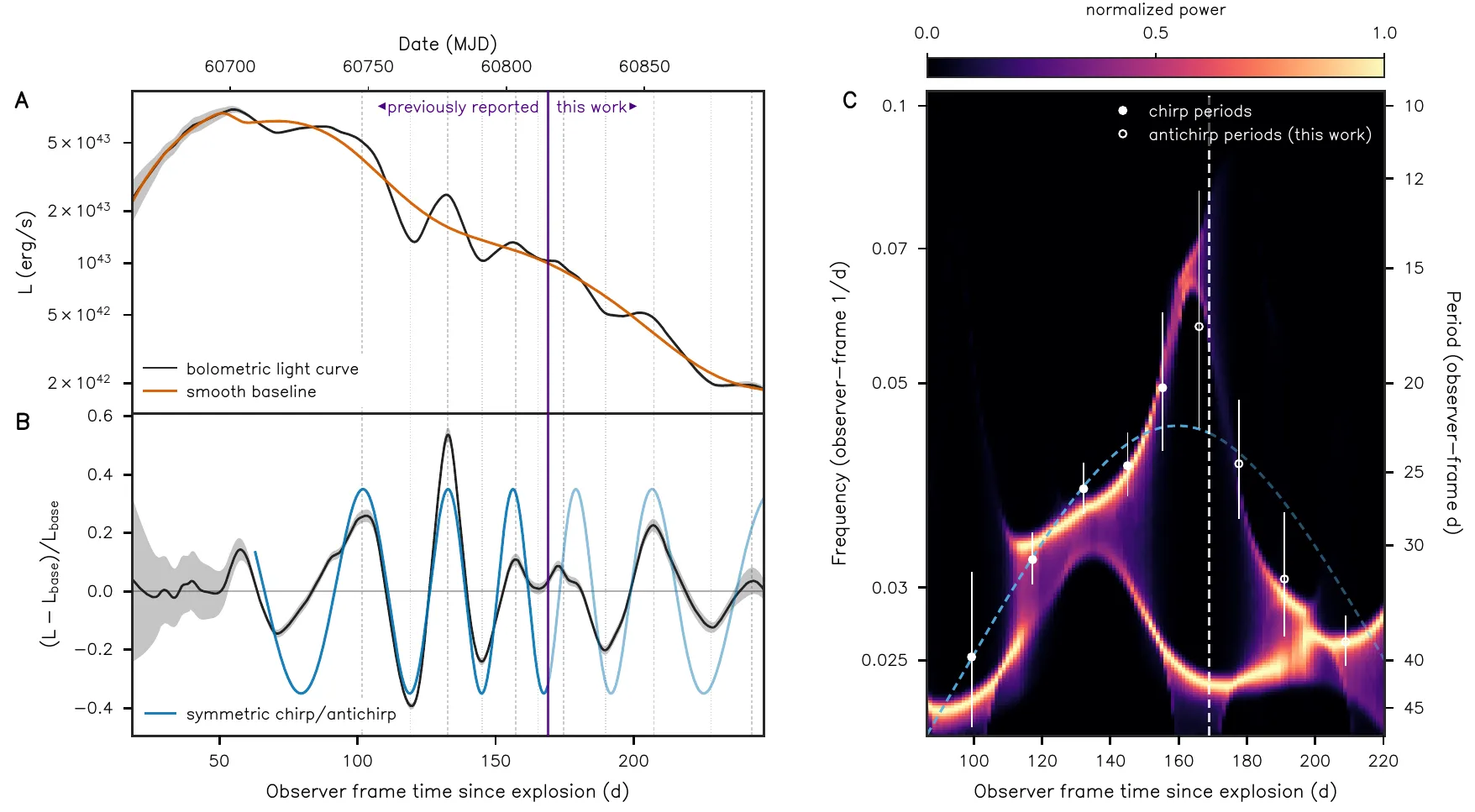
The light curve of SN 2024afav (A), its bumps once the smooth decline is removed (B), and their rhythm over time (C): the frequency rises, then falls after about day 160. — Figure 2, Farah, Prust & Yu (2026), arXiv:2610.39240.
The chirp reversed at day 147 ± 3 as seen from Earth — 132 ± 3 days in the supernova’s frame, matching the predicted 133. Afterwards, the period lengthened from about 23 days to about 35. The period grew by about 0.28 day for every day that passed (± 0.12), right in the middle of the predicted range. The straight-line continuation is excluded at well over 5 sigma, a level at which chance is practically ruled out.
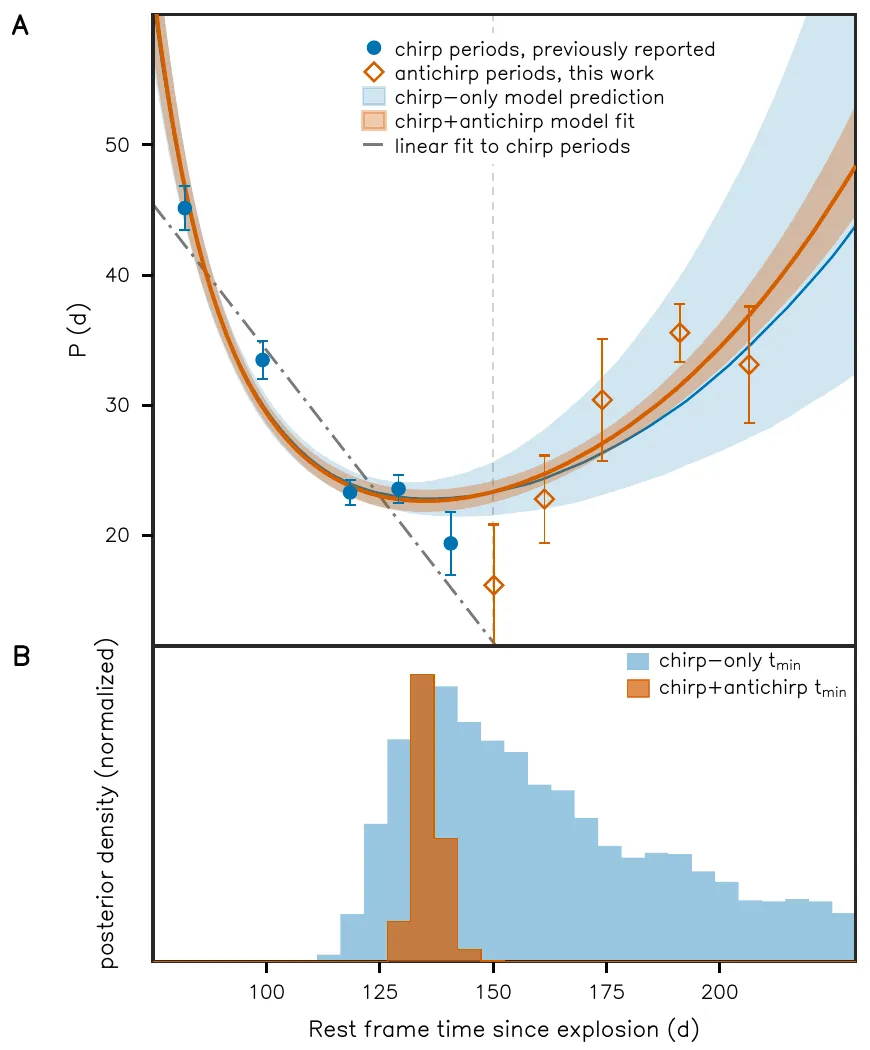
Periods of the earlier chirp (blue) and of the new “antichirp” (orange), against the prediction made from the chirp alone (blue band) and a straight-line extrapolation (dashed). — Figure 3, Farah, Prust & Yu (2026), arXiv:2610.39240.
Not just shells of gas
The spectra of SN 2024afav do show signs of surrounding gas, so it may well be there. But the authors argue it does not set the rhythm. They simulated about 50,000 random, noisy light curves tuned on six other bumpy superluminous supernovae: fewer than 0.1% were as extreme as SN 2024afav. Shells of gas would need spacings that first shrink then widen, with nothing to tie the switch to day 150. And collisions with shells make lopsided bumps, rising fast and fading slowly, whereas these look like a smooth wave.
Reading the disk
The relation allows not one line but a short menu of them, one for each kind of disk and wobble mechanism; the measured slope picks among them. At 11.6 ± 1.6, it is steeper than any thin disk that cools by radiating its heat away could produce. It points instead to a hot inner flow that traps its heat and loses mass in winds — and, among the three candidate causes of the wobble, it lands almost exactly on the one called Lense–Thirring precession (a wobble caused by the spinning star dragging space around it), while ruling out magnetic warping.
Upcoming sky surveys should catch more chirping supernovae. Each will either fall on one of the lines the relation allows, naming its wobble mechanism at a glance, or, like SN 2024afav, reveal something about the disk feeding its engine.