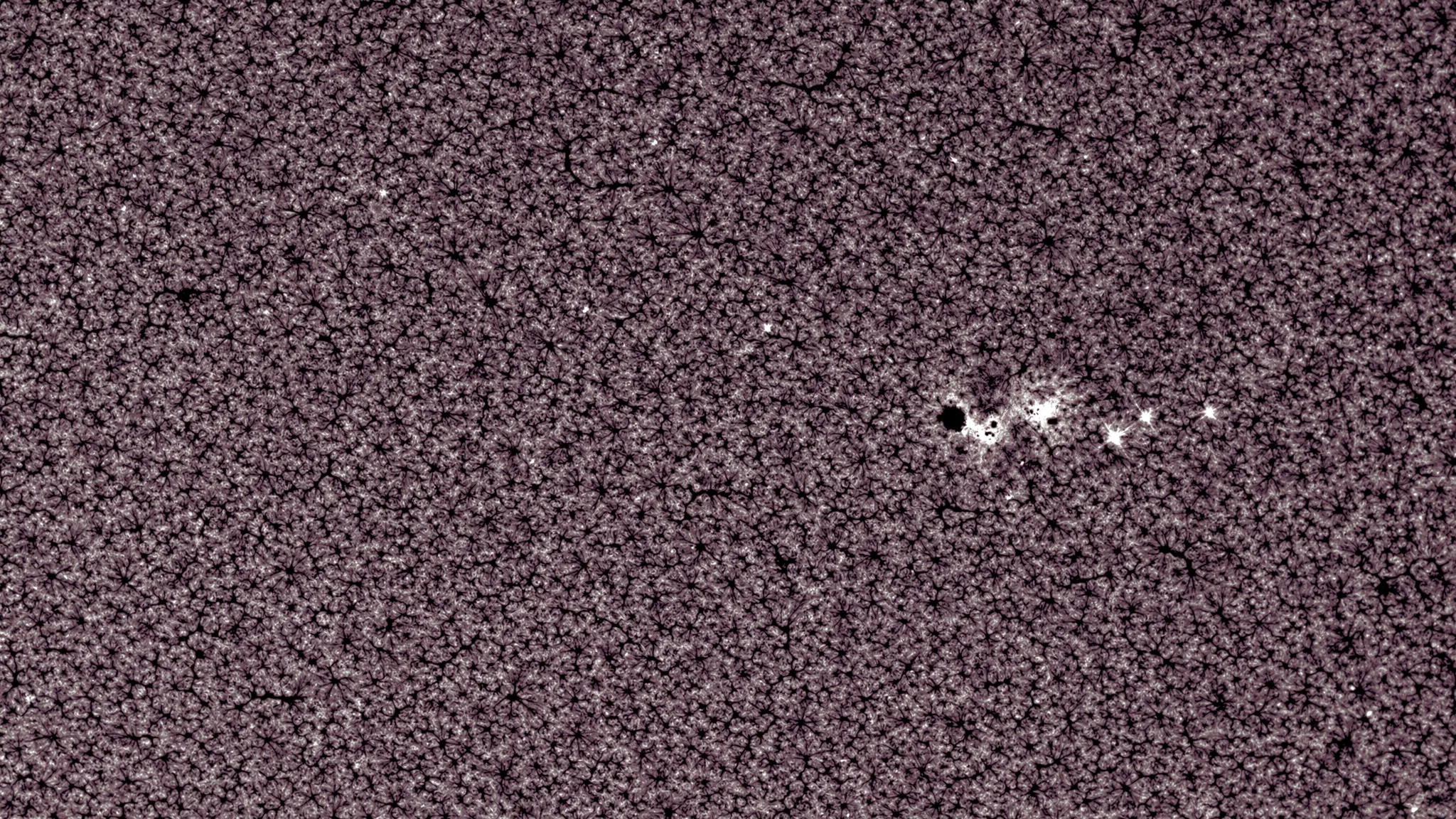
THE SUN'S 'RARE' WHITE-LIGHT FLARES ARE EVERYWHERE
Solar flares are sudden releases of magnetic energy. They send out radiation, energetic particles and plasma that drive space weather across the Solar System. A special class makes even the Sun’s visible light brighten: white-light flares. The first one on record was seen independently by Carrington and Hodgson in 1859.
Ever since, they have been considered rare and extreme. Most of a flare’s energy is released high in the corona, and it is hard to carry enough of it down to heat the deep layers that emit visible light. Early ground-based studies counted only a few per year. Before NASA’s Solar Dynamics Observatory (SDO), only about 150 flares had been firmly identified as white-light flares; today the count is a few hundred, mostly the largest classes, X and M. Flares are graded by their X-ray brightness into classes B, C, M and X, from weakest to strongest. Another camp has long argued the opposite: every flare might glow in white light, and telescopes simply lacked the sensitivity to see it.
Pixel by pixel
Shuanghong Li, Yongliang Song and colleagues at China’s National Astronomical Observatories and China West Normal University set out to settle the question with SDO’s HMI camera, which has photographed the Sun’s visible surface every 45 seconds, with pixels about half an arcsecond across (an arcsecond is a tiny angle, 1/3600 of a degree), for more than 15 years.
Their method is deliberately simple. For each pixel in a flaring region, they follow its brightness over time, subtract the slow background, and look for pulses. If the strongest pulse during the flare stands out from the pulses before and after it by at least six times their scatter, the pixel counts as glowing. Isolated specks of one or two pixels are thrown out, to avoid cosmic-ray hits and noisy pixels. The same threshold applies to every flare.
They chose a demanding sample: 769 active regions — the magnetic patches around sunspots where flares erupt — chosen among the least active, each producing fewer than ten flares, between January 2011 and May 2025. That gave 1,951 flares — 547 of class B, the weakest category in the sample, 1,316 of class C, 88 of class M, and no X-class giants at all.
One flare in two
1,012 of the 1,951 flares glowed in white light: 51.9%. The share climbs with flare size: 36.9% for class B, 55.9% for class C and 85.2% for class M. “For the first time,” the authors write, white-light emission turns out to be widespread even among B-class flares.
Two thirds of the quiet regions (508 of 769) produced at least one white-light flare. The more flares a region made, the likelier: 43.6% of regions with a single flare, 68.1% with two, 76.5% with three, 86.1% with four, and almost all of those with six or more. Year by year, the rate tracked the number of sunspots in the sampled regions closely (correlation r ≈ 0.85). It showed no preference for latitude, and followed the solar cycle: about 57% of flares in cycle 24, 45% so far in cycle 25.
Hiding in plain sight
Why were they missed for so long? The glowing patches, which the authors call kernels, are tiny: mostly under 2 square arcseconds (about eight camera pixels), never more than 5 square arcseconds. They last mostly 6 to 16 minutes and brighten the surface by only 3 to 20%, typically 6 to 9% — right around the 8% threshold many earlier studies used to call a detection.
Above all, most of them lie outside sunspots, in the quiet Sun: 91.4% of kernels in B-class flares, 86.1% in C-class and still 74.4% in M-class ones. There, against an already bright background, the contrast is weak and hard to see by eye. And when a flare has several kernels, they usually brighten out of step with one another, so comparing just two snapshots misses some of them. Small flares mostly have a single kernel; M-class flares usually have more than three.
What sets the glow
A kernel’s brightness, however, shows no link with the flare’s class, the local magnetic field or the kernel’s size. It goes with how long the kernel lasts and how long it takes to rise. The authors suspect that the magnetic layout at the moment of the flare decides how efficiently the deep atmosphere gets heated. About half of the kernels peak between two landmarks of the flare’s X-ray signal, suggesting a mix of heating processes.
Beyond the Sun
The finding reaches further than our star. White-light solar flares resemble flares on other stars, and weak stellar flares drown in the light of the whole star. Stars where no flare has been seen, the authors suggest, may be as active as the Sun. They also list their own limits: anything briefer than 45 seconds or smaller than half an arcsecond escapes the camera, isolated specks were discarded, and the sample holds mostly small flares.
The study comes, its authors note, more than 170 years after Carrington’s observation — and in the year of the 200th anniversary of his birth.