COMETS PROBABLY NEVER DELIVERED ENOUGH OF LIFE'S KEY INGREDIENT
How did life begin? A leading answer runs through prebiotic chemistry: simple, reactive molecules assembling into the building blocks of life. One of them stands out, hydrogen cyanide (HCN). Its triple bond between carbon and nitrogen stores enough energy to drive further reactions, and recent experiments show that at about 10 millimoles per litre it can yield lipids, sugars, nucleobases and nucleotides.
But where would such a concentrated supply have come from? Making HCN in the early atmosphere works best if that air was “reducing” — rich in hydrogen — and much geological evidence says it was not. The alternative, more than a century old, is delivery from space. Comets are especially tempting: they contain HCN at about 0.1% of their water, enough in principle for local concentrations of around 30 millimoles per litre.
Richard Anslow, Catriona McDonald, Amy Bonsor and Paul Rimmer, at the University of Cambridge, and Auriol Rae, at the University of Edinburgh, put that idea to a full test. They chose HCN on purpose: it is the only such molecule found in comets at useful concentrations, and its triple bond makes it tougher than the others. If HCN cannot make it, the rest cannot either.
A comet’s obstacle course
The team rebuilt the young Earth’s comet bombardment from simulations that follow a million icy bodies born beyond Neptune, rather than from the craters on the Moon, which cannot say what hit it. Then they put each comet through three hurdles.
- Spinning apart. Jets of gas spin small comets faster and faster until they break up. This cuts the number of comets reaching Earth by about a factor of ten.
- The atmosphere. Fragile and porous, comets smaller than about 100 metres explode high in the air, scattering their molecules. The air also filters out comets coming in at a shallow angle — precisely the gentle, grazing impacts that would spare their cargo.
- The impact. Comets from the outer Solar System hit Earth at about 28 kilometres per second on average. The heat of the impact destroys most of the HCN.
At every uncertain step — the pressure of the ancient air, the amount of dry land — the team picked the value most favourable to comets. They even assumed the surviving HCN is diluted only in the comet’s own ice, not in any lake or sea.
Zero, most of the time
In the simulations, the young Earth receives more than 100,000 comets larger than 100 metres. Yet over 100,000 simulated histories, the median number of impacts delivering at least 10 millimoles per litre of HCN onto dry land is zero: 54% of the simulations record none at all.
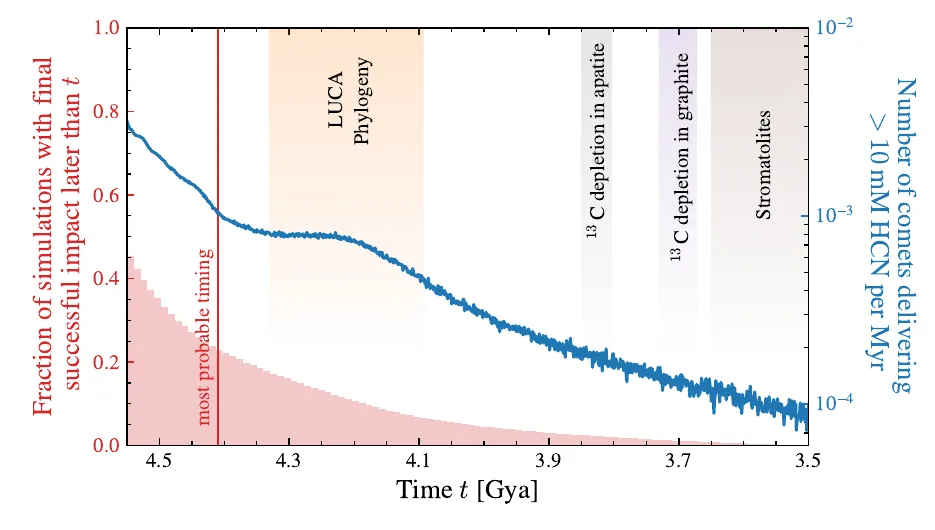
Successful comet deliveries fall off quickly with time (blue). The most likely date of the last success (red line, 4.41 billion years ago) predates the earliest indirect evidence of life (shaded bands, from about 4.2 billion years ago). — Figure 3, Anslow et al. (2026), arXiv:2611.02924.
When a success does happen, it happens early: the most likely date is 4.41 billion years ago, more than 100 million years before the first indirect signs of life, around 4.2 billion years ago. Fewer than 5% of simulations record one after 4.03 billion years. Success requires a rare, slow, very oblique impact, which only turns up while comets are raining down hardest — at a time when Earth had very little dry land, so many of those rare impacts fell into the ocean.
Globally, the picture is no better: all the HCN delivered intact, spread through one ocean, would reach only about 0.75 micromoles per litre — more than ten thousand times weaker than the laboratory recipes.
Mars, the better target
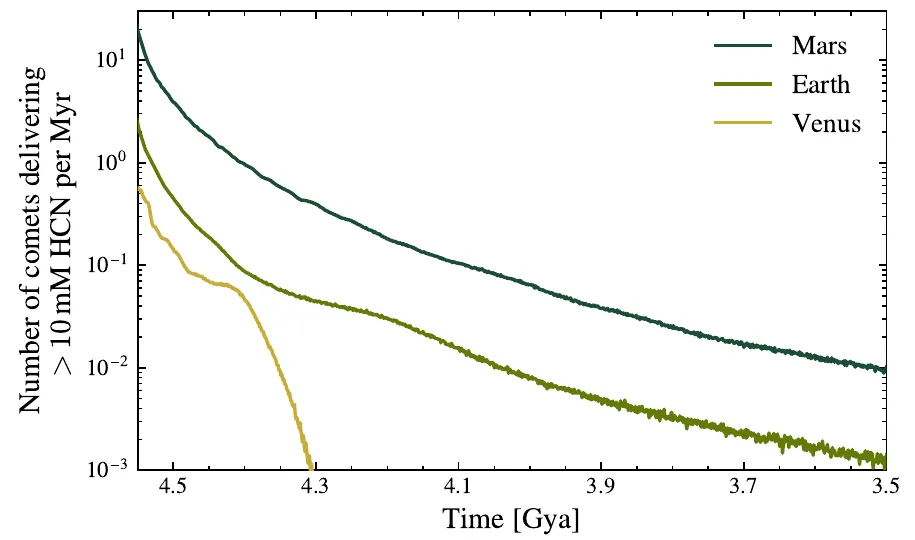
Comets delivering more than 10 millimoles per litre of HCN per million years on Mars, Earth and Venus, before accounting for dry land. — Figure 4, Anslow et al. (2026), arXiv:2611.02924.
Run for Mars and Venus with today’s conditions, the same simulations tell a striking story. Mars receives five times fewer comets, yet records 744 successful impacts, against 87 for Earth and 24 for Venus — before accounting for dry land. Mars has slower impacts, about 20 kilometres per second on average, and an atmosphere so thin that almost every comet larger than 100 metres gets through. Venus’s thick air destroys even comets a few kilometres across. If comets were a necessary step, the authors note, Mars would have been the likelier cradle — although a watery early Mars would face the same shortage of dry land.
Even a lucky strike falls short
Suppose one lucky comet did land intact. Within days to weeks, groundwater, rain and runoff would dilute its HCN below useful levels; even a quiet crater lake renews its water in a few years. A simple model then puts the expected time for life to emerge from comet chemistry beyond the age of the Universe, for plausible values of how often life could arise and of how long the HCN stays concentrated.
The authors cannot rule out one fortunate impact in Earth’s first few hundred million years. But they conclude that comets, long cast as couriers of life’s ingredients, were at best an exceedingly rare and short-lived source.