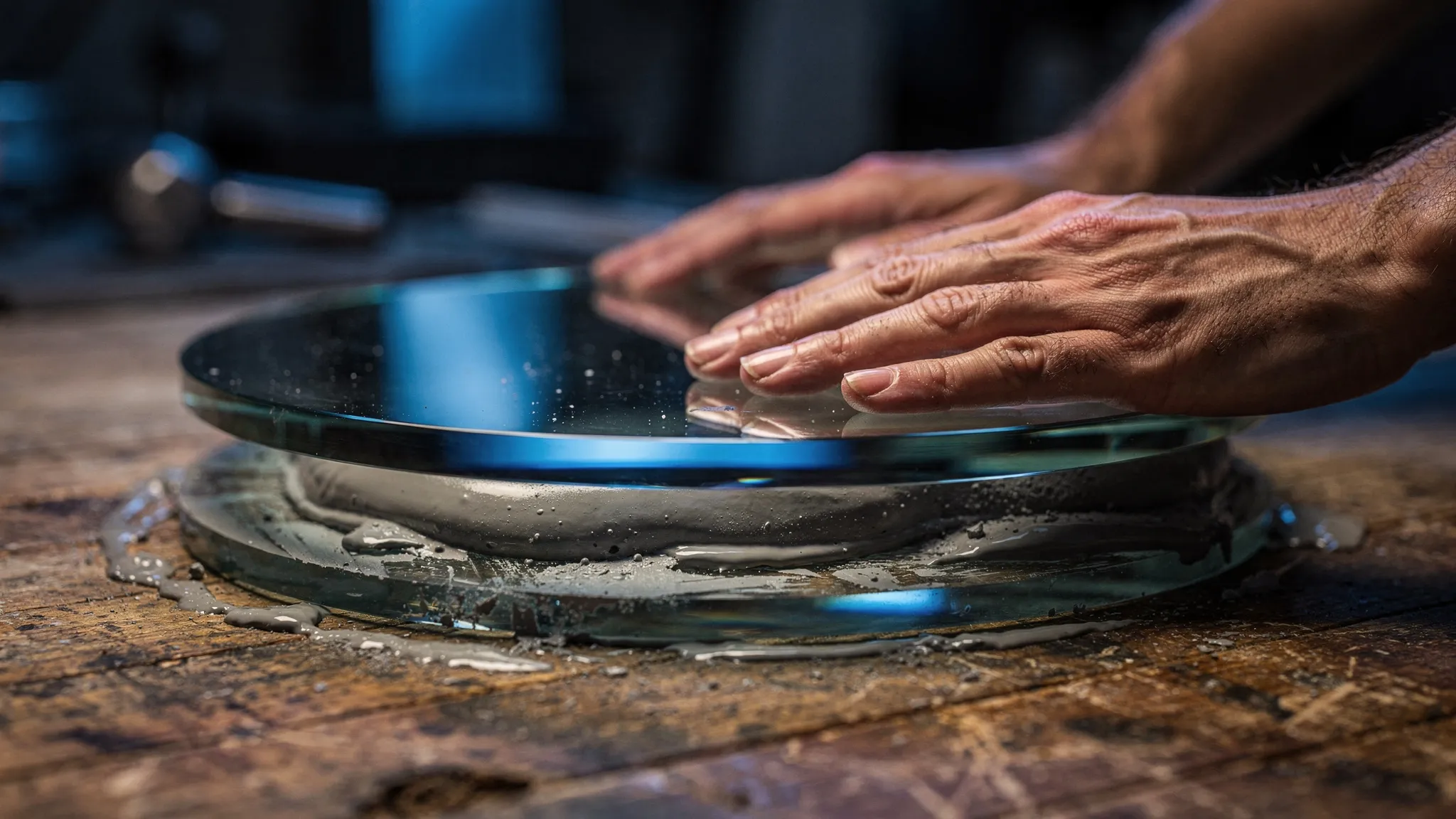
Amateurs still grind telescope mirrors by hand. They rub two glass disks together with grit in between. The strokes are sloppy and random. Yet both surfaces end up as matching spheres, accurate to tens of nanometres.
A physicist at SLAC and Stanford explains why, starting from a 1927 law of wear. Glass wears faster where it is pressed harder and rubbed faster.
The strokes point every which way. Only planes and spheres survive that symmetry. Small bumps fade within about an hour. Large ones spread out and even out, about 30 times slower.
Gravity rules out the plane: the top disk hollows, the bottom one bulges. The same maths explains tumbled pebbles. They turn shiny within weeks, but would need years to become spheres.
Source: From Rock Tumbling to Telescope Mirror Grinding: How Optical Perfection Emerges from Random Motion, https://arxiv.org/abs/2611.01673