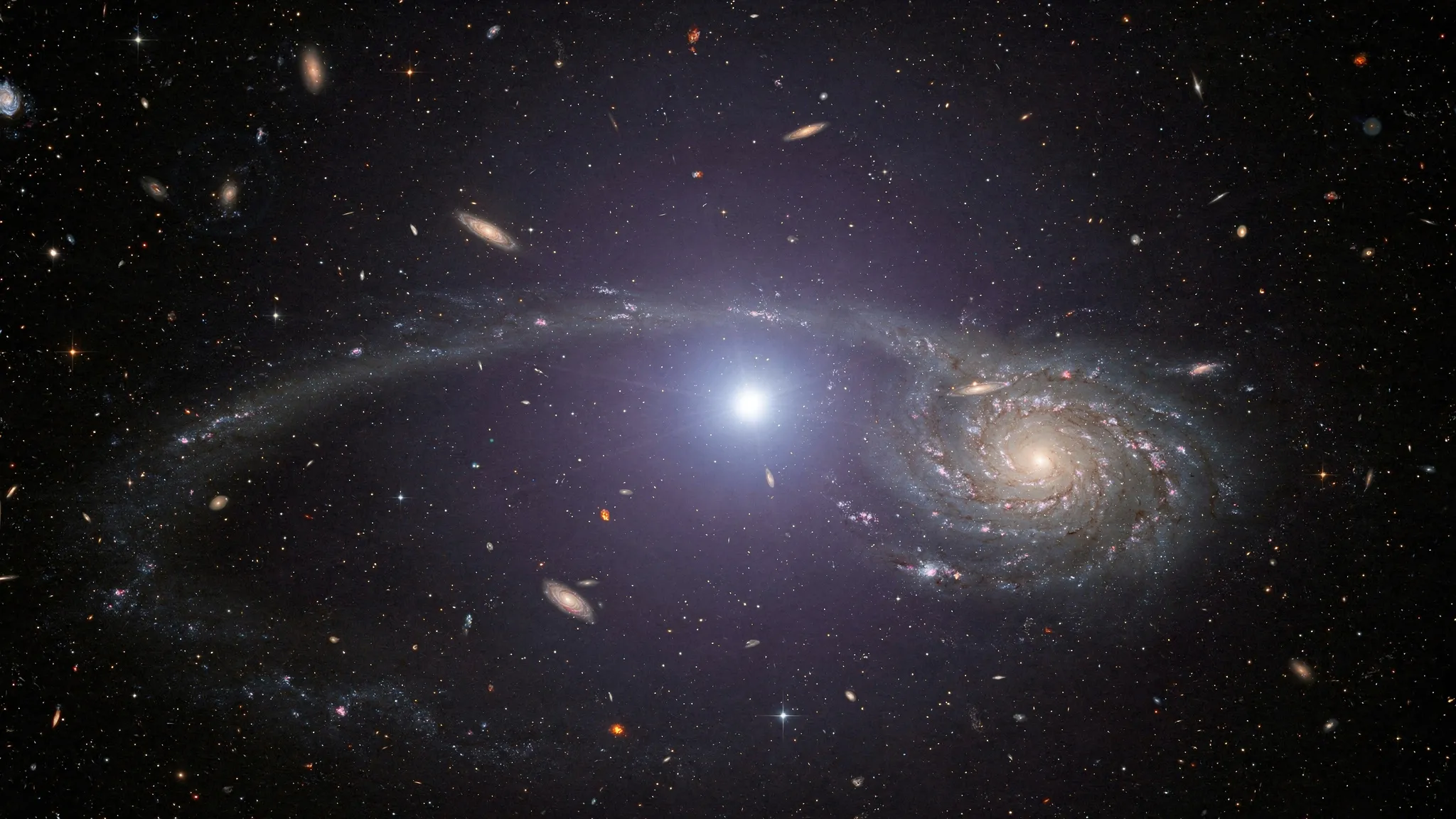
TWO GRAVITATIONAL WAVES 7 HOURS APART, AND A SUPERNOVA
When a massive star collapses, it explodes as a supernova and leaves behind a neutron star or a black hole. If that remnant orbits a companion in a suitable pair, it may one day merge with it and send gravitational waves across the universe. But that day usually comes long after the explosion: at least about 100,000 years. Collapse first, merger much later — that is the standard picture.
Recent observations have started to blur it. Some gamma-ray bursts — brief, intense flashes of high-energy light from distant cosmic explosions — look like a merger and a collapse at once, and two supernovae of the “Type IIb” kind — explosions of stars stripped of most of their hydrogen — have been discussed alongside faint gravitational-wave candidates in 2025, without any firm conclusion. One idea could explain such cases: in a rapidly spinning star that collapses, the dense disk of matter swirling around the newborn black hole could break into fragments, which then merge with each other or fall into the black hole within hours.
A search through the archives
Sheng Yang, of the Henan Academy of Sciences in China, Zong-Hong Zhu, of Beijing Normal University, and 23 colleagues in China, Taiwan, the United States, Australia, Italy and Sweden went looking systematically. They took the public alerts issued by the LIGO, Virgo and KAGRA detectors from April 2019 to January 2025 — 43 of them with some chance of involving a neutron star — and 676 stripped supernovae spotted by the Zwicky Transient Facility. They looked for supernovae sitting inside an alert’s patch of sky and peaking 10 to 30 days after it.
The search returned two matches — both with the same supernova, SN 2019rsq. It links two alerts from 10 September 2019: S190910d, then S190910h, 7.1 hours later. Back then, each alert had triggered its own follow-up; the supernova was only discovered weeks later. The trio emerged only in hindsight.
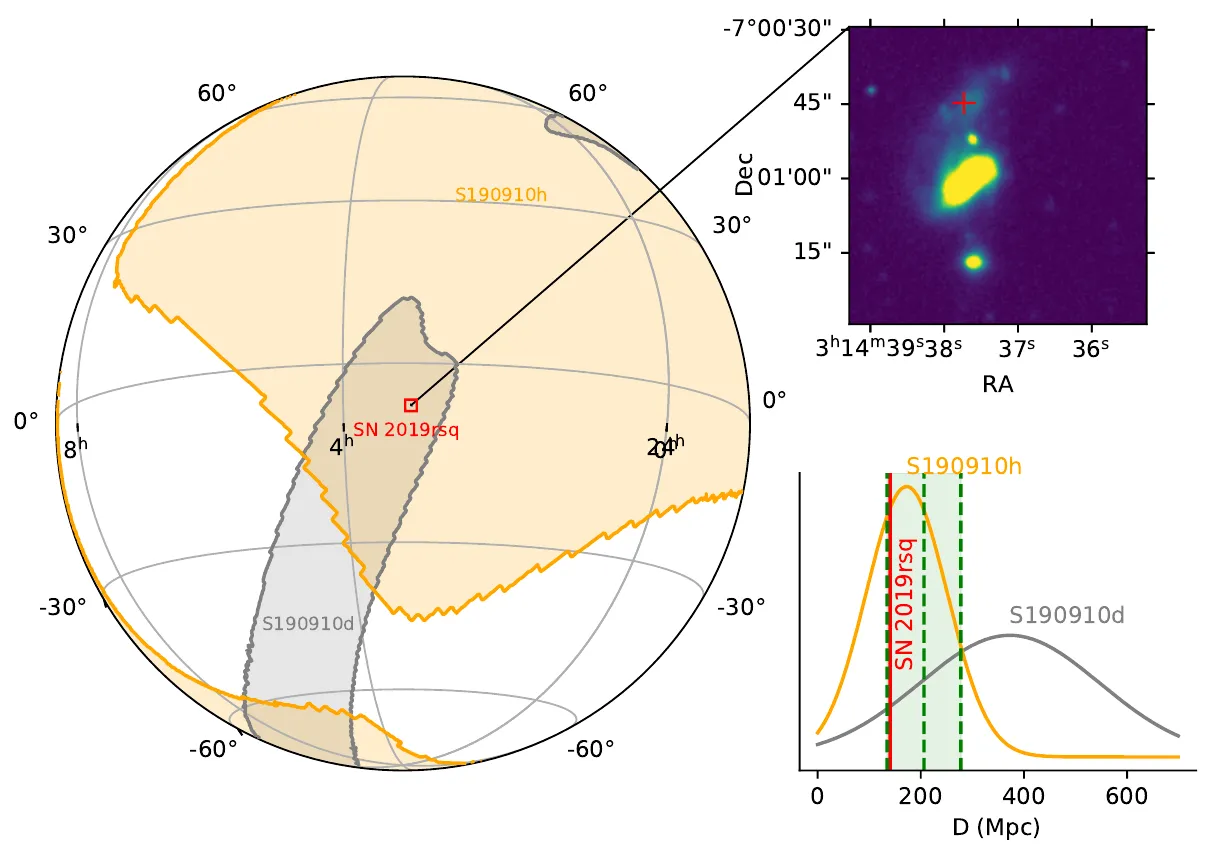
The patches of sky of S190910d (grey) and S190910h (orange) overlap where SN 2019rsq lies (red box, its galaxy upper right); lower right, their distance ranges are compatible with the supernova’s 140.6 megaparsecs (red line). — Figure 1, Yang et al. (2026), arXiv:2611.00440.
How rare is the pair?
Close-in-time alerts do happen. But the two patches of sky also overlap in three dimensions: their distance ranges agree with each other and with the supernova’s distance, 140.6 megaparsecs (the megaparsec is the unit astronomers use for distances between galaxies). To measure how unusual this is, the team shuffled the dates of the alerts a million times. An unrelated pair this close in time and space came up with a probability of 7.6 × 10⁻⁵, about one in 13,000. Among the 43 alerts, ten pairs fell within 5 days of each other, but only three overlapped in 3D, and this one combined the shortest delay with the largest overlap.
The supernova alone, on the other hand, is not surprising: the chance that an unrelated Type IIb explodes in that volume at that time is about 35%. The anomaly is the pair of signals; the supernova provides the collapsing star that could tie them together.
Both signals are weak. Re-analysed, both look like real signals and stand above the background noise of the surrounding data, but neither counts as a confident detection. An independent team had already recovered the first one, with a 58% probability of being astrophysical.
What each signal says
The signals carry the masses of the merging objects. S190910d looks strongly lopsided: about 34 solar masses with a partner of about 3. S190910h is light: about 2.5 and 1.3 solar masses, typical of neutron stars.
SN 2019rsq, discovered on 1 October 2019 by the Pan-STARRS survey, peaked about 24 days after the first signal — a normal rise time for a Type IIb if the star collapsed at that moment. The data cannot date the explosion precisely, but models placing it within three days of S190910d reproduce its light. The supernova is a fast one, and it lies on a tidal tail — a long stream of stars and gas pulled out by a gravitational encounter — of a disturbed galaxy that is forming stars.
One star, several mergers?
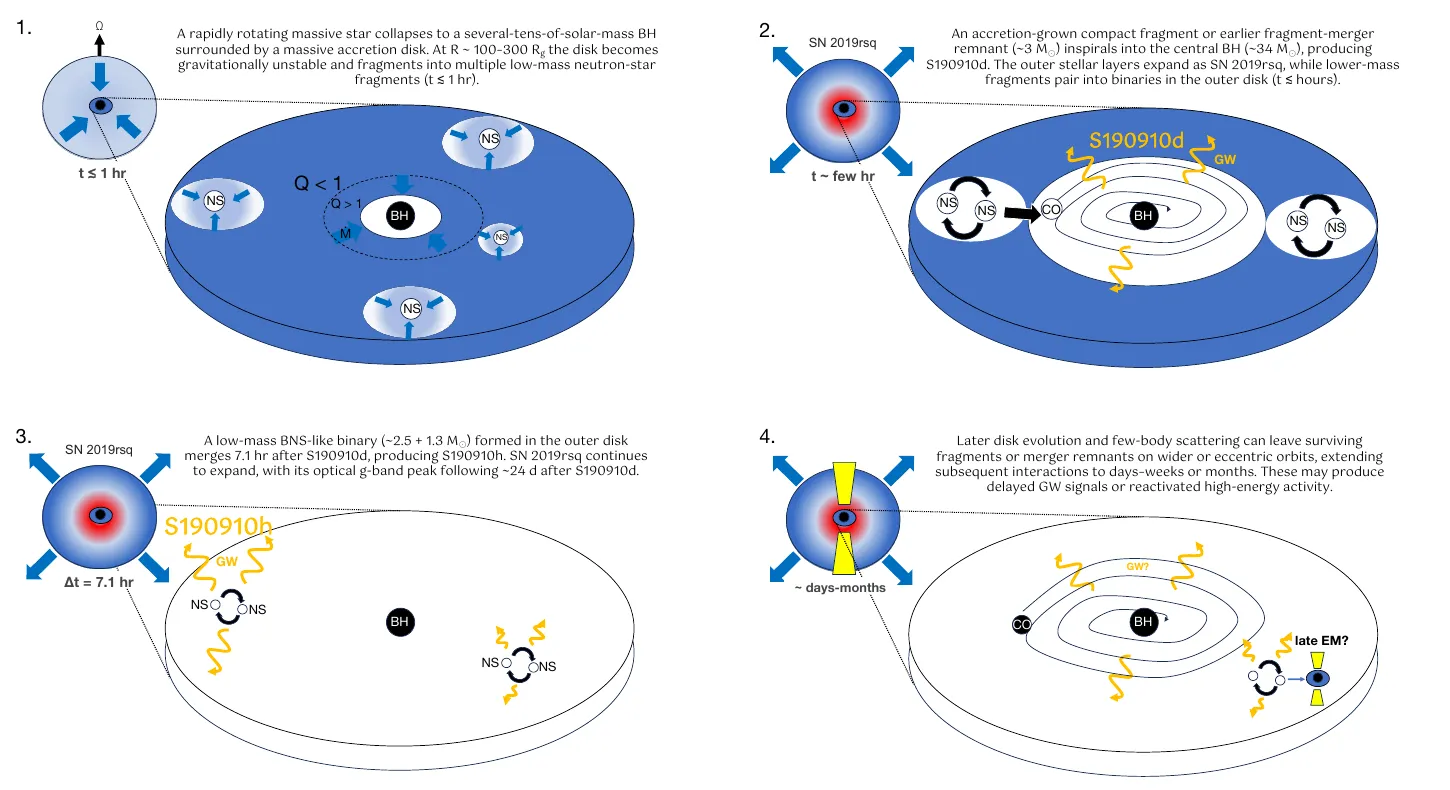
The proposed scenario: a spinning star collapses into a black hole whose disk fragments (1); a 3-solar-mass fragment falls into the 34-solar-mass black hole, S190910d (2); two light fragments merge 7.1 hours later, S190910h (3); later encounters could produce delayed signals (4). — Figure 4, Yang et al. (2026), arXiv:2611.00440.
The team proposes a common origin. A rapidly spinning massive star collapses into a black hole of several tens of solar masses, surrounded by a disk that breaks into fragments. A fragment grown to about 3 solar masses spirals into the central black hole: that is S190910d. Elsewhere in the disk, two lighter fragments pair up and merge: that is S190910h. The calculated spiralling times — from about an hour to several hours — easily cover the 7.1-hour gap.
The authors stay cautious. The probabilities do not account for every search one could have run, and a long gamma-ray burst seen five days later in the same broad region is not counted as evidence. Radio surveys saw nothing, which makes a powerful, long-lived jet unlikely. Whether SN 2019rsq is a rare coincidence or the first example of a star that fired several gravitational-wave signals as it died, the next observing runs, paired with wide sky surveys, should tell whether such clusters keep turning up.