RUB TWO GLASS DISKS AT RANDOM, GET A PERFECT SPHERE
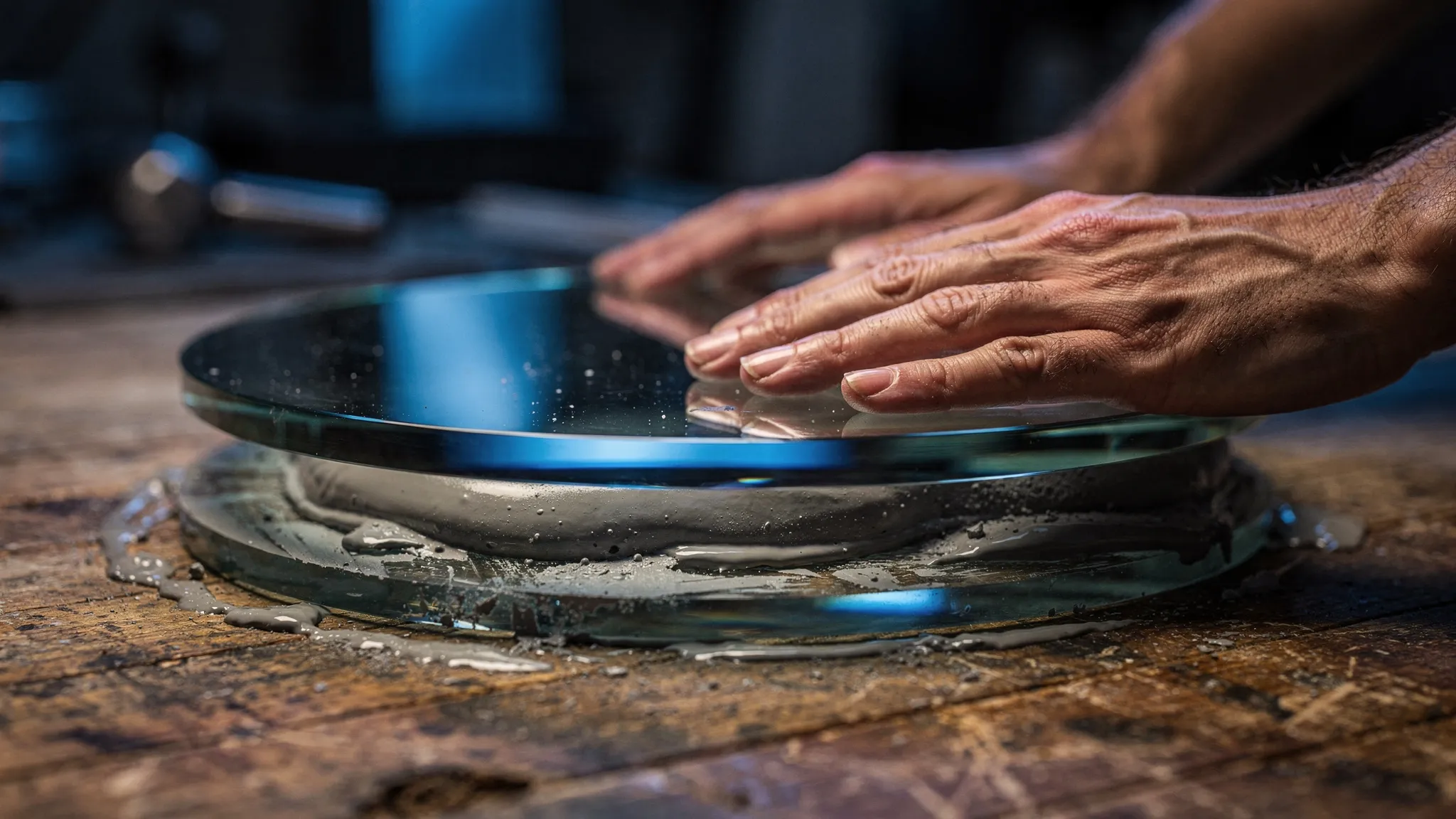
Anyone can make a telescope mirror by hand. You fix one glass disk, the “tool”, to a table, lay a second one, the future mirror, on top, put abrasive grit between them, and push the top disk back and forth in short strokes. You walk slowly around the table and turn the mirror as you go, so that every direction gets its share. Each stroke is a little different from the last. Then you switch to a finer grit, and again, and again.
The result is astonishing: the two surfaces converge on their own to perfectly matching spheres, accurate to a few tens of nanometres. Manuals describe the recipe in detail. What they do not give, according to Emmanuel Schaan, of SLAC National Accelerator Laboratory and Stanford University’s Kavli Institute for Particle Astrophysics and Cosmology, is a physical explanation from first principles of why any starting surface ends up spherical.
One law of wear
Schaan starts from Preston’s law, published in 1927 for plate glass polishing: at each point, material wears away at a rate proportional to the local pressure and to the speed at which the surfaces slide past each other. Add a simple contact model — the more one surface sticks out relative to the other, the harder it is pressed — and everything follows from a single equation.
The first consequence comes from symmetry alone. A pair of surfaces stops changing only if the two are identical and look the same after every movement of the stroke. Strokes that slide in two directions leave only planes; strokes that turn about two different axes leave only spheres. Because a hand-ground mirror is pushed and turned in every direction, planes and spheres are the only possible end points. This holds for any pressure law in which pressure vanishes where the surfaces match.
Three clocks
Whether a surface actually reaches those end points depends on how fast different defects disappear.
- Bumps smaller than the stroke are averaged away. They shrink exponentially on a time called T_grind — tens of minutes to an hour in practice.
- The mismatch between the two disks fades twice as fast, because both surfaces wear at once.
- Deviations larger than the stroke do not simply shrink: averaging over the area the stroke covers turns the equation into a diffusion equation — the kind that describes something spreading out and evening itself out over time. Large deviations spread out and flatten slowly. The last to go spans the whole mirror, and it sets the time to become a sphere:
T_sphere = (32/π²) × (R_mirror / R_stroke)² × T_grind
Here R_mirror is the mirror’s radius and R_stroke how far the mirror strays from the centre in a stroke, half the stroke’s full travel. For the classic “normal” stroke, whose full travel is a third of the mirror’s diameter, R_stroke is a third of R_mirror, and that is about 30 times T_grind — around ten hours.
Why the plane loses
Gravity breaks the symmetry between the two disks. Whenever the top disk overhangs the bottom one, the pressure redistributes: the top disk is ground harder at its centre, the bottom disk at its edges. The top one hollows, the bottom one bulges, so planes are unstable. Spheres survive as long as they form faster than gravity distorts them, which is the case for short enough strokes: the two surfaces then stay matching spheres whose curvature slowly increases. Long strokes reverse the order, which is exactly why mirror makers start with a long “chordal” stroke to dig the centre, then switch to the normal stroke to make it spherical.
A mirror’s logbook
The orders of magnitude are checked against the logbook of the author’s own 25-centimetre mirror, ground by hand in about 50 hours. With two hands pressing at 1 to 2 kilopascals and sliding at 0.1 to 0.3 metres per second, the coarsest grit removes a few micrometres per minute. Digging the 3-millimetre hollow at the centre should take about 10 hours: the logbook says 11 h 50. Making it spherical should take about 30 × T_grind, again about 10 hours: the logbook says 12 h 50. The model even explains why each fine-grit stage lasted roughly the same time, between 2 h 15 and 5 h 25: finer grit removes material more slowly, but it also has a shallower layer of damage to remove, and the two effects cancel.
Pebbles and sandpaper
The same equations cover two everyday cases. In a rock tumbler, pebbles about 1 centimetre across rub over excursions of about 1 millimetre. Small bumps vanish within weeks, so the stones turn shiny; but the factor (R_rock/R_stroke)² of about 100 pushes the time to become spheres to years. Rotary tumblers, with longer sliding contacts, round edges more than vibratory ones. Sanding a small flat object is the opposite extreme: the stroke is longer than the object, deformation is immediate, and the edges always round off.
The model leaves out friction, the uneven pressure of real hands and the soft pitch tool used for final polishing, and its checks are orders of magnitude rather than a dedicated experiment. The paper, conditionally accepted in the American Journal of Physics, is pitched as a classroom case: stable and unstable equilibria, exponential decay and diffusion, all from rubbing two pieces of glass together.