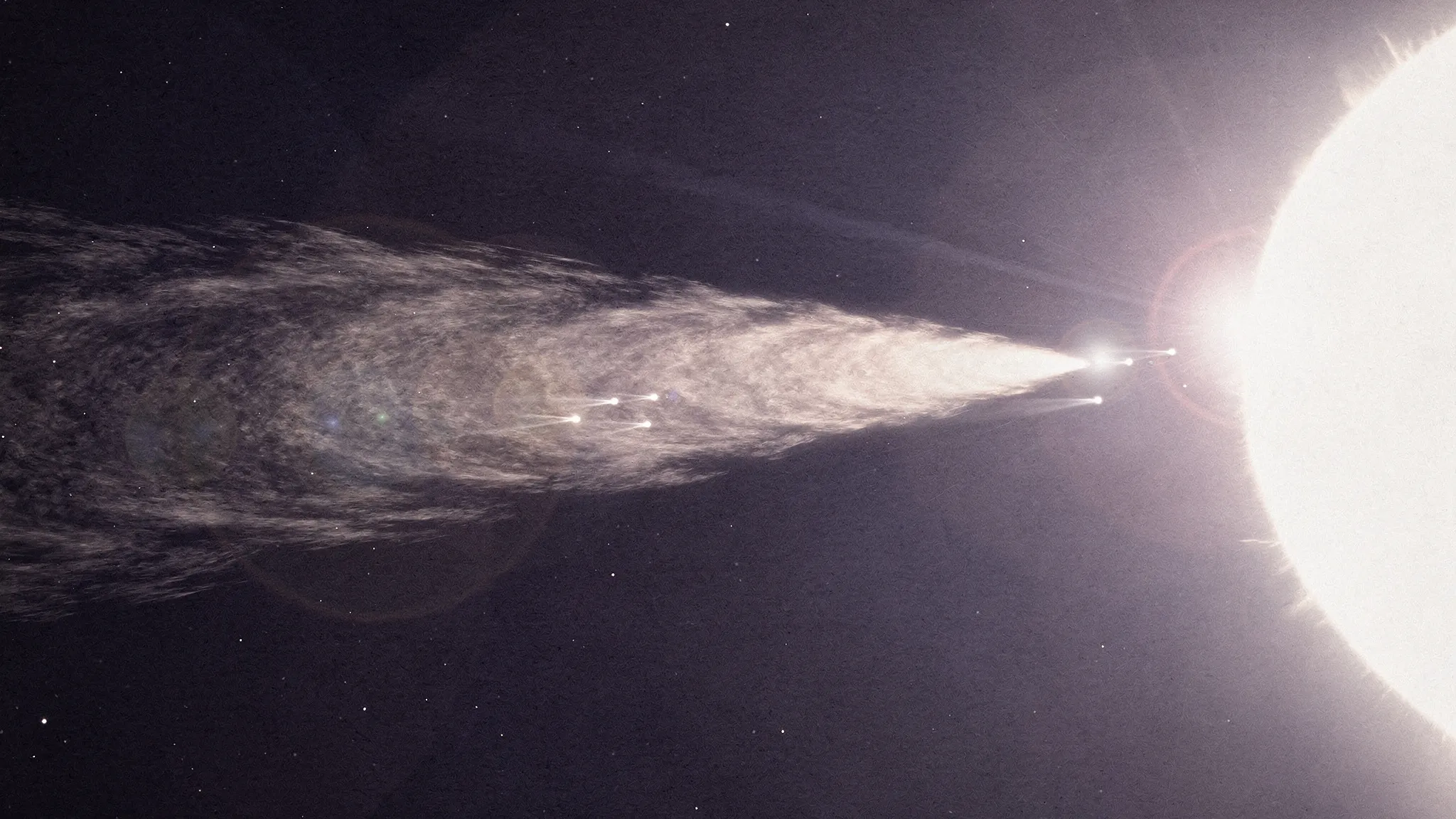
A SUNGRAZING COMET'S LAST BREATHS, HEARD BY RADIO
The Kreutz sungrazers are a family of comets with a death wish. Their orbits carry them extraordinarily close to the Sun, inside the zone where its gravity can tear a body apart. All of them are thought to be pieces of a single comet from the distant Oort cloud that broke up long ago. So far this century, only three have been spotted from the ground. Studying them is a rare chance: their violent activity and fragmentation can expose material from deep inside the nucleus, not just its surface.
The third, C/2026 A1 (MAPS), was discovered in January 2026 by A. Maury, G. Attard, D. Parrott and F. Signoret, at a record distance for one of these comets: 2.1 times the Earth–Sun distance. With an orbit of about 1,700 years, it was due to swing past the Sun at just 0.006 astronomical units — less than 1% of the Earth–Sun distance — on 4 April. The James Webb Space Telescope estimated its nucleus at 0.4 kilometres across.
It never made it. On 4 April, about two hours before its closest approach, the comet disintegrated. The SOHO spacecraft watched it vanish behind the disk that blocks the Sun’s glare and reappear on the other side as a cloud of dust; the STEREO spacecraft saw it turn to dust from another angle.
Three days at the telescope
In the three days just before that end, from 1 to 3 April, Amélie Godard Palluet and Víctor Rivilla, at the Centre for Astrobiology in Madrid, with colleagues at the Paris Observatory and NASA’s Goddard Space Flight Center, aimed the IRAM 30-metre radio telescope in Spain’s Sierra Nevada at the comet. It was then between 0.23 and 0.10 astronomical units from the Sun. After 3 April, the comet was too close to the Sun in the sky for the telescope to point at safely.
They tuned in to the radio signal of hydrogen cyanide (HCN) — each molecule gives off radio waves at its own precise frequencies, like a fingerprint; for HCN, 265.886 gigahertz — and found it every day. It is the first detection of HCN in a Kreutz sungrazer, and the first detection of any molecule in these comets at millimetre wavelengths. Until then, only a few simple molecules (CH, CN, C₂ and C₃) had been seen in one of them, the comet Ikeya-Seki of 1965, in visible light.
So close to the Sun, sunlight breaks HCN apart in about 12 minutes. That turns each measurement into a snapshot of freshly released gas, and lets the team follow the comet’s breathing almost in real time.
A burst on the eve of the end
The comet’s HCN output — the number of HCN molecules it released each second — rose by 20% from 1 to 2 April, then by more than 350% from 2 to 3 April. Most of that rise fits the usual rule for comets — output growing as the inverse square of the distance to the Sun — but not all of it. The team saw two outbursts: a weak one on 1 April and a strong one on 3 April, when the output jumped by more than 75% in 17 minutes before dropping by a quarter.
Adding up the gas over that burst gives 99,000 kilograms of HCN. In comets, HCN typically comes with about a thousand water molecules each; that implies about 66,000 tonnes of water, or 0.4% of the comet’s mass. Counting the dust dragged along with the gas, the loss could reach 1.2%. Spread as a layer 5 metres thick, it would cover a square 163 to 282 metres on a side, on a nucleus 400 metres across.
Less than 24 hours later, the comet was gone. The authors suggest the burst may have helped trigger the break-up, supporting the idea that erratic jets of gas — which push, spin and twist a nucleus — can tear comets apart, not just the Sun’s tides.
A cargo that had already survived
Other work suggests that C/2026 A1 is a second-generation fragment of the comet seen by Aristotle in 372 BC, and a fragment of the comet of AD 363. If so, it had already passed twice through that destructive zone near the Sun. Finding HCN in it shows that fragile, volatile molecules can survive such extreme passes: a porous nucleus lets the heat cook only its outer layers.
The team also searched for six other molecules; none was firmly detected, though a hint of HNC remains. The observation depended on catching the comet early — and on a radio telescope able to point as close as 5 degrees from the Sun, where observatories such as ALMA cannot look.