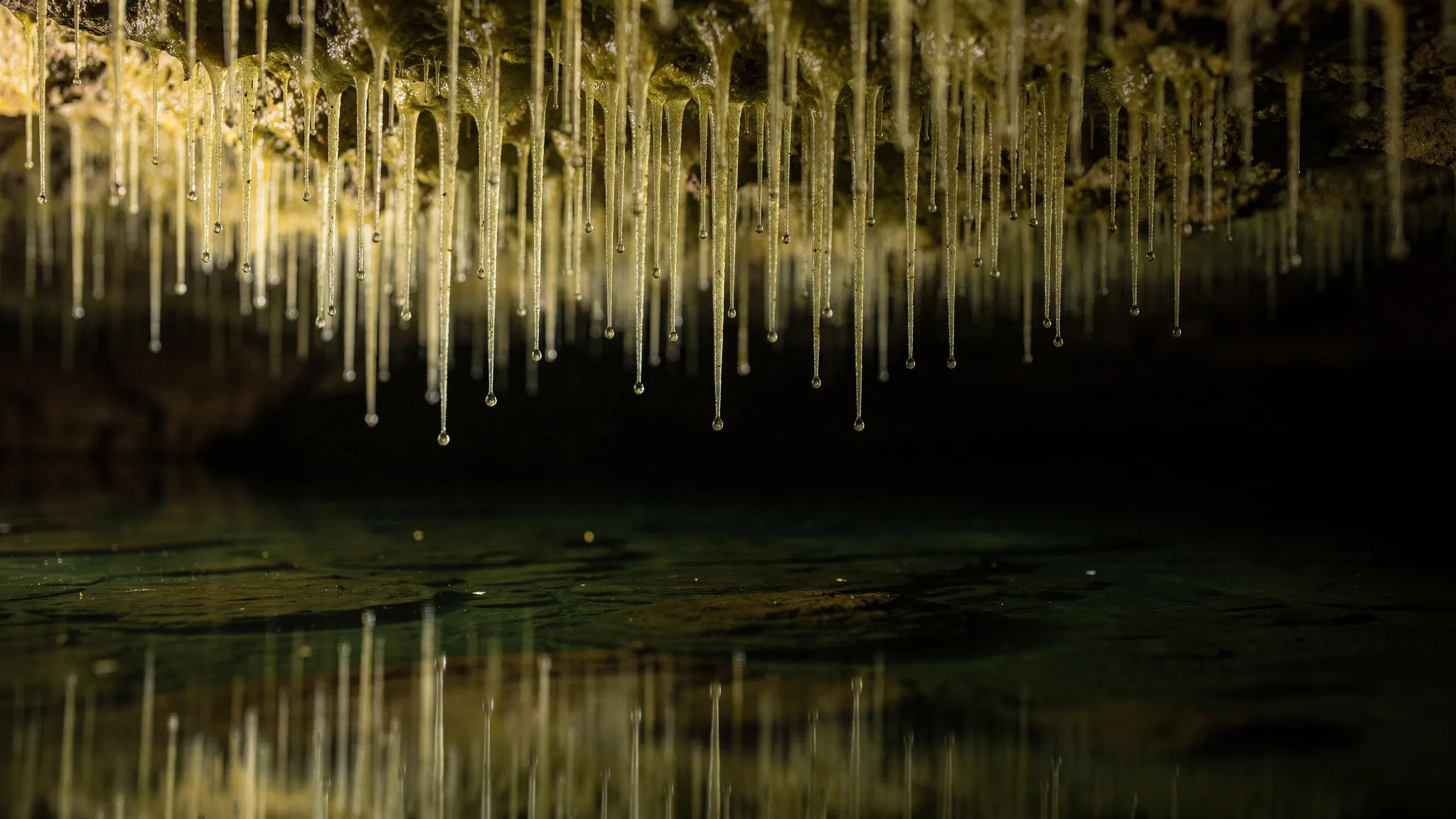
BLASTING NEXT TO A CAVE: THE SHORT STRAWS WERE MOST AT RISK
In the Vercors massif of south-eastern France, the Choranche cave welcomes about 100,000 visitors a year. Its treasure is a forest of soda straws: hollow, translucent stalactites that grow ring by ring of calcite around the drop of water hanging at their tip. They reach up to 3 metres in length for a diameter of about 5 millimetres, with a wall half a millimetre thick. Growing between 0.09 and 0.92 millimetres a year, the longest may have started forming 3,200 to 33,000 years ago.
Then came a construction job. The narrow footpath hanging at the foot of the cliff, which leads visitors to the cave, had to be moved closer to the rock wall over about 100 metres. Heavy machinery could not reach the site, so the rock had to be cut with explosives — a few tens of metres from the straws. Damage to such formations cannot be undone.
Measuring a stalactite’s pitch
P. Bottelin and colleagues at ADRGT, the Université Grenoble Alpes and a local geotechnical firm, with the company that runs the cave and funded the study, started by treating each straw as what it mechanically is: a thin tube clamped at one end. Such a tube vibrates at a series of natural frequencies — its own “notes” — that depend on its length: the shorter the tube, the higher the note.
The team collected 15 broken straws, mostly from the bottom of the cave lake, and measured with a laser vibrometer the vibrations of four of them in the laboratory, then those of one straw still hanging in the cave, where the water drop at its tip reflected the laser beam. The measurements match the textbook formula for a vibrating beam, with a stiffness (Young’s modulus) of 60 gigapascals. The straw in the cave, which nobody could reach to measure, rang at 1.2 hertz (vibrations per second) and at 13 higher notes up to 650 hertz: the notes gave its length, 1.78 metres. Straws barely damp their own vibrations: once set ringing, they keep going.
Bending tests on 25 samples gave the stress — the force pulling on each square millimetre of calcite — at which a straw snaps: between 2.5 and 16.2 megapascals, that is 2.5 to 16.2 newtons per square millimetre. The team took a cautious limit of 1.25 megapascals, half the weakest value.
Test blasts
Next came small test explosions, of up to 0.2 kilograms, recorded by sensors fixed to the cave wall. About 55 metres from the cave sensor, a 0.2-kilogram shot set the rock wall vibrating for a tenth of a second, its surface moving back and forth at a top speed of about 1 millimetre per second — the usual way engineers measure ground shaking. Its vibration spread from 10 to 500 hertz, with a peak around 175 hertz.
A computer model of straws from 2.5 centimetres to 3 metres long then replayed the recorded shaking. The result runs against intuition. The worst stress hit straws about 15 centimetres long, whose fundamental note — the lowest of its series — sits right at 175 hertz: they resonate with the blast. Straws between 10 centimetres and 1 metre were the most exposed; longer ones, though heavier, suffered less. Resonance can multiply the load by up to five.
Construction blasting fires several charges a few tens of milliseconds apart, to keep the waves from adding up. In the model, ten charges spaced 20 to 30 milliseconds apart barely raised the peak shaking, from about 1 to 1.3 millimetres per second, but multiplied the stress by 3.5: the train of waves is richer in high frequencies, exactly those the short straws pick up.
A speed limit for the rock
Scaling the shaking until the stress reached the cautious limit gave a threshold: 2.4 millimetres per second at the cave wall for delayed blasts, 8.6 for a single shot. A law fitted to how vibrations fade with distance then turned this into the maximum charge allowed at each distance. The excavation blasts were carried out within that limit, and no straw was harmed.
The earthquake case
The team also simulated a regional earthquake, using the 2014 Barcelonnette earthquake, of magnitude 5.2, recorded about 10 kilometres from its epicentre, as a stand-in for the local reference quake of 1962, which was never recorded. Deep underground, the shaking is expected to drop to about a tenth of its surface value. An earthquake vibrates slowly, below about 10 hertz, so this time the straws 1 to 2 metres long resonate. The stress stayed below the limit: such an event would probably not break them.
The lesson goes beyond Choranche. Methods that judge a stalactite’s risk from the peak acceleration alone, ignoring resonance, can badly underestimate the danger — a bias for studies that read past earthquakes from broken or intact cave formations. The study, published in 2020 in the Journal of Seismology and now posted on arXiv, only covers perfectly tubular straws; thicker stalactites, columns and draperies would each need their own model.