A MILLIGRAM ROTOR, HELD STILL BY BEING WATCHED
Over the past twenty years, physicists have learned to control mechanical objects close to their quantum limits — from nanoscale resonators weighing femtograms to the multi-kilogram mirrors of gravitational-wave detectors. But nearly all of them are oscillators: something, like a spring, pulls them back to the centre. The simplest system of quantum mechanics, the free particle, with nothing pulling it back, has resisted such control. At the low frequencies where free motion plays out, friction and noise from the surroundings drown everything.
Yet free masses are exactly what several big questions need: testing whether gravity is quantum, probing proposed changes to quantum mechanics, searching for new short-range forces.
A mirror on a glass thread
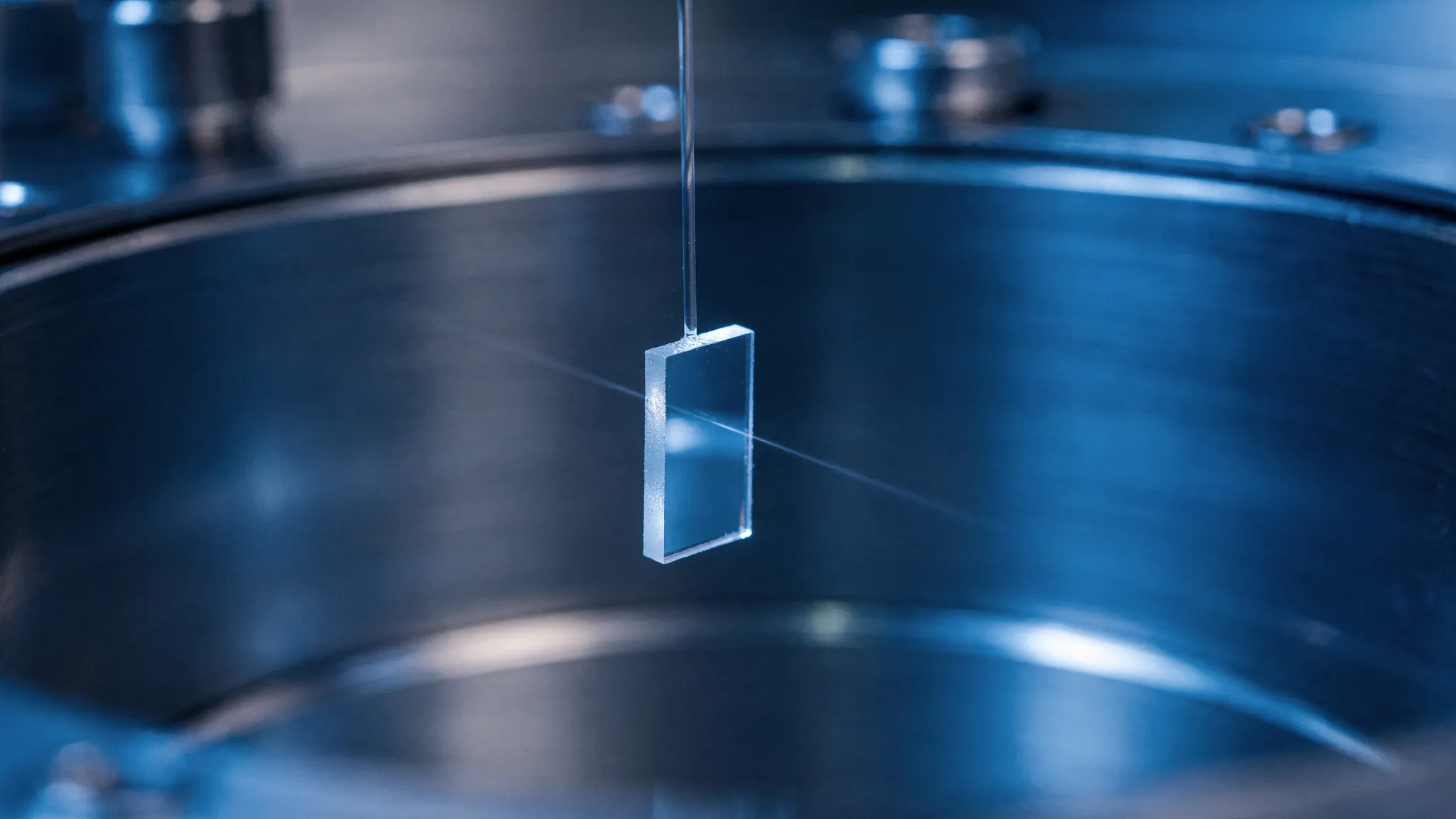
Umang Mishra, Teodor Strömberg, Onur Hosten and colleagues at the Institute of Science and Technology Austria built the test object: a fused-silica mirror bar weighing 1 milligram, 2 millimetres long, hanging from a fused-silica fibre 15 centimetres long and 1 micrometre thick, in a vacuum below 10⁻¹⁰ millibar. Strictly speaking, it is a torsion pendulum that swings back and forth once every 15 seconds. But on the timescales that matter here, tens of milliseconds, it barely feels that pull: it behaves as a free object.
Its isolation is extreme. The team measured the random torques jostling it and found no noise beyond what a damping rate — the pace at which friction with its surroundings drains its motion — of only 7 nanohertz would produce. Used as an accelerometer, the tip of the bar would be nearly a hundred times more sensitive than the best previous experiments at this mass.
To watch it, a “double optical lever” bounces two laser beams off the mirror in opposite directions, so that a wobble of the laser itself cancels out and only the rotation of the bar remains. A third beam can push the bar with the pressure of light. The whole set-up stands on a seismic isolation platform, and a small interferometer with its own hanging mirror tracks any residual motion of that platform.
Measurement instead of a trap
The key idea is that continuous measurement can replace the trap. Left alone, a free object’s position and speed spread out ever more uncertainly. Measured non-stop, its trajectory is revealed as it goes, and our knowledge of its state settles into a stable, finite blur. Here that blur stabilises in about 26 milliseconds.
That residual uncertainty can be turned into a temperature, through the textbook definition linking temperature to changes in entropy — a measure of how much is unknown about a system. This “entropic temperature” says how sharply the rotor’s motion is known, not how cold the glass is: the bar itself is not refrigerated. It lets free objects be compared with oscillators.
The team trapped the bar with light, released it, and recorded its angle in 100 stretches of 1.25 seconds. Two ways of reconstructing its state were compared: a “causal” estimate that uses only past measurements, and a “smoothed” one that also uses the measurements made afterwards. The difference between the two gave a new way to check how well the state is really known.
140 nanokelvin
- From past data alone, the rotor’s state corresponds to 1.2 microkelvin.
- With smoothing, it drops to 140 nanokelvin — 140 billionths of a degree above absolute zero.
That is about two orders of magnitude colder than earlier tabletop experiments with mechanical objects. The authors note that it brings such systems into the ultracold regime, so far associated mainly with clouds of atoms cooled by evaporation. Conventional feedback cooling could not have reached it.
There is a floor. For this level of isolation, the model predicts that the temperature cannot drop below about 15 nanokelvin: by Heisenberg’s uncertainty principle, measuring position ever more finely blurs the rotation speed more and more.
What a quiet free mass is good for
Two uses come at once. Some theories modify quantum mechanics so that quantum blur collapses spontaneously, which would add a faint, random jitter to every object. The rotor’s measured stillness rules out a new range of those models at low frequencies, complementary to limits set by the LISA Pathfinder space mission.
The second use is gravity. Whether gravity can entangle two masses — link their quantum states so that neither can be described on its own — is a central open question. By the team’s figure of merit, two such rotors would already beat any previously demonstrated system by nearly two orders of magnitude on the ratio between creating entanglement and losing it, while remaining far from the goal. Adding a modest optical cavity to read the rotation, the authors write, would bring the needed purity — how sharply defined the rotor’s quantum state is — within reach.