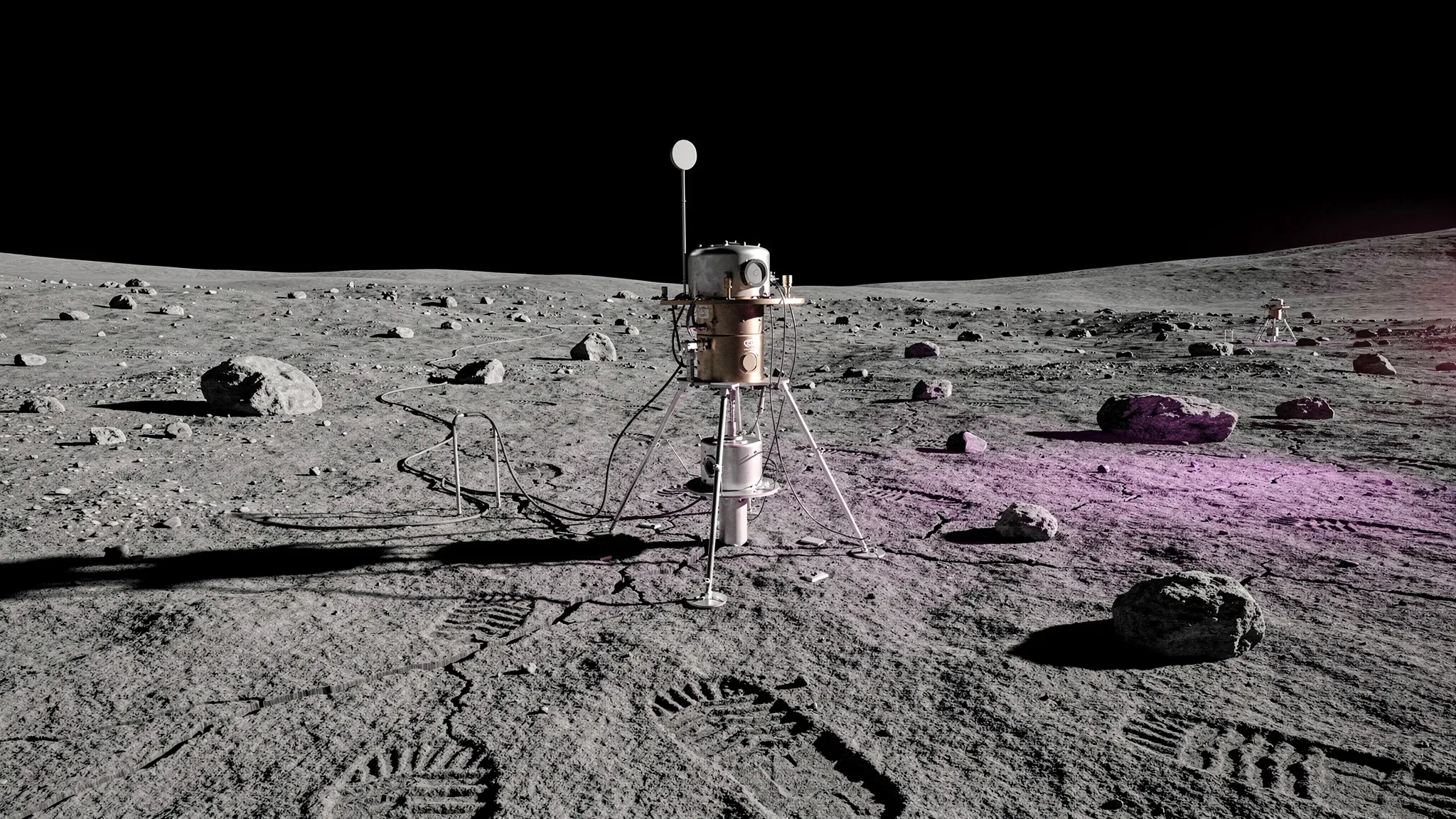
WHY THE MOON RINGS FOR SO LONG
When a seismic wave crosses the Moon, the signal does not end when the wave has passed. It is followed by a long tail of vibrations, the coda, which on the Moon can last for up to hours — about ten times longer than after an earthquake of similar magnitude. For seismologists, that ringing is a nuisance: it drowns the faint echoes from deep layers that would reveal the inside of the Moon.
The usual explanation has been strong scattering in a continuous but very uneven crust, where waves speed up and slow down from place to place. But simulations built on that idea never matched the records of the Apollo seismometers, even with unrealistically strong contrasts.
Cracks that never heal
Lei Zhang, Jinhai Zhang and colleagues at the Chinese Academy of Sciences and the China University of Geosciences took another route. The lunar crust is riddled with fractures: billions of years of impacts, the shrinking of the cooling Moon, tides and volcanic activity have all broken it up. On Earth, fluids gradually heal such cracks. On the Moon, there is no water, so they stay open — empty gaps in the rock.
An empty crack is a wall for a seismic wave: nothing passes through it. The wave is totally reflected. With one crack, part of the wavefront bounces back while the rest goes on undisturbed. With many cracks, the wavefront is shattered and trapped, bouncing from crack to crack, and its energy leaks out slowly. According to the authors, the effect of such fractures on lunar seismic waves had never been considered before.
Replaying Apollo’s crashes
To test the idea, the team built a two-dimensional slice of the lunar crust, 1,000 kilometres long and 80 kilometres deep, scattered with empty cracks in otherwise uniform rock. They compared its predictions with 13 Apollo records of artificial impacts: spent rocket stages and lunar-module ascent stages deliberately crashed onto the Moon, whose time and place of impact are known exactly. The stations were 2.2 to 28 degrees of arc away — a distance measured as the angle between impact and station, seen from the Moon’s centre.
Rather than single wiggles, they compared the overall envelope of each record — a gradual rise, a broad peak, a slow decay that makes it look like a spindle.
The first kilometre does it
- With cracks concentrated in the top kilometre, the simulated envelopes match two representative records with correlations of 0.90 and 0.92 (a score that reaches 1 when the simulated and recorded envelopes have exactly the same shape). A crust without cracks gives only 0.56 and 0.47.
- Twelve variants pin down where the cracks matter. Cracks reaching 12 kilometres deep fit as well as cracks confined to the top kilometre. But remove the cracks from that top kilometre, and the correlation drops to 0.4–0.5.
- Crack length matters too: 0.5 to 2 kilometres gives correlations around 0.85, 4 kilometres only about 0.64. The cracks are probably 2 kilometres long or less.
- Only a fairly high density of cracks reproduces both the shape of the coda and how fast it fades: the top kilometre is heavily fractured.
In the reference model, 85 cracks, each one kilometre long and 250 metres wide, are spread through the top kilometre of the slice.
A tool for what comes next
Radar on lunar rovers has probed layers down to a few hundred metres, typically less than 500. The seismic result reaches deeper, to about a kilometre, and links radar, gravity maps and measurements on returned samples.
The model could also be turned around: once the cracks are known, their ringing could be computed and subtracted from the records, letting the faint reflections from the Moon’s deep interior show through. Future seismometers — on Chang’e-7, near the south pole with Artemis, and on the far side — could test it. And projects that hope to detect gravitational waves by listening to the Moon may have to account for the same cracks.
The model is still a simplification: a two-dimensional slice, uniform rock around the cracks. Real cracks are three-dimensional, intersect, and sit in a crust that is also uneven. But even this bare version rings like the Moon.