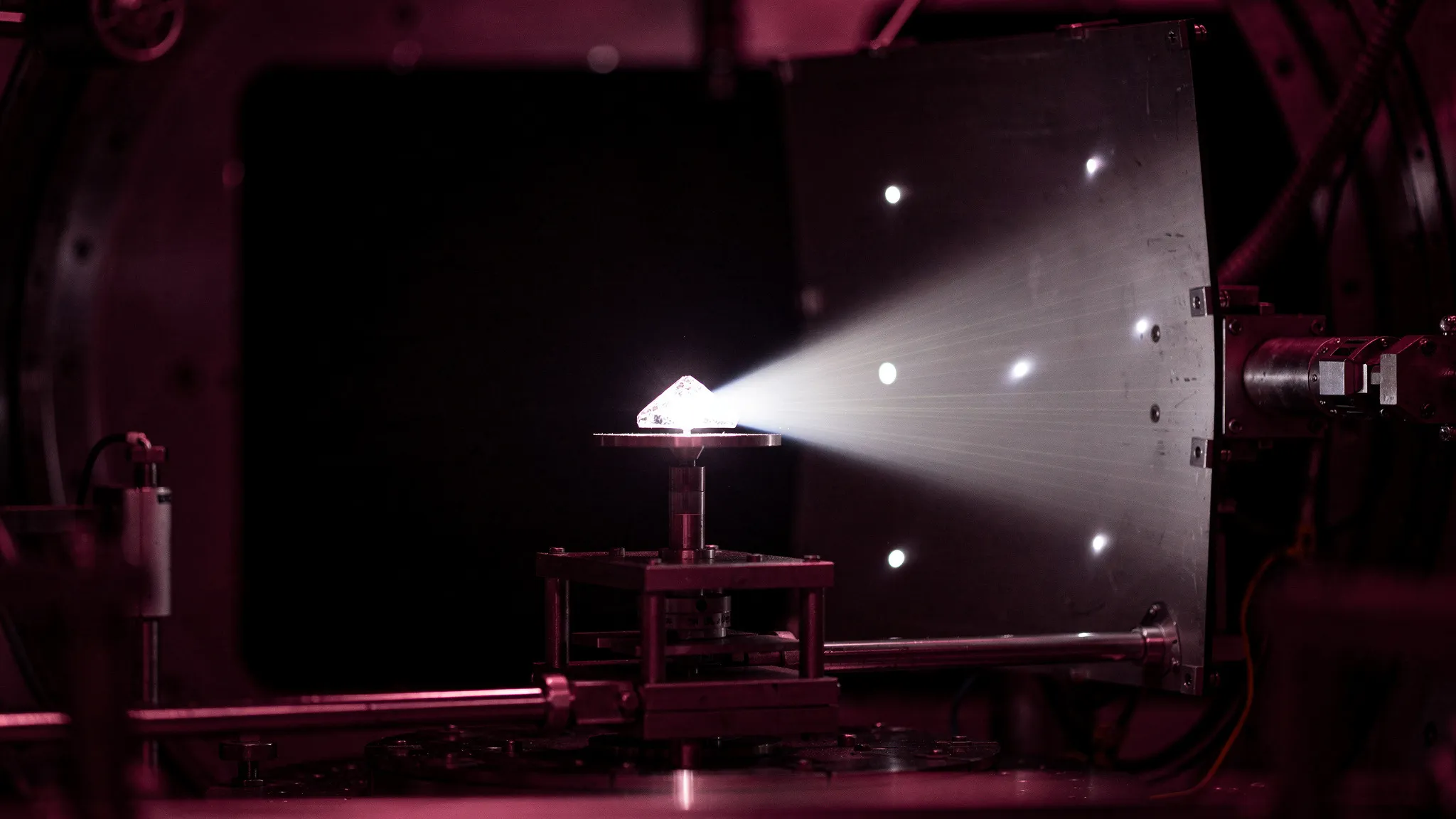
CARBON BEYOND DIAMOND, CAUGHT AS A CRYSTAL
Graphite and diamond are the two familiar faces of carbon. But deep inside Uranus, Neptune and above all carbon-rich exoplanets, pressure can reach the terapascal range — a thousand gigapascals — with temperatures of several thousand kelvin. Under such conditions, theory has long predicted a third structure: BC8, a denser arrangement in which each carbon atom is still bonded to four neighbours, and which should become more stable than diamond.
Studies spanning nearly four decades agree on it, and independent searches for crystal structures point to BC8 as the stable form of carbon at very high pressure. Yet no experiment had ever shown its crystal.
Diamond refuses to give way
Pressure alone is not enough. When diamond is squeezed slowly, in “ramp” compression, it stays diamond up to 2 terapascals without turning into BC8: the atoms are stuck behind energy barriers. Shock experiments on diamond made of many small grains saw it persist to about 1 terapascal, then melt — again with no BC8 in sight. Atomic simulations point the same way: what matters is the path taken through pressure and temperature.
In earlier work, the same team had followed a single diamond crystal hit by a shock that weakens as it travels. The inferred path started in liquid carbon, showed a sharp kink that could signal BC8 crystallising, then ran along the predicted melting line of BC8 down to the point where diamond, BC8 and liquid meet — near 830 gigapascals and 7,200 kelvin. A tempting story, but without direct proof.
A one-nanosecond photograph
Liang Sun, Bo Chen and colleagues, from laboratories in China and Japan — including the Laser Fusion Research Center in Mianyang, the National University of Defense Technology and the high-pressure research centre HPSTAR in Shanghai — went looking for that proof at the SG-III prototype laser facility.
A 1-nanosecond laser pulse of about 800 joules drove a decaying shock into a diamond crystal. At the same moment, a 1-nanosecond flash of 8.4 keV X-rays (keV, kilo-electronvolts, measures the energy of each X-ray photon) passed through the compressed sample, and the diffracted light was recorded on image plates. A laser velocity probe tracked the pressure: in one shot, numbered 242, it fell from about 1.2 to 0.8 terapascals while the X-rays were passing — right across the region where BC8 should melt.
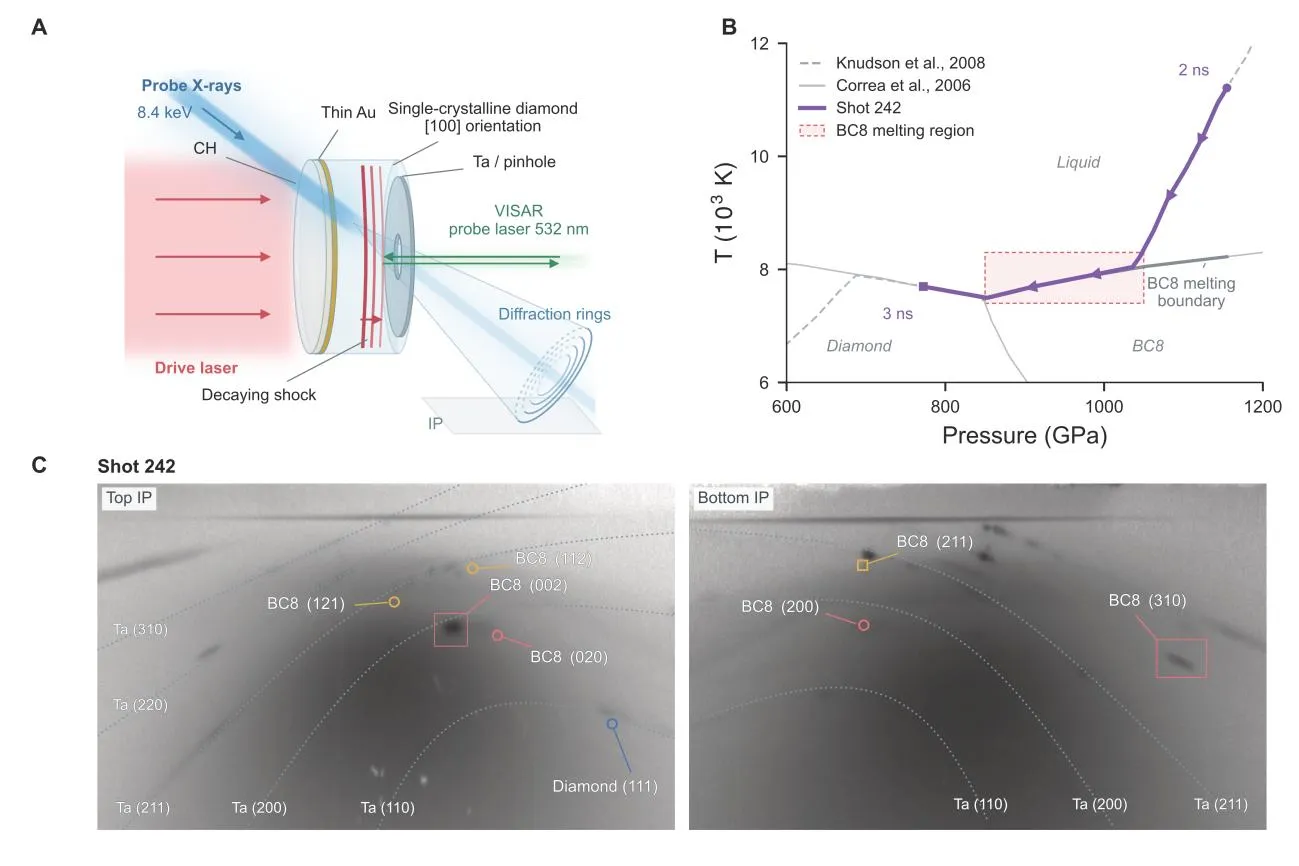
The experiment: the laser drives a decaying shock into the diamond while an X-ray flash probes it (A); the pressure–temperature path of shot 242, from the liquid into the BC8 melting region (B); raw diffraction records, with BC8 reflections marked (C). — Figure 1, Sun, Chen et al. (2026), arXiv:2611.06045.
Spots, not rings
A powder of tiny crystals scatters X-rays into rings, which only give the spacing between atomic planes — often not enough to tell competing structures apart. Here the images showed discrete, sharp spots: the signature of individual crystals.
That allowed a stricter test. A spot’s distance from the centre gives a plane spacing; its angle around the centre tells how the planes are oriented. The team fitted the spacings of these spots, which crystallographers call reflections — 12 in shot 242 and 7 in shot 366 — with a BC8 lattice, then asked whether groups of spots could all come from one crystal with one orientation.
- In shot 242, three reflections are roughly compatible with a common orientation, to within 1.64 degrees on average — a group the team keeps only as a candidate.
- In shot 366, three others fit to within 0.48 degrees. Using any two of them, the team could predict where the third should appear, within 2 degrees.
Some of the reflections are forbidden for ordinary diamond — a perfect diamond crystal cannot produce them — which supports the identification.
Denser than the liquid
Assuming 16 carbon atoms per BC8 unit cell, the fitted cells give a density of 7.19 ± 0.45 grams per cubic centimetre in shot 242 and 7.20 ± 0.46 in shot 366 — two independent experiments, nearly the same number. In the 830–1,000 gigapascal window where BC8 should crystallise, that density sits above the reference curves for liquid carbon, as expected for a solid forming inside the melt. It also matches, within the uncertainty, the value the team had inferred earlier from thermodynamics alone.
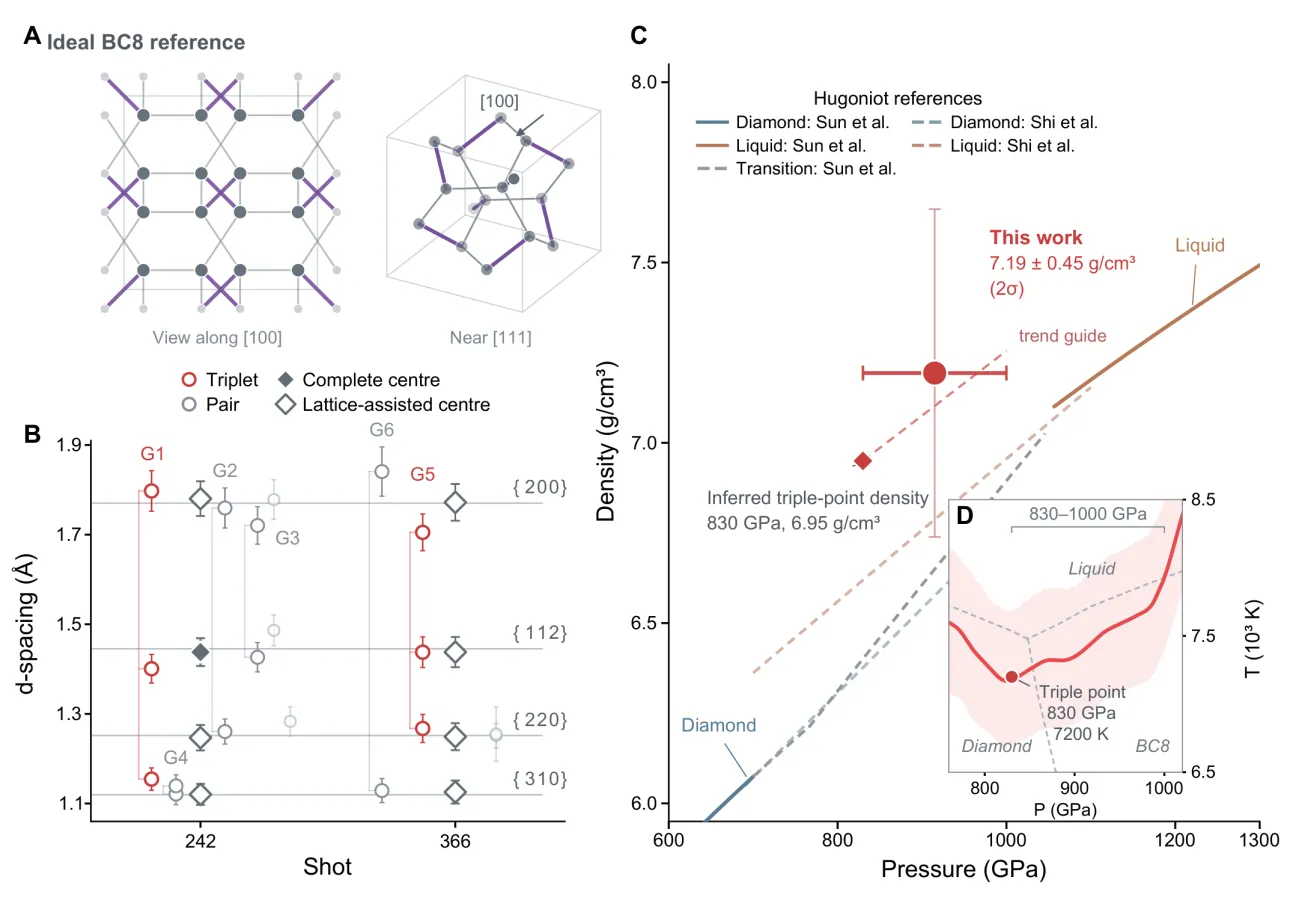
The ideal BC8 structure (A), the measured plane spacings (B) and the density, 7.19 ± 0.45 g/cm³, compared with reference curves for liquid carbon (C). — Figure 3, Sun, Chen et al. (2026), arXiv:2611.06045.
A route through the melt
The crystal did not form by bending solid diamond. It grew from molten carbon, as the shock weakened. For the authors, the way in is a high-temperature route, and it may open other phases predicted at extreme pressure that have never been reached.
The spacings are slightly off those of a perfect cubic BC8, a distortion to which the varying pressure, temperature and stress inside each shot may contribute; its microscopic origin remains open. The result gives models of planetary interiors — and of the dense carbon used in inertial-confinement fusion experiments — a crystal to check themselves against. One question is still unanswered: whether BC8 can survive decompression. If it does, its predicted properties — extremely hard and semiconducting — could finally be measured.